What will be the decreasing order of basic strength of the following conjugate bases?
1
2
3
4
Official Solution
Correct Option: (2)
Understanding Basic Strength in Terms of Conjugate Acids:
The basic strength of a conjugate base is inversely related to the strength of its conjugate acid. A strong acid has a weak conjugate base, and a weak acid has a strong conjugate base.
Order of Acidity of Conjugate Acids:
To determine the basic strength of the conjugate bases, analyze the acidity of their conjugate acids:
For : The conjugate acid is , which is a weak acid.
For : The conjugate acid is (an alcohol), which is generally weaker than water as an acid.
For : The conjugate acid is (acetic acid), which is stronger than water and alcohols.
For : The conjugate acid is , a strong acid.
Determine the Order of Basic Strength:
Based on the above analysis, the decreasing order of basic strength is:
Conclusion:
The correct order of decreasing basic strength is:
which corresponds to Option (2).
02
PYQ 2026
medium
chemistryID: jee-main
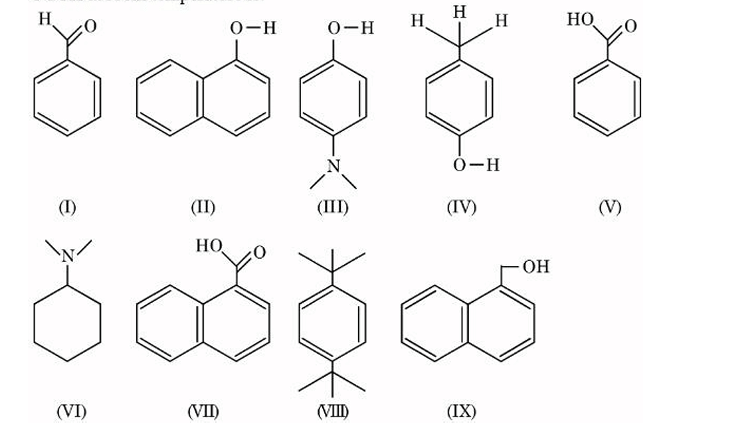
Amongst the following, the total number of compounds soluble in aqueous NaOH at room temperature is:
1
5
2
4
3
6
4
3
Official Solution
Correct Option: (2)
Step 1: Understanding the Concept:
Solubility in aqueous depends on the acidity of the compound. is a strong base; therefore, compounds that are significantly more acidic than water (such as phenols, carboxylic acids, and sulfonic acids) will react with to form water-soluble salts.
Step 2: Key Formula or Approach:
1. Identify the functional groups: Carboxylic acids ( ), Phenols ( on benzene), and Sulfonic acids ( ) are typically soluble.
2. Alcohols ( on alkyl chains) and simple amines are generally not acidic enough to react with .
Step 3: Detailed Explanation:
1. In a standard set for this question (usually containing Phenol, Benzoic acid, o-Cresol, and -Nitrophenol), these four would react with .
2. Phenol forms Sodium Phenoxide ( ).
3. Benzoic acid forms Sodium Benzoate ( ).
4. -Nitrophenol is even more acidic than phenol due to the electron-withdrawing nitro group and dissolves readily.
5. If the list includes alcohols like Benzyl alcohol or Cyclohexanol, they will remain insoluble as they do not form stable salts with .
Step 4: Final Answer:
The total number of soluble compounds is 4.
03
PYQ 2026
medium
chemistryID: jee-main
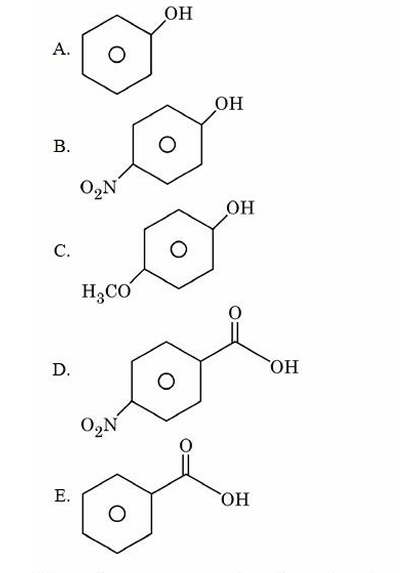
The descending order of acidity among the following compounds is :
1
B > D > E > A > C
2
D > B > E > A > C
3
C > A > B > D > E
4
D > E > B > A > C
Official Solution
Correct Option: (4)
Step 1: Understanding the Concept:
Acidity depends on the stability of the conjugate base formed after losing a proton. Carboxylic acids are generally much stronger acids than phenols because the carboxylate ion is more resonance-stabilized than the phenoxide ion. Electron-withdrawing groups (EWG) increase acidity, while electron-donating groups (EDG) decrease it.
Step 3: Detailed Explanation:
1. Carboxylic acids vs Phenols: Benzoic acids (D, E) are more acidic than phenols (A, B, C).
2. Within benzoic acids: p-nitrobenzoic acid (D) has a strong EWG ( and effect of ), making it stronger than benzoic acid (E). So, .
3. Within phenols: p-nitrophenol (B) has a strong EWG ( ), making it stronger than phenol (A). p-methoxyphenol (C) has a strong EDG ( effect of ), making it the weakest. So, .
Combining the sequences: .
Step 4: Final Answer:
The descending order of acidity is D > E > B > A > C.