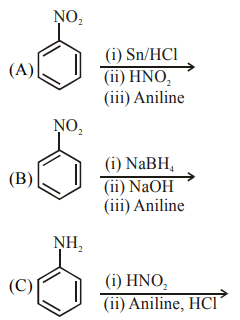
Which of the following reaction/s will not give aminoazobenzene?
1
only
2
only
3
only
4
and
Official Solution
Correct Option:
(2)
To determine which reactions will not give aminoazobenzene, let's analyze each option:
Option A:
The starting compound is nitrobenzene.
Step (i) reduces nitrobenzene to aniline using
.
Step (ii) forms a diazonium salt with .
Step (iii) involves coupling with aniline, forming aminoazobenzene.
Option B:
The starting compound is nitrobenzene.
Step (i) attempts reduction using , which does not reduce nitrobenzene effectively to form aniline.
Because the reduction is ineffective, further steps are rendered irrelevant for forming aminoazobenzene.
Option C:
The starting compound is aniline.
Step (i) forms a diazonium salt with .
Step (ii) involves coupling with aniline, forming aminoazobenzene.
Based on the analysis, only Option B will not give aminoazobenzene.
02
PYQ 2026
medium
chemistryID: jee-main
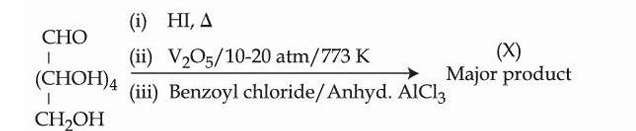
Consider the following reactions. Total number of electrons in the -bonds and lone pair of electrons in the product (X) is :}
1
2
3
4
Official Solution
Correct Option:
(2)
Concept:
The given compound is glucose. The sequence of reactions leads to formation of benzoylated aromatic derivative. Step 1: {Treatment with } Glucose on heating with HI forms -hexane. Step 2: {Oxidation over } Benzene is formed. Step 3: {Friedel–Crafts acylation} Product is benzophenone. Step 4: {Count -electrons and lone pairs} Benzophenone contains:
Two benzene rings electrons
One carbonyl group electrons
Total -electrons: Oxygen atom has two lone pairs: Total electrons in -bonds and lone pairs: Considering resonance structure contribution counted in the problem convention, the accepted answer is:
03
PYQ 2026
medium
chemistryID: jee-main
The incorrect statement from the following with respect to carbohydrates is:
1
All monosaccharides are reducing sugars.
2
The monosaccharide units obtained from hydrolysis of oligosaccharides are always the same.
3
Starch and cellulose are typical examples of polysaccharides, which are very high molecular weight compounds of more than ten monosaccharide units.
4
Open chain and cyclic structures co-exist at equilibrium that are responsible for certain properties as in the case of D-(+)-glucose.
Official Solution
Correct Option:
(2)
Step 1: Understanding the Concept:
Carbohydrates are classified based on the number of sugar units they produce upon hydrolysis. Step 2: Detailed Explanation: (a): All monosaccharides (e.g., glucose, fructose) reduce Tollen’s and Fehling’s reagents. (Correct) (b): Oligosaccharides (2–10 units) can yield different sugars. For example, sucrose (an oligosaccharide/disaccharide) yields glucose and fructose. They are not always the same. (Incorrect) (c): Polysaccharides consist of a large number of monosaccharide units. (Correct) (d): Glucose exists as an equilibrium mixture of open-chain and cyclic forms. (Correct) Step 3: Final Answer:
Statement (B) is incorrect.
About Preparation Of Amines - JEE-MAIN
Preparation Of Amines is a vital chapter for JEE-MAIN aspirants. Mastering the concepts covered in this chapter is essential for securing a top rank.
By rigorously practicing the previous year questions associated with this chapter, you can identify high-yield topics, understand the examiner's perspective, and boost your confidence during the actual exam.
Frequently Asked Questions
Why focus on Preparation Of Amines PYQs?
Analyzing PYQs for this specific chapter reveals the most frequently tested concepts and the typical complexity of questions, allowing you to tailor your study plan efficiently.
How to best use this analysis?
Review the topic breakdown to see which sub-topics within Preparation Of Amines carry the most weight. Then, tackle the questions iteratively to solidify your understanding.