Identify the homoleptic complex(es) that is/are low spin. [(A)] [(B)] [(C)] [(D)] [(E)] Choose the correct answer from the options given below:
1
C and D only
2
B and E only
3
A and C only
4
C only
Official Solution
Correct Option:
(3)
In general, low-spin complexes are formed by transition metals with higher oxidation states and/or ligands that create strong crystal field splitting (such as ).
Based on this: - and are low-spin because is a strong field ligand.
- and are high-spin due to weaker ligands or lower oxidation states.
Thus, the correct complexes that are low-spin are and .
02
PYQ 2025
medium
chemistryID: jee-main
The correct order of the following complexes in terms of their crystal field stabilization energies is:
1
2
3
4
Official Solution
Correct Option:
(3)
To determine the correct order of the complexes in terms of their Crystal Field Stabilization Energies (CFSE), we need to analyze each complex based on the following factors:
Nature of the ligand: The ability of the ligand to split the d-orbitals is called the ligand's field strength. Ligands like en (ethylenediamine) are stronger than NH3 according to the spectrochemical series.
Oxidation state of the metal: Higher oxidation states increase the splitting of the d-orbitals.
Geometry of the complex: The complexes are given to have octahedral geometry unless mentioned otherwise.
Now, let's consider each complex individually:
: Cobalt is in a +2 oxidation state, and NH3 is a moderate field ligand.
: Cobalt is in a +2 oxidation state, and with six ammonia molecules, the ligand field slightly increases compared to four ligands due to enhanced coordination.
: Cobalt is in a +3 oxidation state, significantly increasing the field splitting of the d-orbitals because of the higher positive charge.
: Cobalt in a +3 oxidation state with en ligands, which are stronger field ligands than NH3, results in maximum stability of the complex.
Considering the above analyses and the spectrochemical series, we conclude the increasing order of CFSE:
[\text{Co(NH}_3)_4]^{2+}
[\text{Co(NH}_3)_6]^{2+}
[\text{Co(NH}_3)_6]^{3+}
[\text{Co(en)}_3]^{3+}
This is because the combination of the stronger ligand and higher oxidation state results in the greatest CFSE.
Thus, the correct order is:
03
PYQ 2025
hard
chemistryID: jee-main
Identify the homoleptic complex(es) that is/are low spin.
1
2
3
4
Official Solution
Correct Option:
(3)
The complex is low spin.
Why?
is a strong field ligand (large ), so it causes big splitting of the d-orbitals.
For iron in this complex the large splitting favours electron pairing in the lower set of d-orbitals, giving a low-spin configuration.
Note (comparison)
: F⁻ is a weak field ligand → typically high spin.
: NH₃ is a stronger field than F⁻ and can give low spin for some metal/oxidation states (e.g. Co(III) d⁶ often low spin), but the clearest low-spin example among the list is due to CN⁻ being a very strong field ligand.
04
PYQ 2025
medium
chemistryID: jee-main
The correct order of the following complexes in terms of their crystal field stabilization energies is:
1
2
3
4
Official Solution
Correct Option:
(3)
The crystal field stabilization energy (CFSE) depends on the oxidation state and the ligand field strength.
Generally: - The higher the oxidation state of the metal, the stronger the ligand field and the higher the CFSE. - is a stronger field ligand than (ethylenediamine).
Thus: - will have the lowest CFSE, as it is in a lower oxidation state. - has a higher CFSE compared to . - has a higher oxidation state, leading to higher CFSE. - has the highest CFSE due to the strong ligand field of .
Hence, the correct order is:
05
PYQ 2026
medium
chemistryID: jee-main
Given below are two statements :
Statement I : Presence of large number of unpaired electrons in transition metal atoms results in higher enthalpies of their atomisation.
Statement II : and are the d-orbital splittings in and complex ions respectively.
In the light of the above statements, choose the correct answer from the options given below :
1
Both Statement I and Statement II are correct
2
Both Statement I and Statement II are incorrect
3
Statement I is correct but Statement II is incorrect
4
Statement I is incorrect but Statement II is correct
Official Solution
Correct Option:
(3)
Step 1: Understanding the Concept: Statement I relates the strength of metallic bonding to electronic configuration. Statement II concerns the Crystal Field Splitting patterns for octahedral and tetrahedral complexes. Step 2: Detailed Explanation: Analysis of Statement I: Transition metals have unpaired d-electrons which participate in interatomic metallic bonding. The greater the number of unpaired electrons, the stronger the metallic bond, and hence higher is the enthalpy of atomisation. This is True.
Analysis of Statement II: 1. is an octahedral complex. In octahedral field, d-orbitals split into and . The set is higher in energy. The pattern given ( ) is correct. 2. is a tetrahedral complex (due to weak field ligand). In tetrahedral field, d-orbitals split into and . The set is higher in energy. The second pattern given ( ) is incorrect because belongs to the set, not . Thus, Statement II is Incorrect. Step 3: Final Answer: Statement I is correct but Statement II is incorrect.
06
PYQ 2026
medium
chemistryID: jee-main
Complete combustion of g of an organic compound gave 0.25 g of CO and 0.12 g of H O. If the percent of carbon is 25% and of hydrogen is 4.8%, then _______ g (Nearest integer).}
1
273
2
274
3
273.5
4
227
Official Solution
Correct Option:
(1)
Step 1: Given information.
- Mass of CO = 0.25 g
- Mass of H O = 0.12 g
- Percent of carbon = 25%
- Percent of hydrogen = 4.8%
- Molar masses: , , Step 2: Finding the moles of carbon and hydrogen. - Moles of carbon in CO = (since CO has one mole of carbon per mole of CO )
- Moles of hydrogen in H O = (since H O has two moles of hydrogen per mole of H O) Step 3: Using the given percentages to find .
- Carbon content , so the total mass of the compound is . Step 4: Conclusion.
Therefore, the value of is 273 g. Final Answer: (A) 273
07
PYQ 2026
medium
chemistryID: jee-main
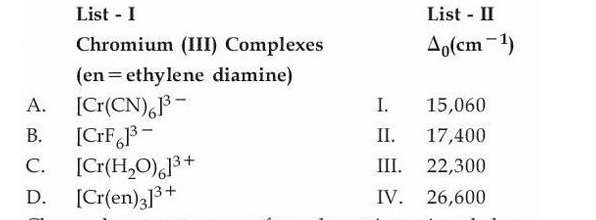
Match List-I with List-II.}
1
A-I, B-II, C-III, D-IV
2
A-II, B-III, C-IV, D-I
3
A-III, B-IV, C-I, D-II
4
A-IV, B-I, C-II, D-III
Official Solution
Correct Option:
(4)
Concept: Crystal field splitting depends on ligand strength. Spectrochemical series: Thus the splitting energy order: Step 1:Arrange } Largest : Smallest : Step 2:Match complexes} Thus
08
PYQ 2026
medium
chemistryID: jee-main
Given below are two statements: Statement I: Each electron in orbitals destabilizes the orbitals by and each electron in the orbitals stabilizes the orbitals by in an octahedral field on the basis of crystal field theory. Statement II: All the d-orbitals of the transition metals have the same energy in their free atomic state but when a complex is formed the ligands destroy the degeneracy of these orbitals on the basis of crystal field theory.
1
Both Statement I and Statement II are correct
2
Both Statement I and Statement II are incorrect
3
Statement I is correct but Statement II is incorrect
4
Statement I is incorrect but Statement II is correct
Official Solution
Correct Option:
(1)
Step 1: Understanding the Question: This question involves the fundamental principles of Crystal Field Theory (CFT) regarding d-orbital splitting in octahedral complexes. Step 2: Detailed Explanation: Statement I: In an octahedral field, the five d-orbitals split into two sets: lower energy (3 orbitals) and higher energy (2 orbitals). The energy center (barycenter) is maintained. The set is lowered by (stabilization) and the set is raised by (destabilization) per electron. Correct. Statement II: In a free atom, all five d-orbitals are degenerate (same energy). When ligands approach, an electrostatic field is created. If the field is non-spherical (as in octahedral or tetrahedral geometry), it causes the d-orbitals to split into different energy levels, destroying the degeneracy. Correct. Step 3: Final Answer: Both statements are correct.
09
PYQ 2026
medium
chemistryID: jee-main
Arrange the following complexes in increasing order of CFSE ( ) (a)
(b)
(c)
1
2
3
4
Official Solution
Correct Option:
(2)
Step 1: Understanding CFSE (Crystal Field Stabilization Energy).
CFSE is a measure of the energy stability of a complex due to the splitting of its d-orbitals in the presence of a ligand field. The greater the splitting, the higher the CFSE. Step 2: Analyzing the complexes.
- (a) :} The complex with , which has a lower charge compared to , resulting in a lower splitting energy ( ).
- (b) :} The complex with , which has a higher charge and thus higher splitting energy, resulting in a higher CFSE than .
- (c) :} The complex with and ethylenediamine (en) ligands, which causes greater ligand field splitting, leading to the highest CFSE among the three. Step 3: Conclusion.
The order of increasing CFSE is , making option (2) the correct answer. Final Answer:} .
About Crystal Field Theory - JEE-MAIN
Crystal Field Theory is a vital chapter for JEE-MAIN aspirants. Mastering the concepts covered in this chapter is essential for securing a top rank.
By rigorously practicing the previous year questions associated with this chapter, you can identify high-yield topics, understand the examiner's perspective, and boost your confidence during the actual exam.
Frequently Asked Questions
Why focus on Crystal Field Theory PYQs?
Analyzing PYQs for this specific chapter reveals the most frequently tested concepts and the typical complexity of questions, allowing you to tailor your study plan efficiently.
How to best use this analysis?
Review the topic breakdown to see which sub-topics within Crystal Field Theory carry the most weight. Then, tackle the questions iteratively to solidify your understanding.