Solutions
182 previous year questions.
High-Yield Trend
Chapter Questions 182 MCQs
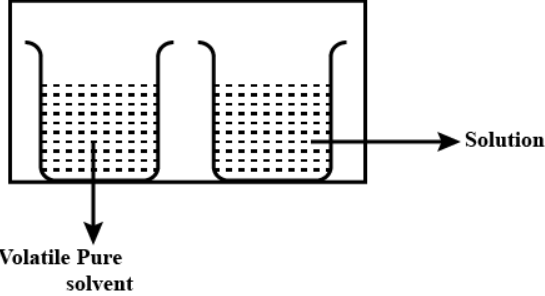
[Molar mass of KCl = 74.5]
(i) 0.10 M
(ii) 0.10 M
(iii) 0.10 M KCl
(iv) 0.10 M
Use: Molal Freezing point depression constant of water = 1.86 K kg mol
Freezing point of water = 273 K
Atomic masses: C: 12.0 u, O: 16.0 u, H: 1.0 u
[ Given : ]
[Given: K = 1.86 K kg mol ; Density of water=1.00 g cm ; Freezing point of water = 273.15 K]
[Use : Atomic masses : Na:23.0 u O:16.0 u H:1.0 u, Density of H O : 1.0 g cm ]
[Use : R = 0.083 L bar mol K ]
Assertion (A) : Dissolved substances can be removed from a colloidal solution by diffusion through a parchment paper.
Reason (R) : Particles in a true solution cannot pass through parchment paper but the colloidal particles can pass through the parchment paper.
In the light of the above statements, choose the correct answer from the options given below
The depression in the freezing point observed for a formic acid solution of concentration 0.5 mL L–1 is 0.0405°C. Density of formic acid is 1.05 g mL–1. The Van’t Hoff factor of the formic acid solution is nearly (Given for water kf = 1.86 k kg mol–1)
Match List-I with List-II :
| List-I | List-II |
| (A) Negatively charged sol | (I) Fe2O3.xH2O |
| (B) Macromolecular colloid | (II) CdS sol |
| (C) Positively charged sol | (III) Starch |
| (D) Cheese | (IV) a gel |
Choose the correct answer from the options given below:
(use R = 0.083 L bar mol–1 K–1)
20 mL of 0.02 M hypo solution is used for the titration of 10 mL of copper sulphate solution, in the presence of excess of KI using starch as an indicator. The molarity of is found to be ________ × . [nearest integer]
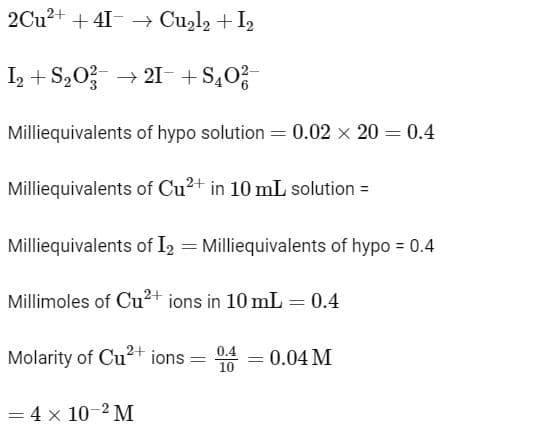
The normality of H2SO4 in the solution obtained on mixing 100 mL of 0.1 M H2SO4 with 50 mL of 0.1 M NaOH is ________ × 10–1 N. (Nearest Integer)
(Enthalpy of neutralisation = 57 kJ mol–1 and Specific heat of water = 4.2 JK–1 g–1)
(Neglect heat capacity of flask)
(Given : Henry’s Law constant for O2 at 303 K is 46.82 k bar and partial pressure of O2 = 0.920 bar)
(Assume solubility of O2 in water is too small, nearly negligible)
[given : ]
[Given : Molar mass of O2 = 32 g mol–1 and Molar mass of Ne = 20 g mol–1]
(Given: partial pressure of at bar. Henry’s law constant for at Kbar. Atomic mass of , and is , , and g mol–1, respectively)
(Molal depression constant for water is 1.80 K kg mol–1 and
molar mass of KCl is 74.6 g mol–1)
[Given : Freezing point of ethanol is 156.0 K, Density of ethanol is 0.80 g cm–3, Freezing point depression constant of ethanol is 2.00 K kg mol–1]
A dilute solution of sulphuric acid is electrolysed using a current of 0.10 A for 2 hours to produce hydrogen and oxygen gas. The total volume of gases produced at STP is ____ cm3. (Nearest integer)
[Given : Faraday constant F = 96500 C mol–1 at STP, molar volume of an ideal gas is 22.7 L mol–1]
(Given : R = 0.083 L bar K–1 mol–1)
The alkaline earth metal sulphate(s) which are readily soluble in water is/are:
(a) BeSO4
(b) MgSO4
(c) CaSO4
(d) SrSO4
(e) BaSO4
Choose the correct answer from the options given below:
1 L Solution (X) + AgNO3 solution (excess) → Y
1 L Solution (X) + BaCl2 solution (excess) → Z
The number of moles of Y and Z respectively are
In the depression of freezing point experiment
A. Vapour pressure of the solution is less than that of pure solvent
B. Vapour pressure of the solution is more than that of pure solvent
C. Only solute molecules solidify at the freezing point
D. Only solvent molecules solidify at the freezing point
Choose the most appropriate answer from the options given below:
Given: PH2O = 760 mm of Hg
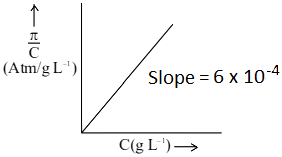
( Given : R = 0.083 L atm K-1 mol-1 )
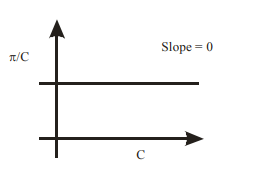
Mass percent, Mole, Mole fraction, Molarity, ppm, Molality
The total pressure observed by mixing two liquids A and B is 350 , mm Hg when their mole fractions are 0.7 and 0.3 respectively The total pressure becomes 410 ,mm ,Hg if the mole fractions are changed to 0.2 and 0.8 respectively for A and B The vapour pressure of pure A is _________mm ,Hg (Nearest integer) Consider the liquids and solutions behave ideally.
A solution containing 2 g of a non-volatile solute in 20 g of water boils at 373.52 K. The molecular mass of the solute is ------- g mol (Nearest integer).
Given: Water boils at 373 K, for water = 0.52 K kg mol .
of acetic acid is dissociated when its is added to of water The depression in freezing point of such water is ____ Atomic mass of and are 12,1 and 16 amu respectively [Given : Molal depression constant and density of water are respectively
Determine the amount of urea (NH2CONH2) to be added in 1000 g of water to decrease its vapour pressure by 25%.
10%
20%
5%
7%
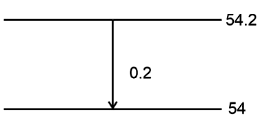
Glucose is added in 100 gm of water. Lowering in vapor pressure is 0.2 mm Hg. Vapour pressure of pure water is 54.2 mm Hg. Then the weight of glucose is?
3.70 gm
4.92 gm
6.73 gm
8.74 gm
Assertion A: 3.1500 g of hydrated oxalic acid dissolved in water to make 250.0 mL solution will result in 0.1 M oxalic acid solution.
Reason R: Molar mass of hydrated oxalic acid is 126 g mol–1.
In the light of the above statements, choose the correct answer from the options given below.
at 300 K is 1.29 mbar. The molar mass of the protein is ____ g mol–1.
Given: R = 0.083 L bar K–1 mol–1
Some amount of urea is added to 1000 gm of H2O due to which vapor pressure decreases by 25% of the original vapor pressure. Find out the mass of urea added (Round off to two decimal places)
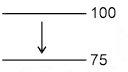
By weight, 23% NaCl and 19.5% MgCl2 are present in salt water. The degree of dissociation of both salts is 100%. Find the average boiling point of salt water (inºC). (Kb = 0.52 K kg mol–1) (Nearest integer)
Given: pKa (CH3COOH) = 4.76
log 2 = 0.30
log 3 = 0.48
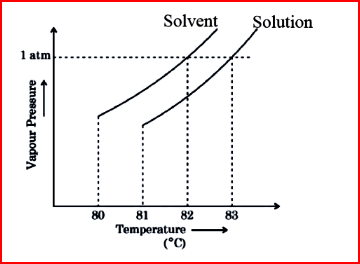
The boiling point of the solvent is _____°C.
Given: Molar mass of N. C. O and H are 14. 12. 16 and 1 2 mol-1 respectively.
A. 1 M aq. NaCl and 2 M aq. Urea
B. 1 M aq. CaCl2 and 1.5 M aq. KCl
C. 1.5 M aq. AlCl3 and 2 M aq. Na2SO4
D. 2.5 M aq. KCl and 1 M aq. Al2(SO4)3
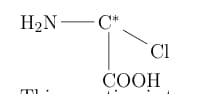
Assertion A : A solution of the product obtained by heating a mole of glycine with a mole of chlorine in presence of red phosphorous generates chiral carbon atom.
Reason R : A molecule with 2 chiral carbons is always optically active.
In the light of the above statements, choose the correct answer from the options given below:
Which of the following salt solutions would coagulate the colloid solution formed when FeCl3 is added to NaOH solution, at the fastest rate?
10 mL of 0.1 mol dm–3 Ca3(PO4)2
10 mL of 0.2 mol dm–3 AlCl3
10 mL of 0.1 mol dm–3 Na2SO4
10 mL of 0.15 mol dm–3 CaCl2
Assume molality to be equal to molarity in all cases.
Given : Vapour pressure of water at 38°C is 50 mm Hg.
(a) The pH of 1 .0 x 10-8M solution of HCl is 8
(b) The conjugate base of H2PO-4 is HPOI2-4
(c) Autoprotolysis constant of water increases with temperature
(d) When a solution of a weak monoprotic acid is treated against a strong base, at half - neutralisation point pH = ( )pKa.
Choose the correct answer from the the options given below
(Assume dilute solution is being formed)
Given : Vapour pressure of pure water is 54.2 mm Hg at room temperature. Molar mass of glucose is 180 g mol–1 .
Given: Molar mass of NaOH is
(Given: Molal boiling point elevation constant of water ( ) = ,1 atm pressure = , molar mass of water = )
| Sample | Van't Haff Factor |
|---|---|
| Sample - 1 (0.1 M) | |
| Sample - 2 (0.01 M) | |
| Sample - 3 (0.001 M) |
[Given molar mass of ]
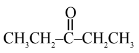
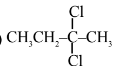

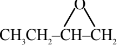
The vapour pressure of pure benzene and methyl benzene at is given as 80 Torr and 24 Torr, respectively. The mole fraction of methyl benzene in vapour phase, in equilibrium with an equimolar mixture of those two liquids (ideal solution) at the same temperature, is (nearest integer).
(Molar mass of )
(Given : Molar mass in g mol Ethyl alcohol : 46, water : 18)
[Given: Molar mass of water = , acetic acid = Freezing point: ]
(Given: Molar Mass and )
[Given density of the solution = 1.25 g/mL.]
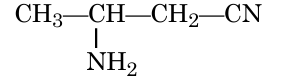
2-Aminopentanitrile
3-Aminobutanenitrile
2-Aminobutanitrile
3-Aminopropanenitrile
Match List-I with List-II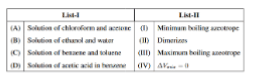
Choose the correct answer from the options given below :
Which of the following properties will change when system containing solution 1 will become solution 2 ? 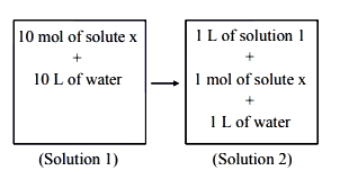
32
40
- (A) 200 mL KI solution reacts with 0.004 mol of KIO3
- (B) 200 mL KI solution reacts with 0.006 mol of H2SO4
- (3) 0.5 L KI solution produced 0.005 mol of I2
- (4) Equivalent weight of KIO3 is equal to Molecular weight / 5
(A) and (D) only
(B) and (C) only
(A) and (B) only
(C) and (D) only
Sea water, which can be considered as a 6 molar (6 M) solution of NaCl, has a density of 2 g mL . The concentration of dissolved oxygen (O ) in sea water is 5.8 ppm. Then the concentration of dissolved oxygen (O ) in sea water, in x 10 m. x = _______. (Nearest integer)
Given: Molar mass of NaCl is 58.5 g mol Molar mass of O is 32 g mol .
Statement-II: When we add a non-volatile solute in water, elevation in boiling point is more than depression in freezing point.
Statement-II: CCl₄ and methanol mixture show positive deviation from Raoult's law.
Solution-2 : urea,
Solution-3 : CaCl ,
Solution-4 : Al (SO ) ,
[2mm] Order of is:
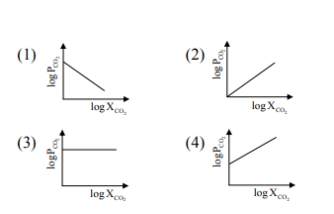
Given:
A substance 'X' (1.5 g) dissolved in 150 g of a solvent 'Y' (molar mass = 300 g mol ) led to an elevation of the boiling point by 0.5 K. The relative lowering in the vapour pressure of the solvent 'Y' is . (nearest integer)
[Given : \) K_{b} ^{-1}$]
Assume the solution to be dilute and no association or dissociation of X takes place in solution.
Given: R = 0.08 L atm K mol
Assume complete dissociation of NaCl
(Given : Molar mass of Na and Cl are 23 and 35.5 g mol respectively.)
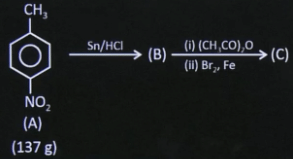
Statement-I: is constant with change in concentration of gas till solution is dilute at a given temperature.
Statement-II: According to Henry’s Law, partial pressure of gas in vapor phase is inversely proportional to mole fraction of gas in solution.
[Given that Henry’s constant for N is mm Hg]
Statement-II: K for solution having same gas solute is independent of nature of solvent?
About Solutions - JEE-MAIN
Solutions is a vital chapter for JEE-MAIN aspirants. Mastering the concepts covered in this chapter is essential for securing a top rank.
By rigorously practicing the previous year questions associated with this chapter, you can identify high-yield topics, understand the examiner's perspective, and boost your confidence during the actual exam.
Frequently Asked Questions
Why focus on Solutions PYQs?
Analyzing PYQs for this specific chapter reveals the most frequently tested concepts and the typical complexity of questions, allowing you to tailor your study plan efficiently.
How to best use this analysis?
Review the topic breakdown to see which sub-topics within Solutions carry the most weight. Then, tackle the questions iteratively to solidify your understanding.