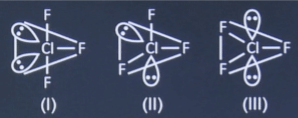
Statement-1: has 3 possible structures. Statement-2: is the most stable structure due to least lone pair-bond pair (lp-bp) repulsion.
Which of the following options is correct?
1
Statement-1 is correct and Statement-2 is incorrect.
2
Statement-1 is incorrect and Statement-2 is correct.
3
Both Statement-1 and Statement-2 are correct.
4
Both Statement-1 and Statement-2 are incorrect.
Official Solution
Correct Option: (1)
Let's evaluate both statements:
- Statement 1: has 3 possible structures. This statement is correct. The molecule (chlorine trifluoride) can indeed have three different resonance structures, which can be derived from different orientations of the lone pairs and bonding pairs around the central chlorine atom. These structures can be represented as: 1. Structure I: is surrounded by 3 fluorine atoms with lone pairs positioned accordingly. 2. Structure II: Another resonance form of . 3. Structure III: A third form with different electron pair arrangements. - Statement 2: is the most stable structure due to least lp-bp repulsion. This statement is incorrect. In the case of , the structure with the least lp-bp repulsion is actually structure I, not structure III. Structure III has more lone pair-bond pair (lp-bp) repulsion due to the positioning of lone pairs. Thus, the most stable structure is the one with the least repulsion, which is structure I. Therefore, the correct answer is (1)
Statement-1 is correct and Statement-2 is incorrect.
02
PYQ 2025
easy
chemistryID: jee-main
A molecule with the formula has all its elements from p-block. Element A is rarest, monoatomic, non-radioactive from its group and has the lowest ionization enthalpy value among A, X, and Y. Elements X and Y have first and second highest electronegativity values respectively among all the known elements. The shape of the molecule is:
1
Square pyramidal
2
Octahedral
3
Planar
4
Tetrahedral
Official Solution
Correct Option: (1)
The problem requires us to determine the shape of a molecule with the formula AX Y, where the elements A, X, and Y are identified based on a series of descriptive clues.
Concept Used:
The solution involves two main concepts:
Identification of Elements using Periodic Trends: We will use fundamental knowledge of the periodic table, including trends in electronegativity, ionization enthalpy, and elemental properties (like natural state and abundance) to identify A, X, and Y.
Valence Shell Electron Pair Repulsion (VSEPR) Theory: Once the molecule is identified, we will use VSEPR theory to predict its shape. This theory states that the geometry of a molecule is determined by minimizing the electrostatic repulsion between electron pairs (both bonding pairs and lone pairs) around the central atom. The steps are:
Identify the central atom.
Calculate the steric number (SN): .
Determine the electron geometry from the SN (e.g., SN=6 Octahedral).
Determine the final molecular shape from the arrangement of atoms (VSEPR type AX E ).
Step-by-Step Solution:
Step 1: Identify Element X.
The clue for X is that it has the "first and highest electronegativity value... among all the known elements." The most electronegative element in the periodic table is Fluorine.
Step 2: Identify Element Y.
The clue for Y is that it has the "second highest electronegativity value... among all the known elements." The second most electronegative element is Oxygen.
Step 3: Identify Element A.
The clues for element A are:
It is from the p-block.
It is the "rarest, monatomic, non-radioactive from its group." The property of being monatomic points to the noble gases (Group 18). Among the non-radioactive noble gases (He, Ne, Ar, Kr, Xe), Xenon is the rarest.
It has the "lowest ionization enthalpy value among A, X and Y." Let's check this: IE (F) 1681 kJ/mol; IE (O) 1314 kJ/mol; IE (Xe) 1170 kJ/mol. Xenon indeed has the lowest ionization enthalpy of the three.
Therefore, element A is Xenon.
The molecular formula is thus XeOF .
Step 4: Apply VSEPR Theory to XeOF .
Central Atom: Xenon (Xe) is the central atom as it is the least electronegative.
Valence Electrons of Xe: Xenon is a noble gas, so it has 8 valence electrons.
Bonding and Lone Pairs:
Xe forms four single bonds with the four fluorine atoms.
Xe forms one double bond with the oxygen atom (as oxygen is divalent).
Total electrons from Xe used in bonding = 4 (for 4 F atoms) + 2 (for 1 O atom) = 6 electrons.
This corresponds to 1 lone pair of electrons on the central Xe atom.
Step 5: Calculate the Steric Number (SN) and determine the shape.
The number of atoms bonded to the central atom is 4 (F) + 1 (O) = 5.
The number of lone pairs on the central atom is 1.
Steric Number (SN) = (Number of bonded atoms) + (Number of lone pairs) = 5 + 1 = 6.
A steric number of 6 corresponds to an octahedral electron geometry.
The VSEPR type of the molecule is AX E (5 bonding pairs, 1 lone pair).
According to VSEPR theory, a molecule with an AX E arrangement has a square pyramidal shape. The lone pair occupies one of the axial positions to minimize repulsion, and the five atoms occupy the remaining five vertices of the octahedron.
The shape of the molecule XeOF is Square pyramidal.
03
PYQ 2025
medium
chemistryID: jee-main
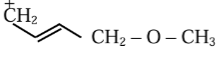
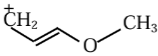
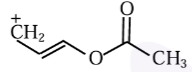
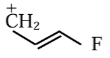
Which one of the carbocations from the following is most stable?
1
2
3
4
Official Solution
Correct Option: (2)
To determine which carbocation is the most stable, we should consider the factors that stabilize carbocations. Carbocation stability is generally enhanced by:
The presence of electron-donating groups that provide inductive support.
Resonance stabilization, where the positive charge can be delocalized over a larger structure.
The degree of alkyl substitution β tertiary carbocations are more stable than secondary, which are more stable than primary.
Let us analyze each option one by one:
This first option is a primary carbocation without any additional resonance or electron-donating stabilization. Thus, it is less stable.
The second option, which is the correct answer, features a tertiary carbocation. Tertiary carbocations are the most stable due to the presence of three alkyl groups that can donate electron density via the inductive effect, stabilizing the positive charge.
The third option is likely a secondary carbocation. It does not benefit from additional resonance stabilization, making it less stable than a tertiary carbocation.
The fourth option is also a primary carbocation without resonance stabilization.
Therefore, the second option is the correct answer as it represents a tertiary carbocation, offering maximum stability among the given options.
04
PYQ 2026
hard
chemistryID: jee-main
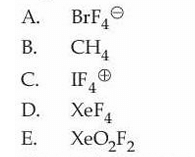
is isostructural with:
1
C Only
2
C and E Only
3
A and D Only
4
B and E Only
Official Solution
Correct Option: (3)
Step 1: Isostructural Concept.
Two molecules are said to be isostructural when they have the same molecular geometry and bonding patterns. Step 2: Determine which compounds are isostructural with SFβ.
SFβ has a seesaw molecular shape due to the presence of one lone pair on the central sulfur atom. Now, let's compare this with the options:
(A) BrFβ: This has a square pyramidal structure, different from SFβ.
(B) CHβ: This has a tetrahedral structure, different from SFβ.
(C) IFβ: This also has a seesaw structure, similar to SFβ, and is isostructural.
(D) XeFβ: This has a square planar structure, different from SFβ.
(E) XeOβFβ: This has a different molecular structure, not matching SFβ.
Thus, the correct answer is (C) IFβ, which is isostructural with SFβ. Final Answer: (C) Only
05
PYQ 2026
medium
chemistryID: jee-main
Given below are two statements: Statement (I): The correct sequence of bond lengths in the following species is:
Statement (II): The correct sequence of number of unpaired electrons in the following species is:
In the light of the above statements, choose the correct answer.
1
Both Statement I and Statement II are true
2
Both Statement I and Statement II are false
3
Statement I is true but Statement II is false
4
Statement I is false but Statement II is true
Official Solution
Correct Option: (1)
Concept: Bond length is inversely proportional to bond order. Higher bond order β shorter bond length. Bond order for oxygen species: Step 1:Find bond orders} Thus bond length order: Hence Statement I is true. Step 2:Find number of unpaired electrons} Thus general decreasing order: Hence Statement II is also true.