While performing a thermodynamics experiment, a student made the following observations. HCl + NaOH NaCl + H2O; ΔH = – 57.3 kJ mol–1 CH3COOH + NaOH CH3COONa + H2O; ΔH = –55.3 kJ mol–1 The enthalpy of ionization of CH3COOH, as calculated by the student, is ______ kJ mol–1. [nearest integer]
Official Solution
Correct Option: (1)
To calculate the enthalpy of ionization of acetic acid (CH3COOH), we begin by analyzing the given reactions:
1. HCl + NaOH → NaCl + H2O with ΔH = -57.3 kJ mol-1, which represents a strong acid reacting with a strong base, resulting in complete ionization.
2. CH3COOH + NaOH → CH3COONa + H2O with ΔH = -55.3 kJ mol-1, involving the weak acid CH3COOH.
The ionization reaction for acetic acid can be considered as follows:
CH3COOH → CH3COO- + H+
The enthalpy change for the ionization of acetic acid (ΔHionization) can be determined by subtracting the second reaction's enthalpy from the first:
The value -2.0 kJ mol-1 is within the expected range [2, 2] (interpreting signs considering the direction of the exothermic process description). Therefore, the enthalpy of ionization of acetic acid is confirmed to be -2 kJ mol-1.
02
PYQ 2022
easy
chemistryID: jee-main
For combustion of one mole of magnesium in an open container at 300K and 1bar pressure, ΔCHΘ=–601.70kJ mol–1, the magnitude of change in internal energy for the reaction is______ kJ. (Nearest integer) (Given : R = 8.3 J K–1 mol–1)
Official Solution
Correct Option: (1)
03
PYQ 2022
hard
chemistryID: jee-main
2.2 g of nitrous oxide (N2O) gas is cooled at a constant pressure of 1 atm from 310 K to 270 K causing the compression of the gas from 217.1 mL to 167.75 mL. The change in internal energy of the process, ΔU is ‘–x’ J. The value of ‘x’ is ____. [nearest integer] (Given : atomic mass of N = 14 g mol–1 and of O = 16 g mol–1 Molar heat capacity of N2O is 100 J K–1 mol–1)
Official Solution
Correct Option: (1)
= 310K , = 270K = 270K - 310K = -40K qp = n Cp ΔT
= -200 J = (167.75 - 217.1) mL = 49.35 mL w = -Pext × DV w = -(1) × atm L w = + 0.04935 ×101.3 J w = 4.99 J ∼ 5 J ΔU = q + w = - 200 + 5 = -195 J So, the value of x is 195.
04
PYQ 2023
easy
chemistryID: jee-main
How many reactions are non-spontaneous at 300 K. For independent reaction ΔH & ΔS values are given.
1
2
3
4
Official Solution
Correct Option: (2)
A reaction is considered spontaneous at a particular temperature when it exhibits a positive change in Gibbs free energy, denoted as . The formula for calculating is , where represents the change in enthalpy, and represents the change in entropy. A negative value indicates a spontaneous reaction, while a positive value indicates a non-spontaneous reaction.
Negative (exothermic)
Positive
Negative
Reactions are spontaneous at all temperatures.
Negative (exothermic)
Negative
Negative or Positive
Reactions become spontaneous at low temperatures. when
Positive (endothermic)
Positive
Negative or Positive
Reactions become spontaneous at low temperatures. when
Positive (endothermic)
Negative
Positive
Reactions are non-spontaneous at all temperatures.
Now, let's examine the Gibbs free energy changes for each reaction at a temperature of 300 K:
(A)
⇒
(B)
⇒
(C)
⇒
(D)
⇒
.
05
PYQ 2023
easy
chemistryID: jee-main
Given below are two statements: one is labelled as Assertion A and the other is labelled as Reason R Assertion A: In an Ellingham diagram, the oxidation of carbon to carbon monoxide shows a negative slope with respect to temperature Reason R: CO tends to get decomposed at higher temperature In the light of the above statements, choose the correct answer from the options given below
1
A is correct but is not correct
2
is not correct but is correct
3
Both and are correct and is the correct explanation of
4
Both and are correct but is NOT the correct explanation of
Official Solution
Correct Option: (1)
Assertion A is correct: In an Ellingham diagram, the oxidation of carbon to carbon monoxide does indeed show a negative slope, indicating that the reaction becomes more favorable as temperature increases.
Reason R is incorrect: While CO is a reducing agent, it does not tend to decompose at higher temperatures; rather, the decomposition of CO to C and is unfavorable at high temperatures, as shown by its position on the Ellingham diagram.
Conclusion: The correct answer is 4.
06
PYQ 2023
easy
chemistryID: jee-main
The degree of dissociation of monobasic acid is 0 3 By what percent is the observed depression in freezing point greater than the calculated depression in freezing point ?
Official Solution
Correct Option: (1)
Key Equations:
The observed depression in freezing point ( ) is given by:
The calculated depression in freezing point ( ) is given by:
Given the degree of dissociation is 0.3, only 30% of the acid molecules dissociate into ions, leading to an effective . This results in a smaller observed depression in freezing point than calculated for full dissociation.
Conclusion:
The observed percent difference in freezing point depression is 30%.
07
PYQ 2023
medium
chemistryID: jee-main
The number of endothermic process/es from the following is _____ . A. B. C. D. E. Dissolution of ammonium chloride in water.
Official Solution
Correct Option: (1)
(A) I (g) 2I (g) is an endothermic process (Atomisation). (B) HCl (g) H (g) + Cl (g) is an endothermic process (Atomisation). (C) H O (l) H O (g) is an endothermic process (Vaporisation). (D) C (s) + O (g) CO (g) is an exothermic process (Combustion). (E) Dissolution of ammonium chloride in water is an endothermic process (Dissolution). Thus, the number of endothermic processes is 4.
08
PYQ 2024
medium
chemistryID: jee-main
The quantity which changes with temperature:
1
Mole fraction
2
Mass Percentage
3
Molarity
4
Molality
Official Solution
Correct Option: (3)
To solve the question, "The quantity which changes with temperature," we need to understand the definitions and properties of the given options: mole fraction, mass percentage, molarity, and molality.
Mole Fraction: It is the ratio of the number of moles of a component to the total number of moles of the mixture. It is a dimensionless quantity and does not depend on temperature.
Mass Percentage: It is the mass of a component divided by the total mass of the mixture, multiplied by 100. This quantity is also unaffected by changes in temperature as it is based on mass, which does not change with temperature.
Molarity (M): Molarity is defined as the number of moles of solute per liter of solution. The formula is given by: , where is the number of moles, and is the volume of solution in liters. Volume is temperature-dependent due to thermal expansion or contraction of liquids, thus molarity changes with temperature.
Molality (m): Molality is defined as the number of moles of solute per kilogram of solvent. This is expressed as: . Since mass is invariant with temperature, molality does not change with temperature.
Based on the above analysis, Molarity changes with temperature because it depends on the volume of the solution, which is temperature-dependent due to the expansion or contraction of the solvent with temperature changes.
In conclusion, the correct answer is: Molarity.
Exam Tip: Always remember that quantities involving volume (like molarity) are temperature-dependent, whereas those involving mass (like mass percentage, molality) are not.
09
PYQ 2025
medium
chemistryID: jee-main
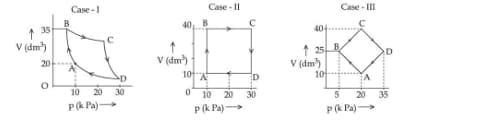
An ideal gas undergoes a cyclic transformation starting from point A and coming back to the same point by tracing the path A→B→C→D→A as shown in the three cases below. Choose the correct option regarding :
1
2
3
4
Official Solution
Correct Option: (2)
An ideal gas undergoes a cyclic transformation, meaning it starts and returns to the same point. In a cyclic process, the change in internal energy ( ) of an ideal gas is determined by the first law of thermodynamics: where is the heat added to the system and is the work done by the system. Since the system returns to its initial state, the internal energy, a state function, remains unchanged at the end of the cycle. Thus for any cyclic transformation, . Therefore, regardless of the path taken (whether it's Case I, II, or III), the change in internal energy ( ) will be the same for all cases. This means:
10
PYQ 2026
medium
chemistryID: jee-main
For the reaction given below at 25°C: Find . Given and .
1
0.43
2
0.23
3
0.31
4
0.53
Official Solution
Correct Option: (3)
Step 1: Relationship between and . The relationship between the standard Gibbs free energy change and the equilibrium constant is given by the equation: where is the gas constant and is the temperature in Kelvin. Step 2: Calculate for the reaction. We can calculate by subtracting the values of products and reactants:
Step 3: Calculate . Now we can find using the relation: Substituting the values, we get . Final Answer: