The correct order of electron gain enthalpies of Cl, F, Te and Po is
1
F < Cl < Te < Po
2
Po < Te < F < Cl
3
Te < Po < Cl < F
4
Cl < F < Te < Po
Official Solution
Correct Option: (1)
The correct option is(D): Cl > F > Te > Po
Te → –190 kJ mol–1
Po → –174 kJ mol–1
F → –333 kJ mol–1
Cl → –349 kJ mol–1
Hence, correct order is Cl > F > Te > Po
02
PYQ 2022
easy
chemistryID: jee-main
Consider an imaginary ion .The nucleus contains ‘a’% more neutrons than the number of electrons in the ion. The value of ‘a’ is ________. [nearest integer
Official Solution
Correct Option: (1)
Number of electrons in is 25. Number of neutrons = 48 – 22 = 26. Percentage increase in the number of neutrons over electrons
= 100=4% ∴ a = 4
03
PYQ 2022
medium
chemistryID: jee-main
Given below are the quantum numbers for 4 electrons. A. n=3, l=2, ml=1,ms=+ B. n=4, l=1, ml=0,ms=+ C. n=4, l=2, ml=–2,ms=– D. n=3, l=1, ml=–1,ms=+ The correct order of increasing energy is
1
D < B < A < C
2
D < A < B < C
3
D < A < B < C
4
B < D < A < C
Official Solution
Correct Option: (2)
To find the correct order of increasing energy for the given electrons according to their quantum numbers, we must understand how the energy levels are determined by quantum numbers.
The energy of an electron in an atom mainly depends on its principal quantum number (n) and azimuthal quantum number (l). Higher values of n and l mean higher energy levels. The following rule is often applied:
Electrons are filled in increasing order of (n + l) value.
If two orbitals have the same (n + l) value, the orbital with the lower n value is filled first.
Let's determine the (n + l) values for the given electrons:
A. n = 3, l = 2: (n + l) = 3 + 2 = 5
B. n = 4, l = 1: (n + l) = 4 + 1 = 5
C. n = 4, l = 2: (n + l) = 4 + 2 = 6
D. n = 3, l = 1: (n + l) = 3 + 1 = 4
Based on these values, the order of increasing energy is determined by sorting according to (n + l), followed by n if there's a tie:
D: (n + l) = 4
A: (n + l) = 5, n = 3
B: (n + l) = 5, n = 4
C: (n + l) = 6
Therefore, the correct order of increasing energy levels is D < A < B < C.
04
PYQ 2023
medium
chemistryID: jee-main
Given below are two statement: one is labelled as Assertion A and the other is labelled as Reason R. Assertion A: 5f electrons can participate in bonding to a far greater extent than 4f electrons Reason R: 5f orbitals are not as buried as 4f orbitals In the light of the above statements, choose the correct answer from the options given below:
1
Both A and R are true and R is the correct explanation of A
2
Both A and R are true but R is NOT the correct explanation of A
3
A is true but R is false
4
A is false but R is true
Official Solution
Correct Option: (1)
The correct option is(A): Both A and R are true and R is the correct explanation of A
05
PYQ 2023
medium
chemistryID: jee-main
Given below are two statement: one is labelled asAssertion A and the other is labelled as Reason R. Assertion A: 5f electrons can participate in bonding to a far greater extent than 4f electrons Reason R: 5f orbitals are not as buried as 4f orbitals In the light of the above statements, choose the correct answer from the options given below:
1
Both A and R are true and R is the correct explanation of A
2
Both A and R are true but R is NOT the correct explanation of A
3
A is true but R is false
4
A is false but R is true
Official Solution
Correct Option: (1)
Solution: Assertion A: 5f electrons can participate in bonding to a far greater extent than 4f electrons.
This assertion is true. 5f electrons, being more spatially extended, have greater interaction with ligand orbitals and thus participate in bonding to a greater extent compared to the more buried 4f electrons.
Reason R: 5f orbitals are not as buried as 4f orbitals.
This reason is also true. 5f orbitals extend further into space than 4f orbitals, meaning they are less shielded by inner electrons and are more available for bonding.
Furthermore, the Reason R directly explains Assertion A. Because 5f orbitals are less buried, they are more available for bonding, which is why 5f electrons participate in bonding to a far greater extent than 4f electrons.
Therefore, both A and R are true, and R is the correct explanation of A.
Correct Answer: (2) Both A and R are true and R is the correct explanation of A.
06
PYQ 2023
medium
chemistryID: jee-main
In alkaline medium, the reduction of permanganate anion involves a gain of _____ electrons.
Official Solution
Correct Option: (1)
The reduction of permanganate anion (MnO ) in alkaline medium involves the following process: The reduction from Mn to Mn involves the gain of 3 electrons, as the change in oxidation number is from +7 to +4. Therefore, the reduction of permanganate anion involves the gain of 3 electrons.
07
PYQ 2023
hard
chemistryID: jee-main
In chromyl chloride, the number of d-electrons present on chromium is same as in (Given at no. of Ti : 22, V : 23, Cr : 24, Mn : 25, Fe : 26)
1
Mn (VII)
2
Fe (III)
3
V (IV)
4
Ti (III)
Official Solution
Correct Option: (1)
Chromium in chromyl chloride (CrO Cl ):
Oxidation state of Cr is +6. Electronic configuration: Cr = [Ar] 3d 4s , meaning there are zero d-electrons. Manganese in Mn (VII): Oxidation state of Mn is +7. Electronic configuration: Mn = [Ar] 3d 4s , also zero d-electrons.
Thus, the number of d-electrons is the same for Cr in CrO Cl and Mn in Mn (VII).
08
PYQ 2025
medium
chemistryID: jee-main
Given below are two statements: Statement I: The conversion proceeds well in a less polar medium. Statement II: The conversion proceeds well in a more polar medium. In the light of the above statements, choose the correct answer from the options given below:
1
Both statement I and statement II are true
2
Both statement I and statement II are false
3
Statement I is false but statement II is true
4
Statement I is true but statement II is false
Official Solution
Correct Option: (1)
To evaluate the given statements about organic reactions involving conversion of , let's examine each one:
Statement I: The conversion proceeds well in a less polar medium.
This reaction is a nucleophilic substitution reaction where hydroxide ion ( ) attacks the alkyl chloride to form butanol.
In SN2 reactions like this one, less polar solvents are preferred because polar solvents can stabilize the nucleophile (here, ), making it less reactive.
Thus, Statement I is accurate as the reaction proceeds better in a less polar medium, supporting the SN2 mechanism.
Statement II: The conversion proceeds well in a more polar medium.
This transformation involves an amine catalyst ( ) facilitating the reaction.
Polar solvents can stabilize the reactants and intermediates involving polar reactants, such as those with amines, which aids in the reaction progress.
Hence, a more polar medium facilitates this reaction, making Statement II correct.
After understanding both reactions, we can conclude that:
Correct Answer: Both statement I and statement II are true.
09
PYQ 2026
medium
chemistryID: jee-main
Increasing order of electron withdrawing power of following functional groups is: a. -CN b. -COOH c. -NO₂ d. -I
1
2
3
4
Official Solution
Correct Option: (3)
Step 1: Understanding the Concept:
The electron-withdrawing power of a functional group is determined by its inductive effect ( effect) and its resonance/mesomeric effect ( or effect). Groups that have highly electronegative atoms or positive charges on the central atom are the strongest withdrawers.
Step 2: Key Formula or Approach:
1. Nitro ( ) is one of the strongest withdrawers due to both strong and effects.
2. Cyano ( ) follows closely behind .
3. Carboxyl ( ) is weaker than but stronger than halogens.
4. Halogens ( ) are primarily withdrawers but show effects.
Step 3: Detailed Explanation:
1. : The nitrogen atom is positively charged in resonance structures, making it extremely electron-deficient and strongly withdrawing.
2. : The triple bond to nitrogen creates a strong dipole and allows for significant resonance withdrawal.
3. : The carbonyl group is withdrawing, but less so than the cyano or nitro groups.
4. : Iodine is electronegative, but it is the least electronegative of the common halogens and lacks the pi-system resonance withdrawal of the other three groups.
5. Therefore, the order is: .
Step 4: Final Answer:
The increasing order is .
10
PYQ 2026
medium
chemistryID: jee-main
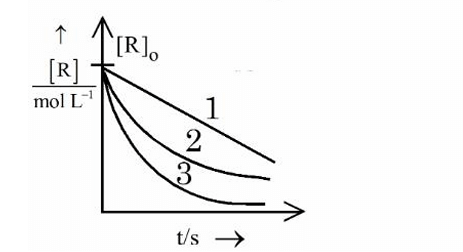
Three different reactions were started with identical initial concentration of reactants. Which of the following statement is correct regarding the given graph showing variation of reactant concentration with time?
1
The order of all the three reactions is same.
2
The rate constant of reaction 3 is larger than the rate constant of reaction 2 if the order of reaction is same for both.
3
The SI unit of rate constant of reaction 1 is .
4
Thermal decomposition of HI on gold surface is an example of reaction 2.
Official Solution
Correct Option: (2)
Step 1: Understanding the Concept:
The concentration vs time graph helps identify the order of a reaction and compare rate constants. A linear decrease indicates a zero-order reaction, while curves indicate higher orders.
Step 3: Detailed Explanation:
Curve 1 is a straight line, which represents a zero-order reaction where .
Curves 2 and 3 are non-linear, representing first or second-order reactions.
- Statement (A) is incorrect because the shapes (linear vs curved) clearly indicate different orders.
- Statement (B) is correct: For curves with the same shape (order), the one that drops faster (Curve 3 is steeper than Curve 2) corresponds to a higher rate of reactant consumption, implying a larger rate constant .
- Statement (C) is incorrect because the SI unit for a zero-order rate constant is , not .
- Statement (D) is incorrect because the thermal decomposition of HI on a gold surface is a well-known example of a zero-order reaction (Reaction 1), not Reaction 2.
Step 4: Final Answer:
The correct statement is (B).