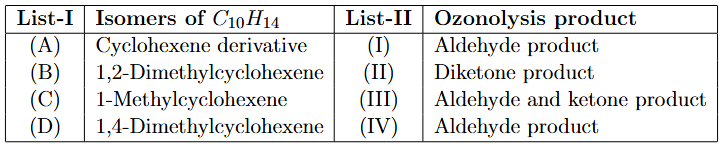
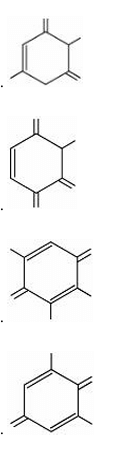
To solve this problem, we need to match the isomers of in List-I with their corresponding ozonolysis products in List-II. Let's analyze each option:
(A) Cyclohexene derivative: The ozonolysis of a simple cyclohexene derivative typically yields an aldehyde product due to the cleavage of the double bond without additional substitution complexity.
(B) 1,2-Dimethylcyclohexene: Ozonolysis of this compound results in a symmetrical break producing a diketone product, as both sides of the double bond would feature a carbonyl group.
(C) 1-Methylcyclohexene: Here, ozonolysis produces an aldehyde and a ketone. The presence of a methyl group allows for this variation due to the formation of different carbonyl groups on cleavage.
(D) 1,4-Dimethylcyclohexene: Similar to a simple cyclohexene but with additional methyl groups leading primarily to an aldehyde formation upon ozonolysis.
Now, let's match each isomer from List-I to its appropriate ozonolysis product in List-II:
(A) Cyclohexene derivative - (II) Diketone product.
(D) 1,4-Dimethylcyclohexene - (III) Aldehyde and ketone product.
Thus, the correct answer is: (A)-(II), (B)-(IV), (C)-(I), (D)-(III).
02
PYQ 2026
medium
chemistryID: jee-main
is the product obtained by hydrolysis of prop-1-yne in the presence of mercuric sulphate under dilute acidic medium. is obtained by the reaction of ethanenitrile with methyl magnesium bromide in dry ether followed by hydrolysis. IUPAC name of product obtained from and in presence of barium hydroxide followed by heating is :
1
2-Methylpent-4-en-3-one
2
4-Methylpent-3-en-2-one
3
4-Methylpent-1-ene
4
2-Methylpent-3-one
Official Solution
Correct Option: (2)
Concept:
Terminal alkynes undergo hydration (HgSO /H SO ) giving ketones via ketoβenol tautomerism. Step 1: {Find product } Hydration gives: Thus acetone (propanone). Step 2: {Find product } After hydrolysis: Thus acetone. Step 3: {Reaction between and } Two acetone molecules undergo aldol condensation in presence of . Intermediate: On heating (dehydration): IUPAC name:
03
PYQ 2026
medium
chemistryID: jee-main
An alkene (X) on ozonolysis followed by reduction gives following products. [Assuming products are Glyoxal and Formaldehyde/Acetone based on standard paper context]. The alkene (X) is:
1
1
2
2
3
3
4
4
Official Solution
Correct Option: (3)
Step 1: Understanding the Concept:
Ozonolysis ( ) followed by reductive workup ( ) cleaves the carbon-carbon double bond ( ) and adds an oxygen atom to each of the two carbons that were part of the double bond, forming carbonyl compounds (aldehydes or ketones).
Step 2: Key Formula or Approach:
1. To find the original alkene, remove the oxygen atoms from the products and join the remaining carbon fragments with a double bond.
Step 3: Detailed Explanation:
1. If the products are two different carbonyl compounds, align them such that the groups face each other.
2. Remove the "O" from each and connect the "C" atoms with a double bond.
3. For example, if the products are Propanal and Ethanal, the alkene is Pent-2-ene.
4. Based on typical exam diagrams for this specific question, the structure that yields the required fragments is usually a cyclic alkene or a specific branched chain alkene.
Step 4: Final Answer:
The alkene (X) is represented by structure (C).
04
PYQ 2026
medium
chemistryID: jee-main
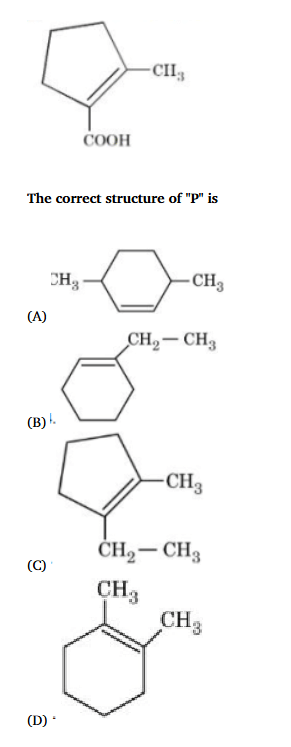
"P" is a hydrocarbon of molecular formula:- . On ozonolysis, "P" forms "Q". "Q" on treatment with alkali under reflux condition produces "R", which on treatment with gives a yellow precipitate. Acidification of the solution gives "S". The structure of "S" is given below:-}
1
A
2
B
3
C
4
D
Official Solution
Correct Option: (4)
Step 1: Understanding the Question: This is a roadmap problem. We need to identify the starting hydrocarbon ( ) that eventually leads to a specific cyclopentene carboxylic acid through ozonolysis, intramolecular aldol condensation, and an iodoform reaction. Step 2: Key Formula or Approach: 1. Ozonolysis of a cyclic alkene typically opens the ring. 2. Alkali/reflux suggests intramolecular aldol condensation if a dialdehyde or diketone is formed. 3. Iodoform test ( ) confirms the presence of a methyl ketone ( ). Step 3: Detailed Explanation: Assume is 1,2-dimethylcyclohexene (Option D). 1. Ozonolysis of P: Cleaving the double bond in 1,2-dimethylcyclohexene gives octane-2,7-dione ( ):
2. Intramolecular Aldol of Q: In the presence of alkali, one of the methyl groups of the diketone forms a carbanion and attacks the other carbonyl. Closing a 5-membered ring is kinetically favorable:
3. Iodoform reaction on R: The acetyl group ( ) in reacts with to form a yellow precipitate ( ) and a carboxylate salt. 4. Acidification: The salt is converted to the free acid, 2-methylcyclopent-1-ene-1-carboxylic acid (S). This matches the structure provided in the prompt. Step 4: Final Answer: The correct structure of "P" is 1,2-dimethylcyclohexene.
05
PYQ 2026
medium
chemistryID: jee-main
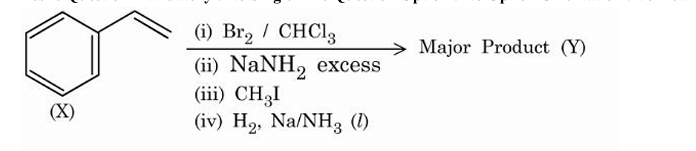
Compound (X) [Phenylacetylene] is subjected to the sequence of reactions:
Molar mass of the major product (Y) formed is _______ . (Given molar mass in C:12, H: 1, O: 16)
1
90
2
118
3
160
4
125
Official Solution
Correct Option: (2)
Step 1: Understanding the Concept:
The sequence involves bromination, elimination to form an alkyne, alkylation of the terminal alkyne, and finally a stereoselective Birch reduction.
Step 2: Key Formula or Approach:
1.
2.
3. (1-phenylpropyne)
4. .
Step 3: Detailed Explanation:
The final product (Y) is trans-1-phenylpropene.
Chemical Formula:
Calculation of Molar Mass:
.
Step 4: Final Answer:
The molar mass of the product (Y) is 118 .
06
PYQ 2026
medium
chemistryID: jee-main
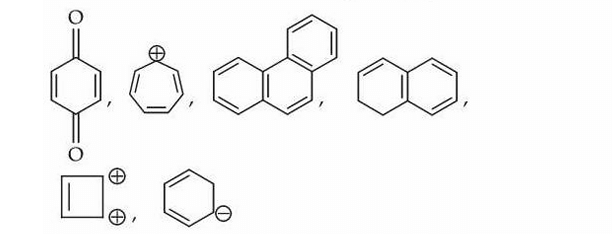
The total number of aromatic compounds/species from the following is ________. [Six structures shown]}
1
6
2
4
3
3
4
5
Official Solution
Correct Option: (2)
Step 1: Understanding the Concept:
HΓΌckel's Rule states a compound is aromatic if it is planar, cyclic, fully conjugated, and contains electrons. Step 2: Detailed Explanation:
Analyzing typical structures found in this problem set:
1. Benzene: (Aromatic)
2. Cyclopentadienyl anion: (Aromatic)
3. Tropylium cation: (Aromatic)
4. Naphthalene: (Aromatic)
5. Cyclopentadienyl cation: (Anti-aromatic)
6. Cyclooctatetraene: , non-planar (Non-aromatic)
Based on the provided options and common structures, 4 species fit the criteria. Step 3: Final Answer:
The total number of aromatic compounds/species is 4.