Polymers
31 previous year questions.
High-Yield Trend
Chapter Questions 31 MCQs
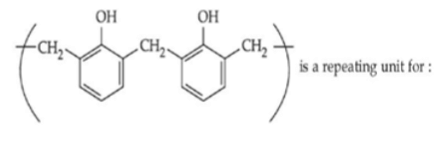
List I: (a) Caprolactum (b) 2-Chloro-1,3-butadiene (c) Isoprene (d) Acrylonitrile.
List II: (i) Natural rubber (ii) Buna-N (iii) Nylon 6 (iv) Neoprene.
| List I (polymer) | List-II (Nature) | ||
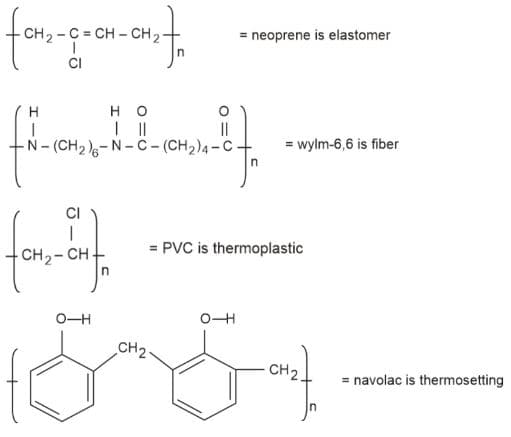
| A. | 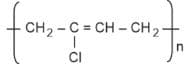 | I. | Thermosetting polymer |
| B. | 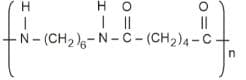 | II. | Fibers |
| C. | 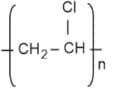 | III. | Elastomer |
| D. | 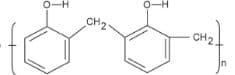 | IV. | Thermoplastic polymer |
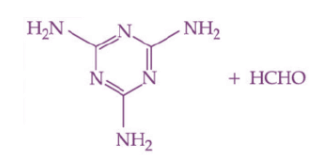
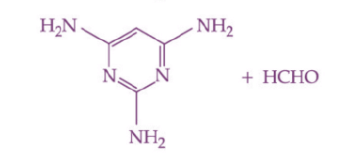
Melamine polymer is formed by the condensation of :
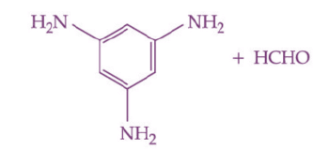
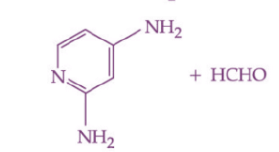
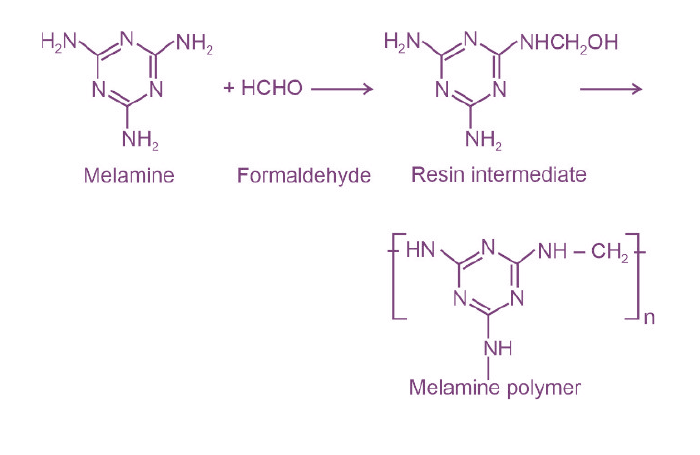
| (Si-Compounds) | (Si-Polymeric/other Products) | ||
|---|---|---|---|
| A. | i | Chain Silicone | |
| B. | ii | Dimeric Silicone | |
| C. | iii | Silane | |
| D. | iv | 2D-Silicone |
Choose the correct answer from the options given below:
| (Polymer) | (Used in) | ||
|---|---|---|---|
| A. | Bakelite | i | Radio and television cabinets |
| B. | Glyptal | ii | Electrical switches |
| C. | PVC | iii | Paints and Lacqures |
| D. | Polystyrene | iv | Water pipes |
Choose the correct answer from the options given below:
Given below are two statements, one is Assertion (A) and other is Reason (R).
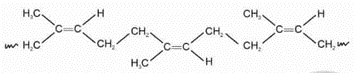
Assertion (A): Natural rubber is a linear polymer of isoprene called cis-polyisoprene with elastic properties.
Reason (R): The cis-polyisoprene molecules consist of various chains held together by strong polar interactions with coiled structure.
In the light of the above statements, choose the correct one from the options given below:
Assertion A : Amylose is insoluble in water.
Reason R : Amylose is a long linear molecule with more than 200 glucose units.
In the light of the above statements, choose the correct answer from the options given below.
Given below are two statements : one is labelled as Assertion A and the other is labelled as Reason R.
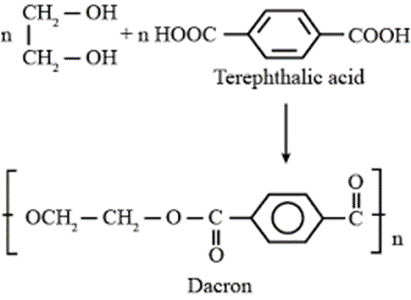
Assertion A : Dacron is an example of polyester polymer.
Reason R : Dacron is made up of ethylene glycol and terephthalic acid monomers.
In the light of the above statements, choose the most appropriate answer from the options given below.
Match List-I with List-II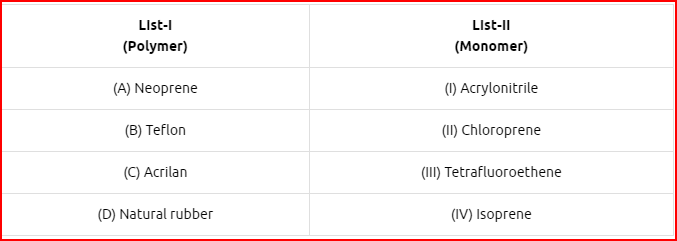
Choose the correct answer from the options given below:
| Column I | Column II | ||
| (A). | Biodegradable | (P). | Polyacrylonitrie |
| (B). | Synthetic | (Q). | PHBV |
| (C). | Natural | (R). | Dacron |
| (D). | Polyester | (S). | Rubber |
Match List I with List II :
| List-I Polymer | List-II used for items | ||
|---|---|---|---|
| A | Nylon 6,6 | I | Buckets |
| B | Low density polythene | II | Non-stick utensils |
| C | High density polythene | III | Bristles of brushes |
| D | Teflon | IV | Toys |
Match the columns Column I Column II (a) Biodegradable (p) polyacrylonitrie (b) Synthetic (q) PHBV (c) Natural (r) dacron (d) Polyester (s) Rubber
a-q; b-p; c-s; d-r
a-q; b-p; c-r; d-s
a-p; b-q; c-s; d-r
a-q; b-r; c-s; d-p
| List-I | Polymer | List-II | Type/ Class |
| (A) | Nylon-2-Nylon-6 | (I) | Thermosetting polymer |
| (B) | Buna-N | (II) | Biodegradable polymer |
| (C) | Urea-formaldehyde | (III) | Synthetic rubber resin |
| (D) | Dacron | (IV) | Polyester |
Statement I : Ethene at 333 to 343 K and 6-7 atm pressure in the presence of AIEt3 and TiCl4 undergoes addition polymerization to give LDP.
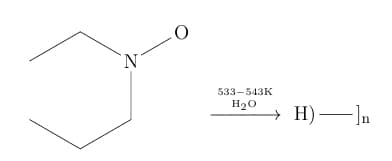
Statement II: Caprolactam at 533-543 K in H2O through step growth polymerizes to give Nylon 6.
In the light of the above statements, choose the correct answer from the options given below:
About Polymers - JEE-MAIN
Polymers is a vital chapter for JEE-MAIN aspirants. Mastering the concepts covered in this chapter is essential for securing a top rank.
By rigorously practicing the previous year questions associated with this chapter, you can identify high-yield topics, understand the examiner's perspective, and boost your confidence during the actual exam.
Frequently Asked Questions
Why focus on Polymers PYQs?
Analyzing PYQs for this specific chapter reveals the most frequently tested concepts and the typical complexity of questions, allowing you to tailor your study plan efficiently.
How to best use this analysis?
Review the topic breakdown to see which sub-topics within Polymers carry the most weight. Then, tackle the questions iteratively to solidify your understanding.