Consider the reaction: $ $ The equation representing the correct relationship between the degree of dissociation of with its equilibrium constant is:
1
2
3
4
Official Solution
Correct Option: (2)
To solve this problem, we need to find the correct relationship between the degree of dissociation of and its equilibrium constant . Let's analyze the given reaction:
Let the initial pressure of be .
At equilibrium, let the degree of dissociation of be . Thus, the pressures at equilibrium are:
For :
For :
For :
Using these expressions, the total pressure at equilibrium is:
The equilibrium constant, , is defined as:
Substitute the equilibrium pressures:
Rearranging for gives:
Assuming is small, .
Solving for , we get:
Hence, the correct relationship between and is:
The solution confirms that the correct answer is the equation .
02
PYQ 2025
easy
chemistryID: jee-main
At temperature T, compound AB2 dissociates as , having degree of dissociation (small compared to unity). The correct expression for in terms of and is:
1
2
3
4
Official Solution
Correct Option: (3)
To solve this problem, we need to find the degree of dissociation, , in terms of the equilibrium constant and the total pressure for the given reaction.
1. Understanding the Equilibrium: The reaction is: . We will use an ICE table to relate the initial pressure, the change in pressure due to dissociation, and the equilibrium pressures.
2. Setting Up the ICE Table:
Assume initial pressure of is .
3. Total Pressure at Equilibrium:
The total pressure is the sum of the partial pressures at equilibrium:
Since , .
4. Expressing in Terms of Partial Pressures:
5. Simplifying the Expression:
Since , we can approximate :
Since , .
6. Solving for :
Final Answer: The degree of dissociation is .
03
PYQ 2026
medium
chemistryID: jee-main
Given is a concentrated solution of a weak electrolyte of concentration and dissociation constant . The degree of dissociation is given by:
1
2
3
4
Official Solution
Correct Option: (1)
Concept:
For weak electrolyte: If initial concentration is and degree of dissociation is : Step 1: {Write equilibrium expression.} Step 2: {Solve for .}
04
PYQ 2026
medium
chemistryID: jee-main
At T(K), the equilibrium constant of is . What is the equilibrium constant for at the same temperature?
1
2
3
4
Official Solution
Correct Option: (4)
Step 1: Understanding the Concept:
When the coefficients of a balanced chemical equation are multiplied by a factor ' ', the new equilibrium constant ( ) becomes the original equilibrium constant ( ) raised to the power of that factor ( ).
Step 2: Key Formula or Approach:
1. Original reaction:
2. New reaction: Coefficients are multiplied by .
3.
Step 3: Detailed Explanation:
1. Apply the power rule:
2. Rewrite as to make the cube root easier:
3. Calculate the cube root:
Step 4: Final Answer:
The new equilibrium constant is .
05
PYQ 2026
medium
chemistryID: jee-main
Decomposition of a hydrocarbon follows the equation} The activation energy of reaction is _____ kJ mol . (Nearest Integer)} Given: }
Official Solution
Correct Option: (1)
Concept: Arrhenius equation: Comparing with the given expression: Thus: Step 1: {Calculate activation energy} Step 2: {Convert to kJ mol } Nearest integer:
06
PYQ 2026
medium
chemistryID: jee-main
The reaction was initiated with the amount 'a' of . At equilibrium it is found that the amount of remaining is at a total pressure of p.
The equilibrium constant of the reaction can be calculated from the expression :
1
2
3
4
Official Solution
Correct Option: (2)
Step 1: Understanding the Concept:
is defined as the product of the partial pressures of the products divided by the partial pressure of the reactant at equilibrium. Partial pressure of a gas is the product of its mole fraction and the total pressure. : Key Formula or Approach:
Step 2: Detailed Explanation:
Let's set up the equilibrium table:
\begin{center}
\begin{tabular}{lccc}
& & &
Initial moles: & & 0 & 0
Change: & & &
At equilibrium: & & &
\end{tabular}
\end{center}
Total moles at equilibrium .
Mole fractions at equilibrium:
Partial Pressures:
Calculating :
. Step 3: Final Answer:
The expression for is .
07
PYQ 2026
medium
chemistryID: jee-main
Given at 298 K:
Volt
Volt
The in Volt at 298 K is given by:
1
2
3
4
Official Solution
Correct Option: (2)
Step 1: Understanding the Concept:
Electrode potentials are not additive, but Gibbs free energy changes ( ) are. We use the relation to combine the half-reactions. Step 2: Key Formula or Approach:
1.
2.
The target reaction is: . Step 3: Detailed Explanation:
The target reaction can be obtained by subtracting reaction (1) from reaction (2):
Therefore:
Divide both sides by :
Step 4: Final Answer:
The value of is .
08
PYQ 2026
medium
chemistryID: jee-main
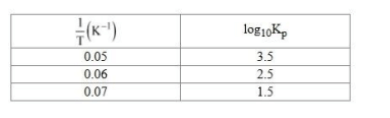
The values of pressure equilibrium constant recorded at different temperatures for the following equilibrium reaction have been given below: }
The magnitude of calculated from the above data is ____. (Nearest integer)}
Official Solution
Correct Option: (1)
Step 1: Understanding the Question: The variation of equilibrium constant with temperature is given by the van't Hoff equation. We need to find the enthalpy of reaction scaled by the gas constant. Step 2: Key Formula or Approach: The integrated form of the van't Hoff equation in terms of base-10 log is:
The slope of a plot of versus is . Step 3: Detailed Explanation: Let's use two data points: Point 1: Point 2: Slope = From the formula:
Rounding to the nearest integer, we get 230. Step 4: Final Answer: The magnitude of is 230.
09
PYQ 2026
medium
chemistryID: jee-main
20 mL of a solution of acetic acid required 28.4 mL of 0.1 M NaOH for its neutralization. A solution (X) was prepared by mixing 20 mL of the above acetic acid and 14.2 mL of 0.1 M NaOH solution. What is the pH of the solution (X)? ( value of acetic acid is 4.75).
1
7.0
2
4.75
3
3.5
4
4.82
Official Solution
Correct Option: (2)
Step 1: Understanding the Concept:
Neutralization of a weak acid with a strong base forms a salt. If only half of the acid is neutralized, a buffer solution containing the weak acid and its salt is formed.
Step 2: Key Formula or Approach:
Henderson-Hasselbalch equation:
Step 3: Detailed Explanation:
1. Find moles of acid: At neutralization, moles acid = moles base.
Moles acid in 20 mL = .
2. Prepare solution X: Mix 2.84 mmol acid with NaOH.
3. Reaction: .
Initial: acid = 2.84, base = 1.42.
Reacted: acid = -1.42, base = -1.42, salt = +1.42.
Final: acid = 1.42 mmol, salt = 1.42 mmol.
4. Since [acid] = [salt], the log term in HH equation becomes .
.
Step 4: Final Answer:
The pH of the solution is 4.75.
10
PYQ 2026
medium
chemistryID: jee-main
Solid carbon, CaO and CaCO are mixed and allowed to attain equilibrium at T K.
The partial pressure of CO is _______ atm.
Official Solution
Correct Option: (1)
\textcolor{red}{Step 1: Understand the reactions and their equilibrium constants.} We are given two reactions and their equilibrium constants: 1. , with
2. , with We need to find the partial pressure of CO. \textcolor{red}{Step 2: Use the equilibrium constants.} Since solid substances do not appear in the expression for the equilibrium constant, we only consider the gases. For the first reaction:
Thus, the partial pressure of is 0.08 atm. For the second reaction:
Let the partial pressure of CO be . Substituting the values:
\textcolor{red}{Step 3: Solve for .}
Rearranging the equation:
\textcolor{red}{Step 4: Adjust the answer to the required form.} The partial pressure of CO is atm.