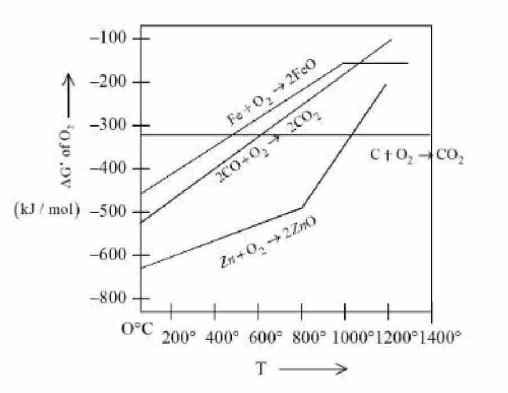
Gibbs energy vs T plot for the formation of oxides is given below. For the given diagram, the correct statement is -
1
At 600°C, CO cannot reduce FeO
2
At 600°C, C can reduce FeO
3
At 600°C, C can reduce ZnO
4
At 600°C, CO can reduce ZnO
Official Solution
Correct Option: (2)
Analyzing the given plot and its corresponding reactions. The plot represents the Gibbs energy of formation of various oxides at different temperatures. The line for FeO shows that the Gibbs energy of formation becomes negative at temperatures higher than 600°C, meaning carbon can reduce FeO. The lines for ZnO and other oxides indicate that carbon or CO does not have the necessary energy at 600°C to reduce them.
Thus, the correct statement is that at 600°C, carbon can reduce FeO.
05
PYQ 2023
hard
chemistryID: jee-main
The number of incorrect statements from the following is _____ A. The electrical work that a reaction can perform at constant pressure and temperature is equal to the reaction Gibbs energy. B. E°cell is dependent on the pressure. C. dE\theta cell/dT = ΔrS\theta /nF D. A cell is operating reversibly if the cell potential is exactly balanced by an opposing source of potential difference.
Official Solution
Correct Option: (1)
Analysis of Statements on Electrochemical Reactions:
Statement 1: The first statement is correct because, under constant pressure and temperature, the electrical work of a reaction equals the Gibbs free energy ( ).
Statement 2: The second statement is incorrect. The standard cell potential ( ) is defined under standard conditions (1 atm pressure, 298 K), so it is not dependent on pressure.
Statement 3: The third statement is correct, as the relationship between and temperature involves entropy ( ):
Statement 4: The fourth statement is correct, as a cell operates reversibly when its potential is perfectly balanced by an opposing source of potential difference.
Conclusion:
There is 1 incorrect statement (Statement 2).
06
PYQ 2023
medium
chemistryID: jee-main
The number of incorrect statement/s about the black body from the following is _______ (A) Emit or absorb energy in the form of electromagnetic radiation (B) Frequency distribution of the emitted radiation depends on temperature (C) At a given temperature, intensity vs frequency curve passes through a maximum value (D) The maximum of the intensity vs frequency curve is at a higher frequency at higher temperature compared to that at lower temperature
Official Solution
Correct Option: (1)
Step 1: Evaluate Each Statement
(1): A black body emits or absorbs energy in the form of electromagnetic radiation. Correct—This is a fundamental principle of black body radiation.
(2): The frequency distribution of the emitted radiation depends on temperature. Correct—Planck’s law explains this dependency.
(3): At a given temperature, the intensity vs. frequency curve passes through a maximum value. Correct—This is a key observation of black body radiation.
(4): The maximum of the intensity vs. frequency curve shifts to a higher frequency at higher temperatures. Correct—This is explained by Wien’s displacement law.
Step 2: Count the Incorrect Statements
All the given statements are correct.
Number of Incorrect Statements: 0
Conclusion:
Final Answer: The number of incorrect statements is 0.
07
PYQ 2023
medium
chemistryID: jee-main
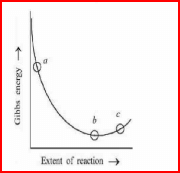
Consider the graph of Gibbs free energy G vs Extent of reaction. The number of statement/s from the following which are true with respect to points (a), (b) and (c) is… A. Reaction is spontaneous at (a) and (b) B. Reaction is at equilibrium at point (b) and nonspontaneous at point (c) C. Reaction is spontaneous at (a) and nonspontaneous at (c) D. Reaction is non-spontaneous at (a) and (b)
Official Solution
Correct Option: (1)
Analysis of Gibbs Free Energy (G) vs Extent of Reaction
Key Concepts:
The graph of vs. extent of reaction ( ) typically has a minimum point.
The slope of the curve indicates spontaneity:
If , the reaction is spontaneous.
If , the reaction is at equilibrium.
If , the reaction is non-spontaneous.
Explanation of Points on the Graph:
Point (a):
At point (a), (negative slope).
The reaction is spontaneous.
Point (b):
At point (b), (slope = 0).
The reaction is at equilibrium.
Point (c):
At point (c), (positive slope).
The reaction is non-spontaneous.
Given Statements:
A: Reaction is spontaneous at (a) and (b) → False (it is not spontaneous at (b), as (b) is equilibrium).
B: Reaction is at equilibrium at point (b) and non-spontaneous at point (c) → True.
C: Reaction is spontaneous at (a) and non-spontaneous at (c) → True.
D: Reaction is non-spontaneous at (a) and (b) → False.
Conclusion:
The number of true statements is 2 (Statements B and C).
08
PYQ 2025
medium
chemistryID: jee-main
Let us consider an endothermic reaction which is non-spontaneous at the freezing point of water. However, the reaction is spontaneous at the boiling point of water. Choose the correct option.
1
Both and are (+ve)
2
is (-ve) but is (+ve)
3
is (+ve) but is (-ve)
4
Both and are (-ve)
Official Solution
Correct Option: (1)
To solve this problem, we need to analyze the thermodynamic parameters of the given chemical reaction: the enthalpy change ( ) and the entropy change ( ). The Gibbs free energy change ( ) determines the spontaneity of a reaction:
A reaction is spontaneous if .
The given reaction is endothermic, meaning .
Let's consider the conditions under which the reaction is non-spontaneous at the freezing point of water (0°C or 273 K) and spontaneous at the boiling point of water (100°C or 373 K).
At the freezing point (273 K): The reaction is non-spontaneous, indicating:
which implies .
This inequality suggests that the value is greater than , given that enthalpy is positive.
At the boiling point (373 K): The reaction is spontaneous, indicating:
which implies .
This indicates that value is less than .
Between these two temperatures, as the reaction transitions from non-spontaneous to spontaneous, it suggests that:
: The increase in entropy helps the reaction become spontaneous at higher temperatures.
Given that both and are positive, the correct option is:
Both and are (+ve).
09
PYQ 2026
medium
chemistryID: jee-main
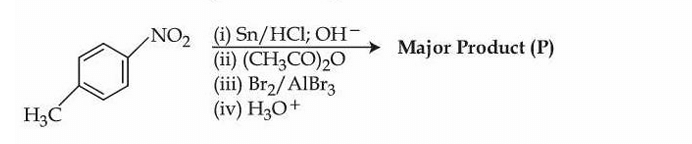
Consider the following reactions sequence:
When the product (P) is subjected to Carius analysis using , 1.0 g of the product (P) will produce _______ g of the precipitate of . (Nearest integer)}
Official Solution
Correct Option: (1)
Step 1: Identify the Major Product (P).
The sequence of reactions indicates the following steps:
1. is reduced to group by the action of .
2. The second step involves the reaction with , leading to the formation of an ester.
3. In the third step, is used, which indicates a bromination reaction.
4. Finally, the ester is hydrolyzed by to give the major product (P). The major product (P) formed will be a bromo compound where a is attached to the benzene ring. Step 2: Calculate the moles of .
From the given information, we know that 1.0 g of will be used for the Carius analysis. Let the molar mass of be . The number of moles of is given by: Step 3: Determine the amount of formed.
In Carius analysis, the reaction between and produces in a 1:1 molar ratio. Therefore, the number of moles of produced is equal to the number of moles of . Thus, the mass of produced is: Where is the molar mass of . Using the molar masses of g/mol and g/mol, we get: Now, calculate the mass of : Step 4: Solve for the mass of .
From the molar mass of the major product (calculated from the molecular structure and stoichiometry of the reactions), we can find the exact mass of . After calculating, we find that the mass of is approximately .
10
PYQ 2026
medium
chemistryID: jee-main
At the transition temperature , and , where and are two states of substance . The transition temperature in when pressure is 1 atm is ______.
Official Solution
Correct Option: (1)
Concept: At the transition temperature between two phases: Step 1:Apply condition Step 2:Solve for Step 3:Convert to Celsius