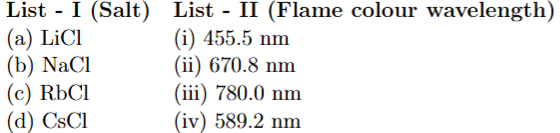
is a stronger oxidizing agent than in aqueous solution
Official Solution
Correct Option: (1)
Step 1: Understanding the Concept:
Interhalogen compounds ( ) are generally more reactive than the corresponding halogens (except ) because the bond is weaker than the bond due to difference in electronegativity and size. Step 2: Detailed Explanation:
1. Statement (A): is an interhalogen compound. Because the bond is weaker than the bond, is more reactive than . Thus, Statement (A) is incorrect.
2. Statement (B): is the most reactive of all halogens due to its low bond dissociation enthalpy and small size. It is more reactive than . Statement (B) is correct.
3. Statement (C): During hydrolysis of interhalogens, the more electronegative halogen forms a hydrohalic acid ( ) and the less electronegative one forms a hypohalous acid ( ).
Statement (C) is correct.
4. Statement (D): Fluorine has the highest reduction potential ( ) compared to Chlorine ( ), making it a much stronger oxidizing agent. Statement (D) is correct. Step 3: Final Answer:
The incorrect statement is " is more reactive than ".
02
PYQ 2021
medium
chemistryID: jee-main
The conversion of hydroxyapatite occurs due to presence of ions in water. The correct formula of hydroxyapatite is :
1
2
3
4
Official Solution
Correct Option: (3)
Step 1: Understanding the Concept:
Tooth enamel is primarily composed of hydroxyapatite, a calcium phosphate mineral. Fluoride ions can replace the hydroxyl groups in this structure to form fluorapatite, which is harder and more resistant to acid. Step 2: Detailed Explanation:
1. Hydroxyapatite is a complex mineral with the formula or .
2. When fluoride ions are present in drinking water, they replace the ions in hydroxyapatite to form fluorapatite, .
3. The question specifically asks for the formula of hydroxyapatite, which is the hydroxyl-containing form. Step 3: Final Answer:
The formula of hydroxyapatite is .
03
PYQ 2021
medium
chemistryID: jee-main
The number of 4f electrons in the ground state electronic configuration of is _________. [Atomic number of Gd = 64] (Integer answer)
Official Solution
Correct Option: (1)
Step 1: Understanding the Concept: Electronic configuration of lanthanides involves filling the 4f subshell. Gadolinium (Gd) is unique because it exhibits a half-filled stability in its 4f subshell. Step 2: Key Formula or Approach: First, write the ground state configuration of neutral Gd (Z=64), then remove electrons starting from the outermost subshell (6s, then 5d or 4f). Step 3: Detailed Explanation: 1. Ground state configuration of Gd (Z=64):
This configuration is stable because the 4f subshell is exactly half-filled. 2. Formation of : To form a 2+ ion, two electrons are removed from the outermost subshell, which is 6s. Configuration of :
3. Counting 4f electrons: There are 7 electrons in the 4f subshell. Step 4: Final Answer: The number of 4f electrons is 7.
04
PYQ 2021
medium
chemistryID: jee-main
The number of halogen/(s) forming halic (V) acid is ____________
Official Solution
Correct Option: (1)
Step 1: Understanding the Concept: Halic (V) acids are oxoacids of halogens where the halogen atom is in the oxidation state. The general formula for these acids is . Step 2: Detailed Explanation: We examine the common halogens: Fluorine, Chlorine, Bromine, and Iodine. 1. Fluorine (F): Being the most electronegative element, fluorine does not show positive oxidation states. It forms only one oxoacid, (fluoric (I) acid), where its oxidation state is effectively treated as or depending on convention, but it never reaches . 2. Chlorine (Cl): It forms chloric acid ( ), where the oxidation state of Cl is . 3. Bromine (Br): It forms bromic acid ( ), where the oxidation state of Br is . 4. Iodine (I): It forms iodic acid ( ), where the oxidation state of I is . Thus, the three halogens that form halic (V) acids are Chlorine, Bromine, and Iodine. Step 3: Final Answer: The number of halogens forming halic (V) acid is 3.
05
PYQ 2021
medium
chemistryID: jee-main
Which one of the following is formed (mainly) when red phosphorus is heated in a sealed tube at 803 K ?
1
-Black phosphorus
2
-Black phosphorus
3
White phosphorus
4
Yellow phosphorus
Official Solution
Correct Option: (2)
Step 1: Understanding the Question:
This is a factual question about the allotropes of phosphorus. We need to identify the specific allotrope formed under the given conditions. Step 2: Detailed Explanation:
Phosphorus exists in several allotropic forms, the most common being white, red, and black phosphorus. Black phosphorus is the most thermodynamically stable form and exists in two modifications: -black and -black phosphorus.
The methods of preparation distinguish them:
- White (or Yellow) Phosphorus: This is the least stable, most reactive form. It is prepared by heating phosphate rock with coke and sand.
- Red Phosphorus: This is formed by heating white phosphorus in an inert atmosphere at about 573 K. It is more stable and less reactive than white phosphorus.
- -Black Phosphorus: This form is obtained when red phosphorus is heated in a sealed tube at 803 K. It has an opaque, monoclinic or rhombohedral crystal structure.
- -Black Phosphorus: This form is prepared by heating white phosphorus at 473 K under very high pressure (around 12,000 atmospheres). It has a layered structure similar to graphite. Based on the given conditions (heating red phosphorus at 803 K), the product is -black phosphorus. Step 3: Final Answer:
Heating red phosphorus in a sealed tube at 803 K mainly forms -black phosphorus.
06
PYQ 2021
medium
chemistryID: jee-main
Which one of the following is used to remove most of plutonium from spent nuclear fuel ?
1
I O
2
BrO
3
ClF
4
O F
Official Solution
Correct Option: (3)
Step 1: Understanding the Question:
The question asks to identify a chemical compound used in the reprocessing of spent nuclear fuel, specifically for the removal of plutonium. Step 2: Detailed Explanation:
Reprocessing of spent nuclear fuel involves separating useful materials like uranium and plutonium from fission products. One of the advanced methods for this is called "fluoride volatility." This process takes advantage of the fact that some elements form fluorides that are volatile (can be easily turned into a gas) at moderate temperatures.
- Chlorine trifluoride (ClF ): This is an extremely powerful fluorinating agent. It is one of the most reactive compounds known. It can react with uranium and plutonium metals or their oxides to convert them into their volatile hexafluorides, UF and PuF .
- Once in gaseous form, PuF can be separated from other less volatile or non-volatile fission product fluorides.
- The other compounds listed are not used for this purpose. I O is an oxidizing agent, BrO is an oxoanion, and O F is a highly unstable oxide of fluorine. ClF is uniquely suited due to its extreme fluorinating power. Step 3: Final Answer:
Chlorine trifluoride (ClF ) is used to remove plutonium from spent nuclear fuel by converting it to volatile plutonium hexafluoride (PuF ).
07
PYQ 2021
medium
chemistryID: jee-main
Given below are two statements: one is labelled as Assertion (A) and the other is labelled as Reason (R).
Assertion (A) : Barium carbonate is insoluble in water and is highly stable.
Reason (R) : The thermal stability of the carbonates increases with increasing cationic size.
Choose the most appropriate answer from the options given below :
1
Both (A) and (R) are true and (R) is the true explanation of (A).
2
Both (A) and (R) are true but (R) is not the true explanation of (A).
3
(A) is true but (R) is false.
4
(A) is false but (R) is true.
Official Solution
Correct Option: (1)
Step 1: Understanding the Statements
The question presents two statements, an Assertion (A) about the properties of Barium Carbonate (BaCO ) and a Reason (R) about a chemical trend for carbonates. We need to evaluate the truthfulness of both statements and determine if (R) correctly explains (A). Step 2: Analyzing Assertion (A)
Assertion (A) states that Barium carbonate is insoluble in water and is highly stable. Solubility: Carbonates of alkaline earth metals (Group 2) are generally insoluble in water. As we move down the group, the hydration energy of the cations decreases more rapidly than the lattice energy. For carbonates, the lattice energy does not change significantly because the anion is large. Thus, the solubility of carbonates decreases down the group. BaCO is at the bottom of the group and is indeed insoluble in water. Stability: Thermal stability refers to the ease of decomposition upon heating. Barium carbonate (BaCO ) decomposes at a very high temperature (around 1360 C), making it the most thermally stable carbonate among the alkaline earth metals. Therefore, Assertion (A) is true. Step 3: Analyzing Reason (R)
Reason (R) states that the thermal stability of the carbonates increases with increasing cationic size.
This is a correct trend for the carbonates of Group 1 and Group 2 elements. As the size of the cation increases down a group, its polarizing power (ability to distort the electron cloud of the anion) decreases. A smaller cation with a higher charge density will polarize the large carbonate ion (CO ) more effectively, weakening the C-O bonds within the carbonate ion and making it easier to decompose into the metal oxide and CO .
For Group 2: Be (increasing cationic size).
Thermal Stability Order: BeCO .
Thus, Reason (R) is true. Step 4: Connecting Reason (R) and Assertion (A)
Assertion (A) mentions that BaCO is highly stable. Reason (R) states that thermal stability increases with cationic size. Since Barium (Ba ) is the largest cation in its group (alkaline earth metals), its carbonate (BaCO ) is the most thermally stable. Therefore, the reason correctly explains the high stability part of the assertion. Final Answer: Both (A) and (R) are true, and (R) is the correct explanation for the stability mentioned in (A).
08
PYQ 2021
medium
chemistryID: jee-main
Potassium permanganate on heating at 513 K gives a product which is :
1
paramagnetic and colourless
2
diamagnetic and colourless
3
paramagnetic and green
4
diamagnetic and green
Official Solution
Correct Option: (3)
Step 1: Understanding the Question:
We need to identify the properties (color and magnetic nature) of the product formed when potassium permanganate (KMnO ) is heated. Step 2: Detailed Explanation: 1. The Reaction:
When potassium permanganate is heated to about 513 K (240 C), it undergoes thermal decomposition. The balanced chemical equation for the reaction is:
The main solid products are potassium manganate (K MnO ) and manganese dioxide (MnO ). The question most likely refers to the major ionic product, potassium manganate. 2. Color of the Product:
Potassium manganate (K MnO ) is a well-known compound that is green in color. Potassium permanganate itself is purple, so a distinct color change occurs. 3. Magnetic Nature of the Product:
The magnetic nature depends on the presence of unpaired electrons in the manganese ion.
- In potassium manganate, K MnO , the oxidation state of manganese needs to be determined. Let it be x. 2(+1) + x + 4(-2) = 0 2 + x - 8 = 0 x = +6.
- The atomic number of Mn is 25, and its ground-state electron configuration is [Ar] 3d 4s .
- For Mn , the electron configuration is [Ar] 3d .
- Since the Mn ion has one unpaired electron in its d-orbital, the manganate ion (MnO ) and thus the compound K MnO is paramagnetic. Step 3: Final Answer:
Combining the properties, the product (potassium manganate) is paramagnetic and green.
09
PYQ 2021
medium
chemistryID: jee-main
Which one of the following when dissolved in water gives coloured solution in nitrogen atmosphere ?
1
2
3
4
Official Solution
Correct Option: (2)
Step 1: Understanding the Concept:
The color of transition metal ions in solution is usually due to d-d transitions. This requires an incompletely filled d-subshell ( to ). Ions with or configurations are typically colourless. Step 2: Detailed Explanation:
1. : Contains ion. Configuration is . Because the d-shell is completely filled, no d-d transition is possible. It is colourless.
2. : Contains ion. Configuration is . It has one unpaired electron, allowing for d-d transitions. It forms a blue/green coloured solution in water.
3. : Contains ion. Configuration is . Similar to , it is colourless (and also largely insoluble in water).
4. : Contains ion. Configuration is . It is a white insoluble solid and gives a colourless supernatant if any dissolves. Step 3: Final Answer:
gives a coloured solution when dissolved in water.
10
PYQ 2021
medium
chemistryID: jee-main
Chalcogen group elements are :
1
Se, Tb and Pu.
2
S, Te and Pm.
3
Se, Te and Po.
4
O, Ti and Po.
Official Solution
Correct Option: (3)
Step 1: Understanding the Question:
The question asks to identify the set of elements that belong to the chalcogen group of the periodic table. Step 2: Key Formula or Approach:
This is a question based on knowledge of the periodic table. The chalcogens are the elements in Group 16. Step 3: Detailed Explanation:
Group 16 of the periodic table is known as the oxygen family or the chalcogens. The elements in this group are:
- Oxygen (O)
- Sulfur (S)
- Selenium (Se)
- Tellurium (Te)
- Polonium (Po)
- Livermorium (Lv) (synthetic) Now let's examine the given options:
(A) Se, Tb and Pu: Selenium (Se) is a chalcogen, but Terbium (Tb) is a lanthanide and Plutonium (Pu) is an actinide. So, this option is incorrect.
(B) S, Te and Pm: Sulfur (S) and Tellurium (Te) are chalcogens, but Promethium (Pm) is a lanthanide. So, this option is incorrect.
(C) Se, Te and Po: Selenium (Se), Tellurium (Te), and Polonium (Po) are all members of the chalcogen group. So, this option is correct.
(D) O, Ti and Po: Oxygen (O) and Polonium (Po) are chalcogens, but Titanium (Ti) is a transition metal (Group 4). So, this option is incorrect. Step 4: Final Answer:
The set of elements that are all chalcogens is Se, Te and Po. This corresponds to option (C).
11
PYQ 2021
medium
chemistryID: jee-main
What are the products formed in sequence when excess of is passed in slaked lime ?
1
2
3
4
Official Solution
Correct Option: (1)
Step 1: Understanding the Concept:
Slaked lime is calcium hydroxide, . The reaction with carbon dioxide is a two-step process depending on the amount of available. Step 2: Detailed Explanation:
1. Step 1 (Limited ): When is passed through slaked lime, it reacts to form calcium carbonate, which is insoluble and makes the solution appear milky.
2. Step 2 (Excess ): If the passage of continues, the calcium carbonate reacts with water and more to form calcium bicarbonate. This compound is soluble in water, so the milkiness disappears.
Therefore, the sequence of products is first then . Step 3: Final Answer:
The products formed in sequence are and .
12
PYQ 2021
medium
chemistryID: jee-main
The number of non-ionisable hydrogen atoms present in the final product obtained from the hydrolysis of PCl is :
1
1
2
2
3
3
4
0
Official Solution
Correct Option: (4)
Step 1: Understanding the Question
The question asks for the number of non-ionisable hydrogen atoms in the product formed when phosphorus pentachloride (PCl ) undergoes complete hydrolysis. Step 2: Writing the Hydrolysis Reaction
Phosphorus pentachloride (PCl ) reacts with water in a two-step process, but the final product of complete hydrolysis is phosphoric acid (H PO ) and hydrochloric acid (HCl).
The overall reaction is:
The final product we need to analyze is phosphoric acid, H PO . Step 3: Determining Ionisable and Non-ionisable Hydrogens
In oxyacids, hydrogen atoms are ionisable (acidic) if they are bonded to a highly electronegative atom, typically oxygen. Hydrogen atoms bonded directly to the central, less electronegative atom (like phosphorus) are generally non-ionisable.
In the structure of H PO , the central phosphorus atom is double-bonded to one oxygen atom and single-bonded to three hydroxyl (-OH) groups. All three hydrogen atoms are attached to oxygen atoms.
Since all three hydrogens are part of -OH groups, they can be released as H ions in an aqueous solution. Therefore, all three hydrogen atoms are ionisable. Step 4: Final Answer
The number of non-ionisable hydrogen atoms in H PO is zero.
13
PYQ 2021
medium
chemistryID: jee-main
Given below are two statements:
Statement I: and forms of sulphur can change reversibly between themselves with slow heating or slow cooling.
Statement II: At room temperature the stable crystalline form of sulphur is monoclinic sulphur.
1
Both Statement I and Statement II are true.
2
Both Statement I and Statement II are false.
3
Statement I is true but Statement II is false.
4
Statement I is false but Statement II is true.
Official Solution
Correct Option: (3)
Let's analyze the two statements about the allotropes of sulfur. Statement I: Sulfur exists in two common crystalline allotropic forms: rhombic sulfur ( -sulfur) and monoclinic sulfur ( -sulfur). Rhombic sulfur is stable below 369 K (96 °C), while monoclinic sulfur is stable above this temperature. The temperature 369 K is known as the transition temperature. At this temperature, the two forms are in equilibrium and can be interconverted by slow heating or cooling. So, the change is reversible. Statement I is true. S S (at 369 K) Statement II: Room temperature is typically around 298 K (25 °C), which is well below the transition temperature of 369 K. Therefore, at room temperature, the thermodynamically stable crystalline form of sulfur is rhombic sulfur ( -sulfur), not monoclinic sulfur. Statement II is false. Since Statement I is true and Statement II is false, the correct option is (C).
14
PYQ 2021
medium
chemistryID: jee-main
In which one of the following molecules strongest back donation of an electron pair from halide to boron is expected?
1
BI
2
BBr
3
BCl
4
BF
Official Solution
Correct Option: (4)
Step 1: Understanding the Question:
We need to determine in which boron trihalide (BX ) the back donation of electrons from the halogen to the boron is the strongest. Step 2: Key Formula or Approach:
In boron trihalides, the boron atom is sp hybridized and has a vacant 2p orbital, making it electron-deficient. The halogen atoms have filled p orbitals containing lone pairs of electrons. Back bonding (p -p back donation) occurs when a lone pair from a halogen's p-orbital is donated into the empty 2p-orbital of boron.
The strength of this back bonding depends on the effectiveness of the orbital overlap. Effective overlap occurs when the interacting orbitals are of similar size and energy. Step 3: Detailed Explanation:
Let's compare the orbitals involved in back bonding for each molecule:
- BF : Back bonding occurs between the vacant 2p orbital of Boron and a filled 2p orbital of Fluorine. Since both orbitals are in the second shell, they are of similar size and energy. This leads to very effective p -p overlap and strong back bonding.
- BCl : Back bonding is between the 2p orbital of Boron and a filled 3p orbital of Chlorine. The size and energy difference between the 2p and 3p orbitals is significant, leading to less effective overlap and weaker back bonding compared to BF .
- BBr : Back bonding is between the 2p orbital of Boron and a filled 4p orbital of Bromine. The overlap is even less effective.
- BI : Back bonding is between the 2p orbital of Boron and a filled 5p orbital of Iodine. The overlap is the least effective, and back bonding is the weakest. The order of back bonding strength is: BF >BCl >BBr >BI . Step 4: Final Answer:
The strongest back donation is expected in BF due to the most effective 2p-2p orbital overlap.
15
PYQ 2021
medium
chemistryID: jee-main
The number of water molecules in gypsum, dead burnt plaster and plaster of Paris, respectively are :
1
2, 0 and 1
2
0.5, 0 and 2
3
5, 0 and 0.5
4
2, 0 and 0.5
Official Solution
Correct Option: (4)
Step 1: Understanding the Question:
We need to state the number of water molecules of crystallization for three related calcium sulfate compounds: gypsum, dead burnt plaster, and plaster of Paris. Step 2: Key Formula or Approach:
This is a factual question that requires knowing the chemical formulas for these common compounds. Step 3: Detailed Explanation:
Let's identify each compound and its formula:
1. Gypsum: This is the naturally occurring, fully hydrated form of calcium sulfate. Its chemical formula is CaSO 2H O. It contains 2 molecules of water of crystallization. 2. Dead Burnt Plaster: This is formed when gypsum is heated strongly, above 393 K. It loses all of its water of crystallization and becomes anhydrous calcium sulfate. Its formula is CaSO . It contains 0 molecules of water. It is called "dead burnt" because it loses the property of setting with water. 3. Plaster of Paris (POP): This is calcium sulfate hemihydrate. It is prepared by carefully heating gypsum to about 393 K (120°C), causing it to lose three-quarters of its water. Its formula is CaSO H O. It contains 0.5 (or ) molecules of water per formula unit of CaSO . The question asks for the number of water molecules in the order: gypsum, dead burnt plaster, and plaster of Paris.
The corresponding numbers are 2, 0, and 0.5. Step 4: Final Answer:
The correct sequence of the number of water molecules is 2, 0, and 0.5. This matches option (D).
16
PYQ 2021
medium
chemistryID: jee-main
In polythionic acid, H S O (x = 3 to 5) the oxidation state(s) of sulphur is/are :
1
+5 only
2
+3 and +5 only
3
0 and +5 only
(D) +6 only
4
Official Solution
Correct Option: (3)
Step 1: Understanding the Question:
We need to find the different oxidation states of sulfur atoms in the general structure of polythionic acids, H S O . Step 2: Key Formula or Approach:
Calculating an average oxidation state from the formula can be misleading when atoms of the same element are bonded to each other. The best method is to determine the oxidation states from the chemical structure of the molecule, assigning electrons based on electronegativity differences. Step 3: Detailed Explanation:
Let's draw the general structure of a polythionic acid anion, S O . The structure consists of a chain of sulfur atoms, with two terminal sulfur atoms each bonded to three oxygen atoms.
The general structure is:
For example, for tetrathionic acid (x=4), the structure is HO S-S-S-SO H. Let's analyze the oxidation states based on this structure: Terminal Sulfur Atoms: Each of the two terminal sulfur atoms is bonded to three more electronegative oxygen atoms and one other sulfur atom. When a bond is between atoms of the same element (S-S), the electrons are shared equally, and this bond does not contribute to the oxidation state. We only consider the bonds to oxygen. Each terminal sulfur is double-bonded to two oxygens and single-bonded to one OH group. Assigning charges based on electronegativity, each double-bonded oxygen contributes +2 and the OH group contributes +1 to the sulfur's oxidation state. Total oxidation state = 2(+2) + 1(+1) = +5. Or, more simply, each terminal S is bonded to 3 O atoms and 1 S atom. The S-S bond contributes 0. For the S-O bonds, S gets +2 for each double bond and +1 for the single bond to the OH group's oxygen. Thus, the oxidation state is +5. Central Sulfur Atoms: There are (x-2) sulfur atoms in the middle of the chain. Each of these sulfur atoms is bonded only to other sulfur atoms. Since there is no electronegativity difference, the oxidation state of these central sulfur atoms is 0.
So, in any polythionic acid (for x 3), there are always two sulfur atoms with an oxidation state of +5 and (x-2) sulfur atoms with an oxidation state of 0. Step 4: Final Answer:
The oxidation states of sulfur present in polythionic acids are +5 and 0. This corresponds to option (C).
17
PYQ 2021
medium
chemistryID: jee-main
The number of electrons in the ground state electronic configuration of Np ( ) is _________. (Integer answer)
Official Solution
Correct Option: (1)
Step 1: Understanding the Concept: The electronic configuration of actinides ( series) follows the filling of , , and orbitals. Step 2: Detailed Explanation: Neptunium ( ) has atomic number . The noble gas core is Radon ( , ). The ground state electronic configuration is:
Counting the electrons in the subshell: The number of electrons is 4. Step 3: Final Answer: The number of electrons is 4.
18
PYQ 2021
medium
chemistryID: jee-main
The addition of dilute NaOH to Cr salt solution will give :
1
a solution of [Cr(OH) ]
2
precipitate of Cr(OH)
3
precipitate of Cr O (H O)
4
precipitate of [Cr(OH) ]
Official Solution
Correct Option: (2)
Step 1: Understanding the Question:
We need to predict the product when a dilute solution of sodium hydroxide (NaOH) is added to a solution containing chromium(III) ions (Cr ). Step 2: Detailed Explanation:
Chromium(III) hydroxide, Cr(OH) , is amphoteric, meaning it can react with both acids and bases.
1. Reaction with a limited amount of base: When a dilute or limited amount of a base like NaOH is added to a Cr solution, the hydroxide ions react with the chromium ions to form a gelatinous, greyish-green precipitate of chromium(III) hydroxide. The chemical equation for this precipitation reaction is:
2. Reaction with excess strong base: If an excess of a strong base (like concentrated NaOH) were added, the amphoteric precipitate would redissolve to form a soluble, green-colored complex ion, tetrahydroxochromate(III), [Cr(OH) ] . Since the question specifies the addition of dilute NaOH, this implies a limited amount of base is used, leading to the formation of the precipitate, not its redissolution. The formula Cr O (H O) represents hydrated chromium(III) oxide, which is essentially the same as Cr(OH) , but Cr(OH) is the conventional way to write the formula for the hydroxide precipitate. Step 3: Final Answer:
The addition of dilute NaOH to a Cr salt solution will give a precipitate of Cr(OH) .
19
PYQ 2021
medium
chemistryID: jee-main
The major component/ingredient of Portland Cement is :
1
tricalcium aluminate
2
dicalcium aluminate
3
tricalcium silicate
4
dicalcium silicate
Official Solution
Correct Option: (3)
Step 1: Understanding the Concept: Portland cement is a complex mixture of silicates and aluminates of calcium produced by heating limestone and clay. Step 2: Detailed Explanation: The approximate percentage composition of Portland cement is: - Tricalcium silicate ( ): - Dicalcium silicate ( ): - Tricalcium aluminate ( ): - Other oxides (MgO, ): Small amounts. Tricalcium silicate is the major component and is responsible for the early strength of concrete. Step 3: Final Answer: Tricalcium silicate is the primary ingredient of Portland cement.
20
PYQ 2021
medium
chemistryID: jee-main
The correct statement about B H is :
1
All B—H—B angles are of 120 .
2
The two B—H—B bonds are not of same length.
3
Terminal B—H bonds have less p-character when compared to bridging bonds.
4
Its fragment, BH , behaves as a Lewis base.
Official Solution
Correct Option: (3)
Step 1: Diborane ( ) has two types of bonds: 2-center-2-electron (terminal) and 3-center-2-electron (bridging).
Step 2: Bridging bonds ( ) are longer and weaker, requiring more -character from Boron.
Step 3: Terminal bonds are shorter and stronger, possessing more -character (and thus less -character).
Step 4: (A) is wrong; angles are approx 97 and 120 . (B) is wrong; they are symmetric. (D) is wrong; is electron-deficient (Lewis acid).
21
PYQ 2021
medium
chemistryID: jee-main
Match List - I with List - II : List - I (a) Be (b) Mg (c) Ca (d) Ra List - II (i) treatment of cancer (ii) extraction of metals (iii) incendiary bombs and signals (iv) windows of X-ray tubes (v) bearings for motor engines. Choose the most appropriate answer from the option given below :
1
(a)-(iv), (b)-(iii), (c)-(ii), (d)-(i)
2
(a)-(iii), (b)-(iv), (c)-(ii), (d)-(v)
3
(a)-(iv), (b)-(iii), (c)-(i), (d)-(ii)
4
(a)-(iii), (b)-(iv), (c)-(v), (d)-(ii)
Official Solution
Correct Option: (1)
Step 1:Beryllium (a) is used for windows of X-ray tubes (iv) because it is transparent to X-rays.
Step 2:Magnesium (b) is used in incendiary bombs and signals (iii) due to its bright white flame.
Step 3:Calcium (c) is used in the extraction of metals (ii) (like Uranium) from their oxides.
Step 4:Radium (d) is used in radiotherapy for the treatment of cancer (i).
22
PYQ 2021
medium
chemistryID: jee-main
A xenon compound 'A' upon partial hydrolysis gives XeO₂F₂. The number of lone pair of electrons present in compound A is _________. (Round off to the Nearest Integer)
Official Solution
Correct Option: (1)
Step 1: Partial hydrolysis sequence: . Thus, is .
Step 2: In , Xe has 8 valence . 6 are used for bonds with F.
Step 3: Lone pair .
23
PYQ 2021
medium
chemistryID: jee-main
Given below are two statements : Statement I : None of the alkaline earth metal hydroxides dissolve in alkali. Statement II : Solubility of alkaline earth metal hydroxides in water increases down the group. In the light of the above statements, choose the most appropriate answer from the options given below :
1
Statement I and Statement II both are correct.
2
Statement I and Statement II both are incorrect.
3
Statement I is correct but Statement II is incorrect.
4
Statement I is incorrect but Statement II is correct.
Official Solution
Correct Option: (4)
Step 1: Understanding the Concept: Alkaline earth metals (Group 2) show specific trends in the chemical properties of their compounds. Solubility depends on the balance between hydration enthalpy and lattice enthalpy. Step 2: Detailed Explanation: 1. Statement I: Beryllium hydroxide ( ) is amphoteric. It dissolves in excess alkali to form beryllate ions . Thus, Statement I is incorrect. 2. Statement II: For Group 2 hydroxides, as we move down the group, lattice enthalpy decreases much more rapidly than hydration enthalpy. This leads to an increase in solubility. Thus, Statement II is correct. Step 3: Final Answer: Statement I is incorrect, but Statement II is correct.
24
PYQ 2021
medium
chemistryID: jee-main
Which one of the following compounds of Group-14 elements is not known ?
1
2
3
4
Official Solution
Correct Option: (2)
Step 1: Understanding the Concept: The existence of a complex depends on the size of the central atom and the size of the ligands (steric hindrance). Step 2: Detailed Explanation: 1. Silicon is a relatively small atom in Group 14. 2. Fluorine is a small ligand, so six ions can fit around the Silicon atom in . 3. Chlorine is a large ligand. Six large Chloride ions cannot be accommodated around the small Silicon atom due to significant steric repulsion. 4. As we move down to and , the atomic size increases, allowing them to accommodate larger ligands like or . Therefore, is not known. Step 3: Final Answer: The correct option is (B).
25
PYQ 2021
medium
chemistryID: jee-main
Match List - I with List - II :List - I
(a) Ca(OCl)₂
(b) CaSO₄ · 1/2 H₂O
(c) CaO
(d) CaCO₃ List - II
(i) Antacid
(ii) Cement
(iii) Bleach
(iv) Plaster of Paris
1
(a)-(i), (b)-(iv), (c)-(iii), (d)-(ii)
2
(a)-(iii), (b)-(ii), (c)-(i), (d)-(iv)
3
(a)-(iii), (b)-(ii), (c)-(iv), (d)-(i)
4
(a)-(iii), (b)-(iv), (c)-(ii), (d)-(i)
Official Solution
Correct Option: (4)
Step 1: is Calcium Hypochlorite, the active ingredient in bleaching powder (**Bleach**).
Step 2: is Calcium Sulfate Hemihydrate, known as **Plaster of Paris**.
Step 3: (Quicklime) is a critical component in the manufacture of **Cement**.
Step 4: is commonly used as an **Antacid** to neutralize stomach acid.
26
PYQ 2021
medium
chemistryID: jee-main
The number of ionisable hydrogens present in the product obtained from a reaction of phosphorus trichloride and phosphonic acid is :
1
1
2
2
3
0
4
3
Official Solution
Correct Option: (2)
Step 1: Reaction: The product is Pyrophosphorous acid ( ).
Step 2: The structure of contains two P atoms connected by an O bridge (P-O-P). Each P is bonded to one H and one OH group.
Step 3: Only Hydrogens attached to Oxygen ( ) are ionisable.
Step 4: There are 2 such groups, so 2 ionisable hydrogens.
27
PYQ 2021
medium
chemistryID: jee-main
Number of Cl=O bonds in chlorous acid, chloric acid and perchloric acid respectively are :
1
1, 1 and 3
2
3, 1 and 1
3
1, 2 and 3
4
4, 1 and 0
Official Solution
Correct Option: (3)
Let's determine the structure and count the number of double bonds between chlorine and oxygen for each acid. The hydrogen atom is always bonded to an oxygen atom. 1. Chlorous acid (HClO ): The central atom is chlorine (Cl). It is bonded to one hydroxyl group (-OH) and one oxygen atom. To satisfy the valency, the oxygen atom is double-bonded to chlorine. The structure is H-O-Cl=O.
Number of Cl=O bonds = 1. 2. Chloric acid (HClO ): The central atom is Cl. It is bonded to one -OH group and two oxygen atoms. The two oxygen atoms are double-bonded to chlorine. The structure is H-O-Cl(=O) .
Number of Cl=O bonds = 2. 3. Perchloric acid (HClO ): The central atom is Cl. It is bonded to one -OH group and three oxygen atoms. The three oxygen atoms are double-bonded to chlorine. The structure is H-O-Cl(=O) .
Number of Cl=O bonds = 3. The respective numbers of Cl=O bonds are 1, 2, and 3.
28
PYQ 2021
medium
chemistryID: jee-main
Number of amphoteric compounds among the following is _______. (A) BeO (B) BaO (C) (D)
Official Solution
Correct Option: (1)
Step 1: Group 2 metal oxides and hydroxides are generally basic, except for Beryllium.
Step 2: and are amphoteric (react with both acids and bases).
Step 3: and are purely basic due to high electropositivity and larger size of and .
Step 4: The count of amphoteric compounds is 2.
Among the following, the number of halide(s) which is/are inert to hydrolysis is ___________: (A) BF , (B) SiCl , (C) PCl , (D) SF
Official Solution
Correct Option: (1)
Step 1: (A) hydrolyzes partially to give and .
Step 2: (B) hydrolyzes readily to .
Step 3: (C) hydrolyzes to and then .
Step 4: (D) is inert to hydrolysis. Due to the steric hindrance of 6 Fluorine atoms and the lack of accessible -orbitals (kinetically), water cannot attack the central Sulfur atom.
31
PYQ 2021
medium
chemistryID: jee-main
The correct order of bond dissociation enthalpy is:
1
F >Cl >Br >I
2
I >Br >Cl >F
3
Cl >Br >F >I
4
Cl >F >Br >I
Official Solution
Correct Option: (3)
Bond dissociation enthalpy is the energy required to break one mole of a specific bond in the gaseous state. The general trend for halogens is that the bond enthalpy decreases down the group from Cl to I. This is because as the atomic size increases, the bond length increases, and the overlap between the atomic orbitals becomes less effective, resulting in a weaker bond. This gives the order: Cl >Br >I . However, fluorine (F ) is an exception to this trend. Although fluorine is the smallest and most electronegative halogen, its bond dissociation enthalpy is lower than that of chlorine and even bromine. This anomaly is due to the small size of the fluorine atom. The F-F bond length is very short, which brings the non-bonding electron pairs (lone pairs) on the two fluorine atoms very close to each other. This leads to significant inter-electronic repulsion (lone pair-lone pair repulsion), which weakens the F-F covalent bond. The experimental values for bond dissociation enthalpies (in kJ/mol) are approximately: Cl : 242 Br : 193 F : 159 I : 151 Therefore, the correct decreasing order is Cl >Br >F >I . This matches option (C). (Note: The provided answer key may state option (D), but this contradicts experimental data. The correct order is C).
32
PYQ 2021
medium
chemistryID: jee-main
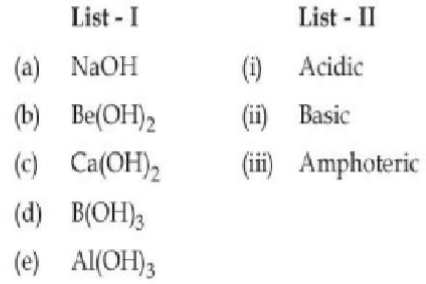
Match List - I with List - II : Choose the most appropriate answer from the options given
Let's determine the nature of each hydroxide in List-I. (a) NaOH: Sodium hydroxide is a classic strong alkali, a compound of a Group 1 metal. It is strongly Basic. So, (a) matches with (ii). (b) Be(OH) : Beryllium hydroxide is an exception in Group 2. Due to the small size and high charge density of Be , it is Amphoteric, meaning it can react with both acids and bases. So, (b) matches with (iii). (c) Ca(OH) : Calcium hydroxide (slaked lime) is a strong base, typical for a Group 2 metal hydroxide. So, (c) matches with (ii). (d) B(OH) : Boron hydroxide is better known as Boric Acid. It is a weak Lewis acid, accepting an OH ion from water rather than donating a proton. So, (d) matches with (i). (e) Al(OH) : Aluminium hydroxide is a well-known Amphoteric hydroxide, reacting with acids to form Al salts and with strong bases to form aluminates like [Al(OH) ] . So, (e) matches with (iii). The complete matching is: (a)-(ii), (b)-(iii), (c)-(ii), (d)-(i), (e)-(iii). This corresponds to options (B) and (C) which are identical in the provided image. We select (B).
33
PYQ 2021
medium
chemistryID: jee-main
The oxidation states of 'P' in , and , respectively, are :
1
6, 4 and 5
2
5, 4 and 3
3
5, 3 and 4
4
7, 5 and 6
Official Solution
Correct Option: (3)
We can determine the oxidation state (O.S.) of phosphorus (P) in each compound by assigning the standard oxidation states to oxygen (-2) and hydrogen (+1). Let the O.S. of P be x. 1. For (Pyrophosphoric acid):
The sum of oxidation states is zero.
. 2. For (Diphosphorous acid):
. 3. For (Hypophosphoric acid):
This acid contains a direct P-P bond. When using the algebraic method, it gives the average oxidation state.
.
(Drawing the structure (HO) (O)P-P(O)(OH) and assigning electronegativities confirms the +4 state for each P atom). The respective oxidation states are +5, +3, and +4. This corresponds to option (C).
34
PYQ 2023
medium
chemistryID: jee-main
For elements B, C, N, Li, Be, O and F, the correct order of first ionization enthalpy is:
1
2
3
4
Official Solution
Correct Option: (3)
The first ionization energy is the energy required to remove an electron from a neutral atom in its gaseous phase. The general trend for the first ionization energy is that it increases across a period (from left to right) and decreases down a group.
Thus, the order of first ionization enthalpy for the elements provided, starting from the lowest, is: Therefore, the correct order is given by option (3).
35
PYQ 2025
medium
chemistryID: jee-main
First ionisation enthalpy values of the first four group 15 elements are given below. Choose the correct value for the element that is a main component of the apatite family:
1
1012 ,
2
1402 ,
3
834 ,
4
947 ,
Official Solution
Correct Option: (1)
The apatite family is composed of minerals that are mainly made of phosphate ions, and one of the key elements in this family is phosphorus. Phosphorus is the element in Group 15, and its ionization enthalpy is . Hence, the correct value corresponds to the ionization enthalpy of phosphorus.
Thus, the correct answer is .
36
PYQ 2025
medium
chemistryID: jee-main
In group 17, which property does not follow the regular trend?
1
Electron affinity
2
Ionisation energy
3
Covalent radii
4
Ionic radii
Official Solution
Correct Option: (1)
In group 17 of the periodic table (the halogens), the properties generally follow a regular trend as you move down the group. However, one property does not follow this trend:
1. Electron Affinity: Electron affinity typically increases across a period (left to right), but in group 17, the electron affinity does not increase regularly down the group. Fluorine, for example, has a lower electron affinity than chlorine, which is an anomaly due to the smaller size of the fluorine atom, which results in repulsion between the added electron and the lone pairs of electrons in the valence shell. 2. Ionisation Energy: Ionisation energy generally decreases as you go down a group, but the trend is fairly regular. 3. Covalent Radii: The covalent radii increase as you go down group 17 in a regular fashion, as larger atoms with more electron shells form covalent bonds. 4. Ionic Radii: The ionic radii also follow a regular trend as you go down group 17, increasing with the number of electron shells. Thus, the correct answer is electron affinity, as it does not follow the regular trend in group 17.
37
PYQ 2025
hard
chemistryID: jee-main
The type of oxide formed by the element among Li, Na, Be, Mg, B and Al that has the least atomic radius is:
1
2
3
4
Official Solution
Correct Option: (1)
The atomic radius generally decreases across a period from left to right due to increasing nuclear charge. Among the elements given (Li, Na, Be, Mg, B, Al), the atomic radius decreases as we move across the period from Li to Al. The element that forms the oxide with the least atomic radius is Al (aluminum), which forms .
Thus, the correct answer is .
38
PYQ 2026
medium
chemistryID: jee-main
In a period, the first ionisation enthalpy of the element at extreme left and the negative electron gain enthalpy of the extreme right element, except noble gases, are respectively.
1
lowest and lowest
2
highest and lowest
3
lowest and highest
4
highest and highest
Official Solution
Correct Option: (3)
Concept:
Periodic trends across a period:
First ionisation enthalpy increases from left to right.
Electron gain enthalpy becomes more negative from left to right.
Step 1: {First ionisation enthalpy} Elements at extreme left (alkali metals) have the lowest ionisation enthalpy. Step 2: {Electron gain enthalpy} Elements at extreme right (halogens, excluding noble gases) have the most negative electron gain enthalpy. Thus it is the highest in magnitude. Therefore:
39
PYQ 2026
medium
chemistryID: jee-main
Statement I: The covalency of oxygen is generally two but it can exceed up to four. The oxidation state of oxygen in SO₂ is -2 and in OF₂ it is +2. Statement II: The anomalous behaviour of oxygen when compared to the other elements of group 16 is due to its small size and high electronegativity. In the light of the above statements, choose the correct answer:
1
Both Statement I and Statement II are true
2
Both Statement I and Statement II are false
3
Statement I is true but Statement II is false
4
Statement I is false but Statement II is true
Official Solution
Correct Option: (4)
Step 1: Understanding the Concept:
Covalency refers to the number of electron pairs shared by an atom. Oxygen belongs to the 2nd period and lacks d-orbitals, which limits its maximum covalency. Oxidation states are determined by electronegativity differences.
Step 2: Key Formula or Approach:
1. Check oxygen's covalency limits (Valence shell is , orbitals available: ).
2. Compare electronegativities of O, S, and F.
Step 3: Detailed Explanation:
1. Statement I analysis: Oxygen has only four valence orbitals ( and three ). Due to the absence of d-orbitals, its covalency rarely exceeds 2 and cannot exceed 4 (it is usually limited to 3 in hydronium ions, ). However, Statement I says it "can exceed up to four," which is incorrect. Oxidation states are correct (O is -2 in and +2 in because F is more electronegative). Since part of the statement is wrong, Statement I is false.
2. Statement II analysis: Oxygen shows anomalous behavior (like being a gas while others are solids, and forming H-bonds) strictly due to its high electronegativity, small size, and absence of d-orbitals. This is true.
Step 4: Final Answer:
Statement I is false, but Statement II is true.
40
PYQ 2026
easy
chemistryID: jee-main
A monoatomic anion (A⁻) has 45 neutrons and 36 electrons. Atomic mass, group in the periodic table and physical state at room temperature of the element (A) respectively are
1
80, 17, liquid
2
81, 16, solid
3
80, 16, gas
4
81, 15, gas
Official Solution
Correct Option: (1)
Step 1: Understanding the Concept:
A monoatomic anion is formed when a neutral atom gains one electron. Therefore, the number of protons in the neutral atom (Atomic Number, ) is one less than the number of electrons in the anion. Atomic mass ( ) is the sum of protons and neutrons.
Step 2: Key Formula or Approach:
1. Atomic Number ( ) = (Electrons in ) - 1.
2. Atomic Mass ( ) = + Neutrons.
3. Use to identify the element and its group.
Step 3: Detailed Explanation:
1. Find Protons: . The element with is Bromine (Br).
2. Find Atomic Mass: .
3. Periodic Table Position: Bromine belongs to Group 17 (Halogens).
4. Physical State: Bromine is the only non-metal that is a liquid at room temperature.
Step 4: Final Answer:
The values are 80, 17, and liquid.
41
PYQ 2026
medium
chemistryID: jee-main
Given below are two statements: Statement I: The second ionization enthalpy of B, Al and Ga is in the order of B>Al>Ga.
Statement II: The correct order in terms of first ionization enthalpy is Si
In light of the above statements, choose the correct answer from the options given below:
1
Both Statement I and Statement II are true.
2
Both Statement I and Statement II are false.
3
Statement I is true but Statement II is false.
4
Statement I is false but Statement II is true.
Official Solution
Correct Option: (3)
Statement I is correct. The second ionization enthalpy of elements generally increases across a period, and for B, Al, and Ga, the second ionization enthalpy follows the order B>Al>Ga.
Statement II is false. The correct order in terms of first ionization enthalpy is SiFinal Answer: (C) Statement I is true but Statement II is false.
42
PYQ 2026
medium
chemistryID: jee-main
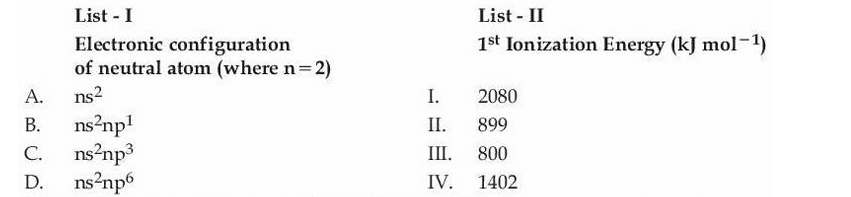
Match List-I with List-II.
1
A-II, B-III, C-IV, D-I
2
A-IV, B-III, C-II, D-I
3
A-III, B-II, C-IV, D-I
4
A-III, B-II, C-I, D-IV
Official Solution
Correct Option: (1)
Step 1: Understanding the Concept:
Ionization energy generally increases across a period (left to right) but shows anomalies at half-filled ( ) and fully-filled ( ) subshells due to extra stability. Step 2: Detailed Explanation:
For (Period 2 elements):
1. D (ns²np⁶): Neon (Noble gas). Highest IE due to stable octet 2080 (I).
2. C (ns²np³): Nitrogen. High IE due to half-filled p-orbital 1402 (IV).
3. A (ns²): Beryllium. Higher than Boron due to fully-filled s-orbital penetration 899 (II).
4. B (ns²np¹): Boron. Lower than Beryllium 800 (III). Step 3: Final Answer:
A-II, B-III, C-IV, D-I.
43
PYQ 2026
medium
chemistryID: jee-main
Given below are two statements: Statement (I): The first ionisation enthalpy of the elements Na, Mg, Cl and Ar follows the order
Statement (II): Among Ca, Al, Fe and B, the third ionisation enthalpy is very high for Ca. In the light of the above statements, choose the correct answer from the options given below:
1
Both Statement I and Statement II are true
2
Both Statement I and Statement II are false
3
Statement I is true but Statement II is false
4
Statement I is false but Statement II is true
Official Solution
Correct Option: (4)
Concept: Ionisation enthalpy generally increases across a period due to increasing effective nuclear charge. Step 1:Check Statement I} Across period 3: Thus the correct increasing order is: But the statement gives the reverse order. Hence Statement I is false. Step 2:Check Statement II} Electronic configurations: After removal of two electrons: The third electron would be removed from a noble gas configuration. Thus the third ionisation enthalpy is very high. Hence Statement II is true.
44
PYQ 2026
medium
chemistryID: jee-main
Correct statements from the following are: A. Nitrogen in oxidation states from to disproportionates in acid medium. B. Nitrogen has the ability to form multiple bonds with itself and other elements with small size and high electronegativity. C. N-N single bond is stronger than P-P single bond. D. Nitrogen has highest density in its group due to small size. E. The maximum covalency of nitrogen is four since it has only four valence orbitals for bonding.
1
B, C and D Only
2
C, D and E Only
3
A, C and E Only
4
A and E Only
Official Solution
Correct Option: (4)
Step 1: Understanding the Question: The question asks to identify correct statements regarding the chemical and physical properties of Nitrogen. Step 2: Detailed Explanation: Statement A: In acidic medium, nitrogen species in intermediate oxidation states ( to ) are unstable and disproportionate (e.g., ). Correct. Statement B: Nitrogen belongs to the 2nd period and lacks d-orbitals. It forms multiple bonds, not . Incorrect. Statement C: The N-N single bond is weaker than the P-P single bond because of high inter-electronic repulsion between non-bonding electrons in the small N atom. Incorrect. Statement D: Density generally increases down the group in the periodic table. Nitrogen, being the first member, has the lowest density in Group 15. Incorrect. Statement E: Nitrogen has only four orbitals in its valence shell ( ). It cannot expand its octet, so its maximum covalency is four. Correct. Step 3: Final Answer: Statements A and E are correct.
45
PYQ 2026
medium
chemistryID: jee-main
Given below are two statements: Statement I: The correct order of electronegativity of fluorine, oxygen and nitrogen is . Statement II: The oxidation state of oxygen in is and in is .
1
Both Statement I and Statement II are true
2
Both Statement I and Statement II are false
3
Statement I is true but Statement II is false
4
Statement I is false but Statement II is true
Official Solution
Correct Option: (1)
Step 1: Understanding the Question: The question tests knowledge of periodic trends (electronegativity) and oxidation state calculation rules. Step 2: Detailed Explanation: Statement I: Electronegativity increases across a period from left to right. Nitrogen, Oxygen, and Fluorine are in the same period. Their values on the Pauling scale are approximately . Therefore, the order is correct. Statement II: In , fluorine is more electronegative than oxygen ( vs ). Fluorine is always assigned . Let oxidation state of O be : . In , sodium is a group 1 metal with an oxidation state of . Let oxidation state of O be : . Thus, Statement II is correct. Step 3: Final Answer: Both statements are true.
46
PYQ 2026
medium
chemistryID: jee-main
The oxidation state of chromium in the final product formed in the reaction between KI and acidified solution is:
1
+3
2
+6
3
+2
4
+4
Official Solution
Correct Option: (1)
Acidified dichromate ( , Cr is ) acts as a strong oxidizing agent. It oxidizes to , and is itself reduced. The balanced ionic reaction in acidic medium is: . The final product containing chromium is . The oxidation state of chromium is .
47
PYQ 2026
medium
chemistryID: jee-main
The electronegativity of a group 13 element 'E' is same as that of Ge (on Pauling scale and upto one decimal point). The CORRECT statements about are:
A. It can act as a reducing agent.
B. It can act as an oxidizing agent.
C. is more stable than .
D. The standard electrode potential value for is positive.
Choose the correct answer from the options given below:
1
A and C Only
2
B and C Only
3
B and D Only
4
A and D Only
Official Solution
Correct Option: (3)
Step 1: Understanding the Concept:
Electronegativities in Group 13 show an unusual trend: B(2.0), Al(1.5), Ga(1.6), In(1.7), Tl(1.8). Germanium (Ge) has an electronegativity of 1.8. Thus, element 'E' is Thallium (Tl).
Step 2: Key Formula or Approach:
Inert pair effect: For heavy p-block elements (like Tl), the +1 oxidation state is more stable than the +3 state because the s-electrons are reluctant to participate in bonding.
Step 3: Detailed Explanation:
Identify E = Tl.
- (C) False: For Tl, is more stable than due to inert pair effect.
- (B) True: Since is unstable, it readily gains 2 electrons to become , acting as a strong oxidizing agent.
- (A) False: Reducing agents lose electrons. won't lose more easily.
- (D) True: Standard reduction potentials for or are positive, indicating spontaneous reduction.
Therefore, B and D are correct.
Step 4: Final Answer:
Statements B and D are correct.
48
PYQ 2026
medium
chemistryID: jee-main
Pairs of elements with the same number of electrons in their respective 4f orbital are
[Atomic number: Eu-63, Gd-64, Dy-66, Ho-67, Tm-69, Yb-70, Lu-71, Hf-72]
A. (Eu and Gd)
B. (Dy and Ho)
C. (Yb and Hf)
D. (Lu and Tm)
Choose the correct answer from the options given below:
1
B and C Only
2
A and B Only
3
A and D Only
4
A and C Only
Official Solution
Correct Option: (4)
Step 1: Understanding the Concept:
The electronic configurations of lanthanides follow the filling. Half-filled ( ) and fully-filled ( ) shells provide extra stability. In Gd and Lu, an electron is placed in the orbital instead of to preserve this stability.
Step 2: Key Formula or Approach:
Write general configuration: . Determine for each element.
Step 3: Detailed Explanation:
- Eu (63): . (f electrons = 7)
- Gd (64): . (f electrons = 7). A is a match.
- Dy (66): . (f electrons = 10)
- Ho (67): . (f electrons = 11). B is not a match.
- Tm (69): . (f electrons = 13)
- Yb (70): . (f electrons = 14)
- Lu (71): . (f electrons = 14)
- Hf (72): . (f electrons = 14). C is a match (Yb and Hf).
Comparing pairs: A matches (7 each) and C matches (14 each).
Step 4: Final Answer:
Pairs A and C have the same number of 4f electrons.
49
PYQ 2026
medium
chemistryID: jee-main
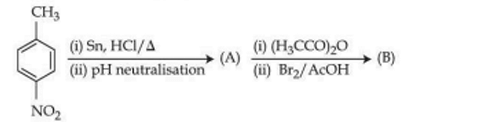
Consider the following sequence of reactions: 4-nitrotoluene Assuming that the reaction proceeds to completion, then 137 mg of 4-nitrotoluene will produce_______ mg of B. (Given molar mass in g mol⁻¹ H: 1, C: 12, N: 14, O: 16, Br: 80)}
1
301
2
208
3
228
4
146
Official Solution
Correct Option: (3)
Step 1: Understanding the Concept:
This is a sequence of functional group transformations: reduction of a nitro group, acetylation of the resulting amine, and electrophilic aromatic substitution (bromination).
Step 2: Key Formula or Approach:
1. Sn/HCl reduces to .
2. converts to (A: 4-methylacetanilide).
3. brominates the ring ortho to the activating acetamido group (B: 2-bromo-4-methylacetanilide). Step 3: Detailed Explanation:
- Molar mass of 4-Nitrotoluene ( ): g/mol.
- Molar mass of B ( ): g/mol.
- Since the stoichiometry is 1:1 throughout the sequence:
- 137 mg of reactant (1 mmol) will produce 1 mmol of product B.
- Mass of B mg. Step 4: Final Answer:
The mass of B produced is 228 mg.
50
PYQ 2026
medium
chemistryID: jee-main
Given below are two statements: Statement I: The second ionisation enthalpy of Na is larger than the corresponding ionisation enthalpy of Mg. Statement II: The ionic radius of is larger than that of .}
1
Statement I is true but Statement II is false
2
Statement I is false but Statement II is true
3
Both Statement I and Statement II are true
4
Both Statement I and Statement II are false
Official Solution
Correct Option: (3)
Statement I: involves removing an electron from the stable noble gas configuration ( ). involves removing a electron from . . True. Statement II: (Z=8) and (Z=9) are isoelectronic (10 electrons). Ionic radius decreases as effective nuclear charge ( ) increases. Since , . True.
51
PYQ 2026
medium
chemistryID: jee-main
Elements X and Y belong to Group 15. The difference between the electronegativity values of 'X' and phosphorus is higher than that of the difference between phosphorus and 'Y'. 'X' & 'Y' are respectively
1
As & Bi
2
Bi & N
3
As & Sb
4
N & As
Official Solution
Correct Option: (4)
Group 15 elements: N, P, As, Sb, Bi. Electronegativity (EN) decreases down the group. We require . The largest change in EN in a group often occurs between the first two members (N and P). Test X=N, Y=As (Option D). : Difference between 2nd and 3rd period element. (Large jump). : Difference between 3rd and 4th period element. (Smaller jump). Since , the condition holds true.
52
PYQ 2026
medium
chemistryID: jee-main
Regarding the hydrides of group 15 elements ,
select the correct statement(s): [A.] The stability of hydrides decreases down the group.
[B.] The basicity of hydrides decreases down the group.
[C.] The reducing character increases down the group.
[D.] The boiling point increases down the group. Choose the correct answer:
1
A, B, C & D
2
A, B & C only
3
B & C only
4
A & D only
Official Solution
Correct Option: (1)
Concept: Down group 15, atomic size increases and E–H bond strength decreases, influencing stability,
basicity, reducing nature, and boiling point. Step 1: Stability of hydrides Due to decreasing E–H bond strength down the group. Statement A is true. Step 2: Basicity of hydrides Basicity depends on availability of the lone pair.
As size increases, the lone pair becomes less available. Statement B is true. Step 3: Reducing character Reducing character increases as E–H bond weakens down the group. Statement C is true. Step 4: Boiling point Although shows hydrogen bonding anomaly, overall boiling point increases
down the group due to increased molar mass. Statement D is true. Final Conclusion:
53
PYQ 2026
medium
chemistryID: jee-main
``X'' is an oxoanion of the lightest element of group 17 (in the periodic table). The metal is in +6 oxidation state in ``X''. The color of the potassium salt of X is
1
purple
2
green
3
orange
4
yellow
Official Solution
Correct Option: (2)
Step 1: Identification of the element. The lightest element of group 17 is chlorine. An oxoanion of chlorine in which the oxidation state of chlorine is +6 corresponds to the chlorate ion (ClO ). Step 2: Potassium salt of the oxoanion. The potassium salt of chlorate is potassium chlorate (KClO ). Potassium chlorate is known to appear greenish in crystalline form under standard conditions. Step 3: Conclusion. Hence, the correct color of the potassium salt of X is green.
54
PYQ 2026
medium
chemistryID: jee-main
Choose the INCORRECT statement
1
Carbon exhibits negative oxidation states along with +4 and +2.
2
CO is the most acidic oxide among the dioxides of group 14 elements.
3
Among the isotopes of carbon, C is a radioactive isotope.
4
Carbon cannot exceed its covalency more than four.
Official Solution
Correct Option: (3)
Step 1: Checking statement (A). Carbon shows negative oxidation states (–4 in CH ) as well as positive oxidation states like +2 (CO) and +4 (CO ). Hence, this statement is correct. Step 2: Checking statement (B). Among group 14 dioxides, CO is the most acidic due to its small size and high electronegativity of carbon. Therefore, this statement is correct. Step 3: Checking statement (C). C is a stable isotope of carbon. The radioactive isotope of carbon is C. Hence, this statement is incorrect. Step 4: Checking statement (D). Carbon does not have vacant d-orbitals and cannot expand its octet, so its maximum covalency is four. This statement is correct. Step 5: Conclusion. The incorrect statement is option (C).