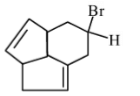
The number of stereoisomers possible for 1,2-dimethyl cyclopropane is :
1
One
2
Two
3
Three
4
Four
Official Solution
Correct Option: (3)
Step 1: Understanding the Question
We need to find the total number of stereoisomers for the molecule 1,2-dimethylcyclopropane.
Stereoisomers include both geometrical isomers (cis/trans) and optical isomers
(enantiomers/diastereomers). Step 2: Identifying Geometrical Isomers
1,2-dimethylcyclopropane can exist as two different geometrical isomers based on the relative positions of the two methyl groups with respect to the plane of the cyclopropane ring. Cis isomer: Both methyl groups are on the same side of the ring (both pointing up or both pointing down). Trans isomer: The methyl groups are on opposite sides of the ring (one pointing up, one pointing down). Step 3: Analyzing for Chirality (Optical Isomerism)
Now, we need to check if these geometrical isomers are chiral. A molecule is chiral if it is non-superimposable on its mirror image. A quick way to check is to look for a plane of symmetry. Cis-1,2-dimethylcyclopropane: This molecule has a plane of symmetry that passes through the C3 atom and bisects the C1-C2 bond. Due to this symmetry, the molecule is achiral, even though it has two chiral centers. Such a compound is called a meso compound. A meso compound is a single stereoisomer. Number of stereoisomers from the cis form = 1. Trans-1,2-dimethylcyclopropane: This molecule does not have any plane of symmetry. Therefore, it is chiral. A chiral molecule and its non-superimposable mirror image form a pair of enantiomers. Number of stereoisomers from the trans form = 2 (the pair of enantiomers). Step 4: Calculating the Total Number of Stereoisomers
The total number of stereoisomers is the sum of all distinct forms.
Total isomers = (Isomers from cis form) + (Isomers from trans form)
Total isomers = 1 (meso compound) + 2 (enantiomeric pair) = 3.
02
PYQ 2021
medium
chemistryID: jee-main
The dihedral angle in staggered form of 1,1,1-Trichloro ethane is ________ degree. (Round off to the Nearest Integer).
Official Solution
Correct Option: (1)
The molecule is 1,1,1-trichloroethane, which has the chemical formula CH -CCl . We are considering the rotation around the C-C single bond. To visualize the dihedral angle, we use a Newman projection. Let's place the CH group in the front and the CCl group in the back.
- The front carbon has three hydrogen atoms attached.
- The back carbon has three chlorine atoms attached. There are two main conformations: eclipsed and staggered.
- In the eclipsed conformation, the substituents on the back carbon are directly behind the substituents on the front carbon. The dihedral angle between a front C-H bond and a back C-Cl bond is 0 .
- In the staggered conformation, the substituents on the back carbon are positioned exactly in the middle of the substituents on the front carbon to minimize steric repulsion. This is the most stable conformation. In this staggered arrangement, the angle between any C-H bond on the front carbon and the nearest C-Cl bond on the back carbon is 60 . This is the dihedral angle. Therefore, the dihedral angle in the staggered form of 1,1,1-trichloroethane is 60 degrees.
03
PYQ 2024
medium
chemistryID: jee-main
Official Solution
Correct Option: (1)
When 2-chlorobutane reacts with chlorine (Cl2) under light (Cl2/hv), multiple isomers of C4H8Cl2 are formed due to the possible substitution of hydrogen atoms by chlorine at different positions.
To determine the number of optically active isomers, we follow this approach:
The reaction yields several structural isomers of C4H8Cl2 depending on the position where chlorine substitutes. Some of these isomers exhibit chirality due to the presence of chiral centers (carbon atoms bonded to four different groups).
Among the possible isomers, six have chiral centers, making them optically active. These isomers can exist as enantiomers (mirror-image pairs), further contributing to their optical activity.
The total number of optically active isomers formed in this reaction is 6.
04
PYQ 2024
medium
chemistryID: jee-main
Total number of optically active compounds from the following is _______.
Official Solution
Correct Option: (1)
Optical activity refers to molecules that have a chiral center (at least one) and have a non-superimposable mirror image.
For example, consider the molecule shown below:
$ $ (Chiral center - optically active)
The chiral center is the carbon atom bonded to four different substituents, which makes it optically active. This means that the molecule can rotate plane-polarized light.
05
PYQ 2024
medium
chemistryID: jee-main
Number of optical isomers possible for 2 ā chlorobutane ________
Official Solution
Correct Option: (1)
The problem asks for the total number of possible optical isomers for the compound 2-chlorobutane.
Concept Used:
Optical isomers, also known as stereoisomers, are compounds that have the same chemical formula and connectivity but differ in the spatial arrangement of their atoms. The number of possible optical isomers for a molecule can be determined by identifying its chiral centers.
A chiral center (or stereocenter) is a carbon atom that is bonded to four different atoms or groups of atoms. A molecule with one or more chiral centers and no plane of symmetry is chiral and will have optical isomers.
The maximum number of possible stereoisomers for a molecule with 'n' chiral centers is given by the formula:
This formula applies when the molecule is unsymmetrical (i.e., it does not contain a plane of symmetry that would create meso compounds).
Step-by-Step Solution:
Step 1: Draw the structure of 2-chlorobutane.
The chemical formula for 2-chlorobutane is CāHāCl. The structure is:
Step 2: Identify any chiral centers in the molecule.
We need to examine each carbon atom in the chain to see if it is bonded to four different groups.
Carbon-1 (C1): This is a CHā group, bonded to three identical hydrogen atoms. It is not a chiral center.
Carbon-2 (C2): This is a CH(Cl) group. Let's look at the four groups attached to it:
A hydrogen atom (āH)
A chlorine atom (āCl)
A methyl group (āCHā)
An ethyl group (āCHāCHā)
Since all four groups are different, Carbon-2 is a chiral center.
Carbon-3 (C3): This is a CHā group, bonded to two identical hydrogen atoms. It is not a chiral center.
Carbon-4 (C4): This is a CHā group, bonded to three identical hydrogen atoms. It is not a chiral center.
The molecule has only one chiral center (n = 1).
Step 3: Calculate the number of optical isomers using the 2āæ rule.
With n = 1 chiral center, the number of possible optical isomers is:
Final Result:
The two possible optical isomers are a pair of enantiomers (non-superimposable mirror images), which are (R)-2-chlorobutane and (S)-2-chlorobutane. Therefore, the number of optical isomers possible for 2-chlorobutane is 2.
06
PYQ 2024
medium
chemistryID: jee-main
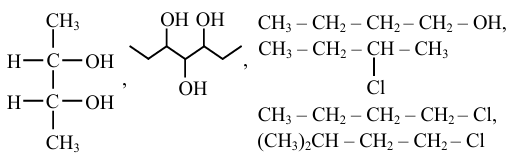
Total number of compounds with Chiral carbon atoms from following is ________.
Official Solution
Correct Option: (1)
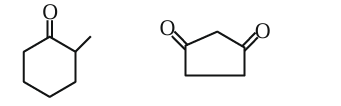
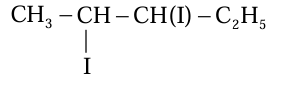
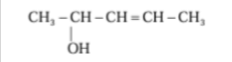
To determine the number of compounds with chiral carbon atoms, we analyze each given compound for chirality. A carbon is chiral if it has four different substituents. We'll examine each compound for such carbons:
The third carbon ( ) is attached to , , , and . This is a chiral center.
The third carbon ( ) is attached to , , , and . It's symmetric, thus not chiral.
The second carbon ( ) is attached to , , , and . This is a chiral center.
The third carbon ( ) is attached to , , , and . This is a chiral center.
The total number of compounds with chiral carbons is 5.
07
PYQ 2025
medium
chemistryID: jee-main
How many different stereoisomers are possible for the given molecule?
1
3
2
1
3
2
4
4
Official Solution
Correct Option: (4)
To determine the number of different stereoisomers for a given molecule, we must first understand the elements contributing to stereoisomerism. These typically include:
Chiral Centers: A chiral center is usually a carbon atom bonded to four different groups. Each chiral center can exist in two configurations (R or S).
Double Bonds: Specifically, carbon-carbon double bonds can give rise to cis and trans (or E/Z) isomerism if each carbon in the double bond has two different groups attached.
The total number of stereoisomers is calculated using the formula: 2n, where n equals the number of stereocenters (chiral centers + independent double bonds contributing to geometric isomerism).
Now, let's apply this to the problem:
1. **Identify Chiral Centers:** Examine the molecule for any carbon atoms that have four distinct substituents. Assume the molecule in the image has two chiral centers.
2. **Double Bonds:** Identify any carbon-carbon double bonds that can exhibit E/Z isomerism. Assume there are no such double bonds here.
3. **Calculate Total Stereoisomers:** Using the formula, where n = 2 for the chiral centers: 22 = 4
Therefore, the total number of different stereoisomers possible for this molecule is 4.
08
PYQ 2025
medium
chemistryID: jee-main
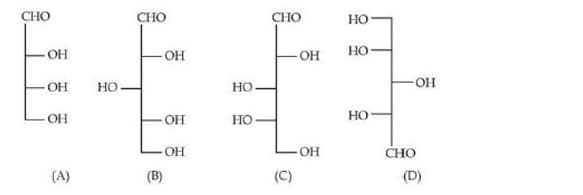
Identify the number of structure/s from the following which can be correlated to D-glyceraldehyde.
1
four
2
three
3
two
4
one
Official Solution
Correct Option: (3)
D-glyceraldehyde is the simplest monosaccharide with one chiral center. It is a three-carbon aldose with the following structural formula: Among the given structures:
- Structure (A) represents D-glyceraldehyde itself, as it matches the formula and configuration of D-glyceraldehyde.
- Structure (B) is an isomer, and the configuration matches that of D-glyceraldehyde.
- Structures (C) and (D) do not correlate to D-glyceraldehyde because they do not maintain the correct stereochemistry at the chiral center.
Thus, only two of the given structures (A) and (B) can be correlated to D-glyceraldehyde.
09
PYQ 2025
medium
chemistryID: jee-main
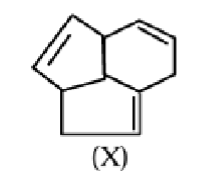
Consider the following molecule (X).
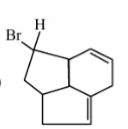
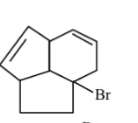
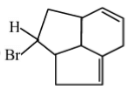
The Structure X is?
1
2
3
4
Official Solution
Correct Option: (2)
The given molecule (X) visually appears to have a bicyclic structure with two fused rings. It consists of one five-membered ring fused with a six-membered ring. Let's analyze the structure and find the correct identification.
Step-by-Step Solution:
Observe that the structure is a fused bicyclic ring system where one ring is five-membered and the other is six-membered.
This particular arrangement is characteristic of indene, a hydrocarbon which is commonly seen in organic chemistry.
Indene consists of a benzene ring fused to a cyclopentene ring.
Comparing the structure of (X) with the options provided, we identify that the second option matches the characteristics of indene.
Hence, the structure (X) is Indene.
The correct answer is option 2, which correctly represents the structure of indene.
This identification relies on recognizing the common fused ring systems and their structural characteristics in organic chemistry.
10
PYQ 2026
easy
chemistryID: jee-main
Heat of atomisation of CH (g) and C H (g) are kJ/mol and kJ/mol respectively. Find the maximum wavelength of photon required to dissociate CāC bond in C H .
1
2
3
4
Official Solution
Correct Option: (4)
Step 1: Write atomisation reactions.
Step 2: Express bond energies.
Step 3: Eliminate .}
Step 4: Convert bond energy to photon wavelength. Energy per mole =
Rewriting:
11
PYQ 2026
medium
chemistryID: jee-main
The heat of atomisation of methane and ethane are kJ mol and kJ mol respectively. The longest wavelength ( ) of light capable of breaking the CāC bond can be expressed in SI unit as:
1
2
3
4
Official Solution
Correct Option: (4)
Step 1: Bond energy concept. Heat of atomisation of methane gives CāH bond energy, while that of ethane includes both CāH and one CāC bond. Step 2: Extracting CāC bond energy. Ethane has 6 CāH bonds and 1 CāC bond. Hence CāC bond energy is proportional to . Step 3: Relation between energy and wavelength.