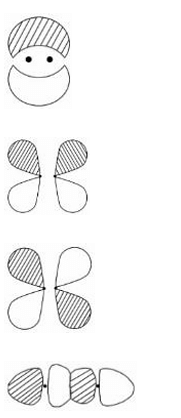
Which of the following pair of ions have equal number of unpaired electrons?
1
and
2
and
3
and
4
and
Official Solution
Correct Option: (2)
To determine the number of unpaired electrons, we must first write the electron configuration of the ions: - V (Vanadium ): The electron configuration of is . For , it loses two electrons, so the configuration is , meaning there are 3 unpaired electrons. - Ni (Nickel ): The electron configuration of is . For , it loses two electrons, so the configuration is , meaning there are 2 unpaired electrons. - Cr (Chromium ): The electron configuration of is . For , it loses two electrons, so the configuration is , meaning there are 4 unpaired electrons. - Mn (Manganese ): The electron configuration of is . For , it loses two electrons, so the configuration is , meaning there are 5 unpaired electrons. - Fe (Iron ): The electron configuration of is . For , it loses two electrons, so the configuration is , meaning there are 4 unpaired electrons. - Sc (Scandium ): The electron configuration of is . For , it loses two electrons, so the configuration is , meaning there is 1 unpaired electron. - Mn (Manganese ): The electron configuration of is . For , it loses three electrons, so the configuration is , meaning there are 4 unpaired electrons. - Fe (Iron ): The electron configuration for was previously calculated as , and there are 4 unpaired electrons. Comparing the number of unpaired electrons: - Cr (4 unpaired electrons) and Mn (5 unpaired electrons) do not match in the number of unpaired electrons. Thus, the correct pair with equal unpaired electrons is option (2) and .
02
PYQ 2025
medium
chemistryID: jee-main
Niobium (Nb) and ruthenium (Ru) have "x" and "y" number of electrons in their respective 4d orbitals. The value of is:
Official Solution
Correct Option: (1)
To solve for , where and are the number of electrons in the 4d orbitals of niobium (Nb) and ruthenium (Ru), respectively, we need to refer to the electron configurations of these elements:
Niobium (Nb): The atomic number of Nb is 41. Its electron configuration is . Thus, Nb has 4 electrons in its 4d orbital ( ).
Ruthenium (Ru): The atomic number of Ru is 44. Its electron configuration is . Therefore, Ru has 7 electrons in its 4d orbital ( ).
Now, compute :
Check that the sum falls within the specified range , confirming that our computed value is correct.
Therefore, the value of is 11.
03
PYQ 2026
medium
chemistryID: jee-main
Which of the following is correct set of 4 quantum numbers of 19th electron in Chromium (Atomic number = 24) in accordance with Aufbau principle?
1
2
3
4
Official Solution
Correct Option: (4)
Step 1: Understanding the Concept:
The Aufbau principle states that electrons fill orbitals in order of increasing energy. The order is: 1s, 2s, 2p, 3s, 3p, 4s, 3d, etc. We must count to the 19th electron following this sequence.
Step 2: Key Formula or Approach:
1. Electron 1-2: 1s orbital
2. Electron 3-4: 2s orbital
3. Electron 5-10: 2p orbitals
4. Electron 11-12: 3s orbital
5. Electron 13-18: 3p orbitals (Ar configuration)
6. Electron 19: 4s orbital (starts the K shell/4th period)
Step 3: Detailed Explanation:
1. The 18th electron completes the subshell.
2. According to the rule, the next orbital to be filled is ( ), because is less than (for ).
3. Therefore, the 19th electron enters the orbital.
4. Quantum numbers for 4s: , , , .
Step 4: Final Answer:
The correct set is .
04
PYQ 2026
medium
chemistryID: jee-main
Which of the following statement(s) is/are true?
A. If two orbitals have the same value of , the orbital with lower value of will have lower energy.
B. Energies of the orbitals in the same subshell increase with increase in atomic number.
C. The size of orbital is less than the size of orbital.
D. Among 5f, 6s, 4d, 5p and 5d orbitals, none of the orbitals have 2 radial nodes.
Choose the correct answer from the options given below :
1
A, B and C only
2
A and C only
3
C and D only
4
A only
Official Solution
Correct Option: (2)
Step 1: Understanding the Concept:
This question tests fundamental principles of atomic structure, specifically the rule for orbital energy, orbital sizes, and the calculation of radial nodes. Step 2: Detailed Explanation: Statement A: This is the Aufbau principle's rule. If two orbitals have the same value, the one with the lower principal quantum number ( ) is lower in energy (e.g., 3d has and 4p has , but 3d is filled first). This is True.
Statement B: As the atomic number ( ) increases, the effective nuclear charge increases. This causes the orbital to be attracted more strongly toward the nucleus, which actually decreases the energy (makes it more negative). Thus, the statement is False.
Statement C: Orbital size is primarily determined by the principal quantum number . Higher means the electron is likely further from the nucleus. Since for and for , is larger. This is True.
Statement D: Radial nodes are calculated as .
5f: .
6s: .
4d: .
5p: .
5d: .
Since the 5d orbital does have 2 radial nodes, the statement "none of the orbitals have 2 radial nodes" is False. Step 3: Final Answer:
Statements A and C are correct. Therefore, the answer is Option (B).
05
PYQ 2026
medium
chemistryID: jee-main
Arrange the following atomic orbitals of multi electron atoms in order of increasing energy. A. B. C. D. E.
1
2
3
4
Official Solution
Correct Option: (4)
Step 1: Understanding the Question: In multi-electron atoms, the energy of an orbital depends on both the principal quantum number ( ) and the azimuthal quantum number ( ). The sequence is determined by the Bohr-Bury rule ( rule). Step 2: Key Formula or Approach: 1. Orbitals with lower values have lower energy. 2. If two orbitals have the same value, the one with the lower value has lower energy. Step 3: Detailed Explanation: Let's calculate for each orbital: A. (3d orbital) B. (4s orbital) C. (6p orbital) D. (5p orbital) E. (2p orbital) Now, sort the orbitals by their values: E (3) B (4) A (5) D (6) C (7). There are no ties in value in this set, so the order is straightforward. Step 4: Final Answer: The increasing order of energy is .
06
PYQ 2026
medium
chemistryID: jee-main
Which of the following pictorial diagram most correctly represents the ( - antibonding) molecular orbital between two atoms if the internuclear axis is taken to be in the z-direction ( )?}
1
1
2
2
3
3
4
4
Official Solution
Correct Option: (3)
Step 1: Understanding the Concept:
Molecular orbitals form by the overlap of atomic orbitals. - orbitals form by lateral (sideways) overlap. Bonding orbitals have constructive interference, while antibonding orbitals have destructive interference, resulting in a nodal plane between the two nuclei.
Step 2: Key Formula or Approach:
Identify the characteristics of MO:
1. Lateral overlap of p-orbitals.
2. Destructive overlap results in a nodal plane perpendicular to the internuclear axis.
3. Opposite phases are adjacent across the vertical node.
Step 3: Detailed Explanation:
Looking at the provided diagrams:
- Diagram (A) shows side-on constructive overlap (bonding ).
- Diagram (B) shows end-on destructive overlap (antibonding ).
- Diagram (C) shows lateral p-orbitals with opposite phases ( and ) adjacent to each other across a nodal plane between the atoms. This is the hallmark of a orbital.
- Diagram (D) shows a different sigma overlap.
Step 4: Final Answer:
Diagram (C) correctly represents the molecular orbital.
07
PYQ 2026
medium
chemistryID: jee-main
Energy of first Balmer line of H-atom is kJ. The energy of the second Balmer line of H-atom is _____
1
2
1.35
3
2
4
Official Solution
Correct Option: (2)
Step 1: Energy of the Balmer series. The energy of each line in the Balmer series for hydrogen can be given by the Rydberg formula. The energy for the first line (n=3 to n=2) and the second line (n=4 to n=2) are related. Step 2: Energy ratio. The energy of the second Balmer line will be higher than the first. The ratio of the energies for the first and second lines can be calculated based on the Rydberg equation, which gives approximately a factor of 1.35 times. Step 3: Conclusion. Thus, the energy of the second Balmer line is 1.35 times that of the first. Final Answer: