Identify the essential amino acids from below: (A) Valine (B) Proline (C) Lysine (D) Threonine (E) Tyrosine
Choose the correct answer from the options given below:
1
(A), (C) and (D) only
2
(A), (C) and (E) only
3
(B), (C) and (E) only
4
(C), (D) and (E) only
Official Solution
Correct Option: (1)
Essential amino acids are those that cannot be synthesized by the human body and must be obtained through the diet. Among the amino acids listed: -Valine (A) is an essential amino acid. - Proline (B) is a non-essential amino acid, as the body can synthesize it. - Lysine (C) is an essential amino acid. - Threonine (D) is an essential amino acid. - Tyrosine (E) is a non-essential amino acid because it can be synthesized from phenylalanine, which is essential. Thus, the essential amino acids are Valine, Lysine, and Threonine, making the correct answer (1).
02
PYQ 2025
medium
chemistryID: jee-main
Given below are two statements :
Statement (I) : On hydrolysis, oligo peptides give rise to fewer number of -amino acids while proteins give rise to a large number of -amino acids.
Statement (II) : Natural proteins are denatured by acids which convert the water soluble form of fibrous proteins to their water insoluble form.
In the light of the above statements, choose the most appropriate answer from the options given below :
1
Both statement I and statement II are correct
2
Statement I is incorrect but Statement II is correct
3
Both statement I and statement II are incorrect
4
Statement I is correct but Statement II is incorrect
Official Solution
Correct Option: (3)
The given question presents two statements regarding peptides and proteins, and we need to evaluate their correctness based on our understanding of chemistry. Let's examine each statement:
Statement (I): "On hydrolysis, oligopeptides give rise to fewer number of \alpha -amino acids while proteins give rise to a large number of \beta -amino acids."
Explanation: Oligopeptides are short chains of amino acids, typically containing 2 to 20 amino acid residues. Upon hydrolysis, they release the amino acids from which they are constituted. Both oligopeptides and proteins, when fully hydrolyzed, yield \alpha -amino acids, not \beta -amino acids. \beta -amino acids are seldom involved in the structure of natural proteins and peptides.
Conclusion: This statement is incorrect because both oligopeptides and proteins give rise to \alpha -amino acids upon hydrolysis.
Statement (II): "Natural proteins are denatured by acids which convert the water-soluble form of fibrous proteins to their water-insoluble form."
Explanation: Denaturation of proteins is a process where proteins lose their native structure and bioactivity due to external stress or compounds, leading to the unfolding of their three-dimensional structure. Acids can indeed cause denaturation. However, the focus of the statement on fibrous proteins becoming water-insoluble is misleading. Generally, denaturation by acids makes proteins less soluble in water, not specifically tailored to fibrous proteins. In fact, fibrous proteins (e.g., collagen, keratin) are typically already insoluble in water due to their structural characteristics.
Conclusion: This statement is misleading and incorrect because it overgeneralizes the effect of acids specifically on fibrous proteins regarding solubility.
Given the evaluations above, both Statement I and Statement II are incorrect. Therefore, the correct answer is: Both statement I and statement II are incorrect.
03
PYQ 2026
medium
chemistryID: jee-main
Identify the correct pair having amino acid (A) and the hormone (B) that is iodinated derivative of the amino acid (A).} Choose the correct answer from the options given below:
1
T - Insulin
2
T - Thyroxine
3
Y - Thyroxine
4
Y - Insulin
Official Solution
Correct Option: (3)
In this question, we are asked to identify the correct pair of amino acid (A) and hormone (B) where the hormone is an iodinated derivative of the amino acid. 1. Amino acid and hormone relationship: - The amino acids are the building blocks of proteins, and certain amino acids also serve as precursors to hormones. Some hormones, particularly thyroid hormones, are derived from amino acids and undergo iodination, which is the addition of iodine atoms to the structure. 2. Thyroxine (T): - The iodinated derivative of the amino acid tyrosine is thyroxine (T). Thyroxine is a hormone produced by the thyroid gland, and it plays an essential role in regulating metabolism and growth. - The chemical structure of thyroxine is derived from the amino acid tyrosine, with iodine atoms added to it. Hence, tyrosine (Y) is the amino acid that is iodinated to form thyroxine. 3. Insulin (Y): - Insulin, on the other hand, is a peptide hormone made from a sequence of amino acids, specifically consisting of two polypeptide chains. It is not derived from an iodinated amino acid. Therefore, insulin cannot be an iodinated derivative of any amino acid. 4. Analysis of the options: - (A) T - Insulin: Incorrect. Insulin is not an iodinated derivative of any amino acid. - (B) T - Thyroxine: Incorrect. While thyroxine is indeed derived from tyrosine (and thus could be represented by T), the pair involving T is incorrect for the specific iodinated version. T here is just used as a placeholder for the amino acid. - (C) Y - Thyroxine: Correct. Tyrosine (Y) is iodinated to form thyroxine (T). This is the correct pair. - (D) Y - Insulin: Incorrect. Insulin is not derived from an iodinated amino acid. 5. Conclusion: - Based on the chemical structure of thyroxine and insulin, and the understanding that tyrosine is the amino acid involved in the formation of iodinated thyroxine, the correct answer is (C) Y - Thyroxine. Final Answer: Y - Thyroxine
04
PYQ 2026
medium
chemistryID: jee-main
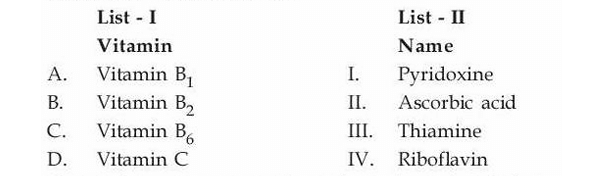
Match ListโI with ListโII.}
Choose the correct answer from the options given below:
1
AโII, BโI, CโIII, DโIV
2
AโIV, BโIII, CโII, DโI
3
AโIII, BโIV, CโI, DโII
4
AโI, BโIII, CโII, DโIV
Official Solution
Correct Option: (3)
Concept: Different vitamins have specific chemical names. Step 1:Identify names} Step 2:Match} Thus