Molecular Orbital Theory
31 previous year questions.
High-Yield Trend
Chapter Questions 31 MCQs
 undefined
 undefined
 undefined
| List - I | List - II |
|---|---|
| (A) | (I) Dipole moment |
| (B) | (II) Bonding molecular orbital |
| (C) | (III) Anti-bonding molecular orbital |
| (D) | (IV) Bond order |
Choose the correct answer from options given below:
The radius of the orbit of is . The expected radius of the orbit of is
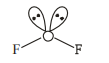
The total number of molecular orbitals formed from 2s and 2p atomic orbitals of a diatomic molecule is _________.
Statement (I): A bonding MO has lower electron density above and below the inter-nuclear axis.
Statement (II): The antibonding MO has a node between the nuclei.
In the light of the above statements, choose the most appropriate answer from the options given below:
Which of the following statement is true with respect to H O, NH and CH ?
(A) The central atoms of all the molecules are sp hybridized.
(B) The H–O–H, H–N–H and H–C–H angles in the above molecules are 104.5°, 107.5° and 109.5° respectively.
(C) The increasing order of dipole moment is CH
(D) Both H O and NH are Lewis acids and CH is a Lewis base.
(E) A solution of NH in H O is basic. In this solution NH and H O act as Lowry-Bronsted acid and base respectively.
Which of the following linear combinations of atomic orbitals will lead to the formation of molecular orbitals in homonuclear diatomic molecules (internuclear axis in z-direction)?
(1) and
(2) and
(3) and
(4) and
(5) and
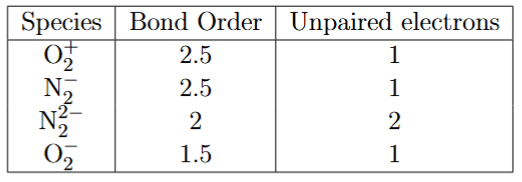
About Molecular Orbital Theory - JEE-MAIN
Molecular Orbital Theory is a vital chapter for JEE-MAIN aspirants. Mastering the concepts covered in this chapter is essential for securing a top rank.
By rigorously practicing the previous year questions associated with this chapter, you can identify high-yield topics, understand the examiner's perspective, and boost your confidence during the actual exam.
Frequently Asked Questions
Why focus on Molecular Orbital Theory PYQs?
Analyzing PYQs for this specific chapter reveals the most frequently tested concepts and the typical complexity of questions, allowing you to tailor your study plan efficiently.
How to best use this analysis?
Review the topic breakdown to see which sub-topics within Molecular Orbital Theory carry the most weight. Then, tackle the questions iteratively to solidify your understanding.