A solution is made by mixing one mole of volatile liquid A with 3 moles of volatile liquid B. The vapor pressure of pure A is 200 mm Hg and that of the solution is 500 mm Hg. The vapor pressure of pure B and the least volatile component of the solution, respectively, are:
1
1400 mm Hg, A
2
1400 mm Hg, B
3
600 mm Hg, B
4
600 mm Hg, A
Official Solution
Correct Option: (4)
The relation between vapor pressures is given by Raoult's law:
Given:
Using the mole fractions and Raoult's law:
Thus, the answer is .
02
PYQ 2025
medium
chemistryID: jee-main
Consider a binary solution of two volatile liquid components 1 and 2. and are the mole fractions of component 1 in the liquid and vapor phase, respectively. The slope and intercept of the linear plot of vs are given respectively as:
1
2
3
4
Official Solution
Correct Option: (1)
To solve this problem, we need to analyze the relationship between the mole fractions in liquid and vapor phases for a binary solution of two volatile components 1 and 2. This relationship can be derived using Raoult's Law and Dalton's Law for ideal solutions and vapors.
The mole fraction of component 1 in the liquid phase is denoted as , and in the vapor phase as .
According to Raoult's Law, the partial pressure of component 1, , is given by:
where is the vapor pressure of pure component 1.
Similarly, for component 2:
where is the vapor pressure of pure component 2.
According to Dalton's Law for the total pressure:
The mole fraction in the vapor phase can be represented as:
The given question involves a linear plot of vs . By rearranging the terms in step 5, we can write:
Inverting the above equation to match the linear form in the question, we get:
The slope of the line is derived as:
The intercept of the line, considering the whole equation setup, is:
Thus, the correct answer is the option with slope and intercept , which matches the interpretation of the question.
03
PYQ 2025
medium
chemistryID: jee-main
When a non-volatile solute is added to the solvent, the vapour pressure of the solvent decreases by 10 mm of Hg. The mole fraction of the solute in the solution is 0.2. What would be the mole fraction of the solvent if the decrease in vapour pressure is 20 mm of Hg?
1
0.6
2
0.4
3
0.2
4
0.8
Official Solution
Correct Option: (1)
To solve this problem, we begin by understanding Raoult's law, which states that the vapour pressure of a solvent in a solution is directly proportional to the mole fraction of the solvent. If a solute is non-volatile, it does not contribute to the vapour pressure.
Initially, when the vapour pressure decreases by 10 mm of Hg, the mole fraction of the solute is 0.2. Let's denote the initial vapour pressure of the pure solvent as .
According to Raoult's law:
Given that the decrease in vapour pressure is 10 mm of Hg, which implies:
From the formula of Raoult's law, the mole fraction of the solvent can be expressed as:
Now consider the change in vapour pressure to 20 mm of Hg. Again applying Raoult's law:
The mole fraction of the solvent in the new situation is denoted by .
Using the relation of proportional decrease:
And since the total pressure decrease is doubled, the new mole fraction will be inverse to solvent coverage:
Using the equation:
Solving for the new condition:
Since mole fraction of solute . Thus:
Thus, the mole fraction of the solvent when the vapour pressure decrease is 20 mm of Hg is 0.6. This confirms that the correct answer is 0.6.
04
PYQ 2026
medium
chemistryID: jee-main
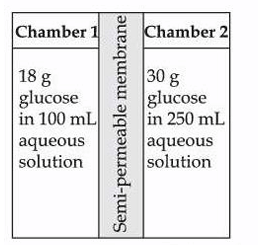
Given below are two statements:} A semipermeable membrane separates two chambers: Statement I:} molecules move from chamber 1 to chamber 2. Statement II:} The osmotic pressure of a solution prepared by dissolving of potassium sulphate in of water (at ) is . Choose the correct answer.
1
Both Statement I and Statement II are true
2
Both Statement I and Statement II are false
3
Statement I is true but Statement II is false
4
Statement I is false but Statement II is true
Official Solution
Correct Option: (3)
Concept:
Osmosis occurs from lower solute concentration to higher solute concentration. where is vanβt Hoff factor. Step 1: {Check Statement I} Molar mass of glucose . Chamber 1: Volume Chamber 2: Volume Thus Water moves from lower concentration to higher concentration, i.e. Hence statement I is false. Step 2: {Check Statement II} Mass Volume For : Temperature Thus Statement II is true. Hence the correct option:
05
PYQ 2026
easy
chemistryID: jee-main
19.5 g of fluoro acetic acid (molar mass = 78 g mol ) is dissolved in 500 g of water at 298 K. The depression in the freezing point of water was . What is of fluoro acetic acid? (For water, ). Assume molarity and molality to have same values.
1
2
3
4
Official Solution
Correct Option: (2)
Concept: Depression in freezing point: where is the van't Hoff factor. For weak acid: Step 1:Calculate molality} Moles of acid: Mass of solvent: Molality: Step 2:Find van't Hoff factor} Step 3:Degree of dissociation} Step 4:Calculate } For weak acid: Given molarity molality Thus
06
PYQ 2026
hard
chemistryID: jee-main
Solution A is prepared by dissolving 1 g of a protein (molar mass = 50000 g mol ) in 0.5 L of water at 300 K. Its osmotic pressure is bar. Solution B is made by dissolving 2 g of the same protein in 1 L of water at 300 K. Osmotic pressure of solution B is bar. Entire solution of A is mixed with entire solution of B at same temperature. The osmotic pressure of resultant solution is bar. , , and respectively are:
1
2
3
4
Official Solution
Correct Option: (2)
Step 1: Understanding osmotic pressure.
The osmotic pressure of a solution is given by the formula:
where is the number of moles of solute, is the universal gas constant, is the temperature, and is the volume of the solution. Osmotic pressure is directly proportional to the number of moles of solute per volume. Step 2: Calculating the osmotic pressure for solution A.
For solution A, the number of moles of protein is:
The osmotic pressure of solution A is:
Thus, . Step 3: Calculating the osmotic pressure for solution B.
For solution B, the number of moles of protein is:
The osmotic pressure of solution B is:
Thus, . Step 4: Calculating the osmotic pressure of the resultant solution.
When solutions A and B are mixed, the total number of moles is . The total volume is . The osmotic pressure of the resultant solution is:
Thus, . Final Answer: (B)
07
PYQ 2026
medium
chemistryID: jee-main
Consider the following reactions in which all the reactants and products are present in gaseous state:
The value of for the equilibrium is:
1
2
3
4
Official Solution
Correct Option: (3)
Step 1: Understanding the Concept:
When reactions are added, their equilibrium constants are multiplied. When a reaction is reversed, is inverted ( ). When a reaction is multiplied by a factor , the new constant is . Step 2: Key Formula or Approach:
Identify how to combine the given equations to get the target equation. Step 3: Detailed Explanation:
Target Eq:
1. Reverse and multiply Eq 1 by :
New constant .
2. Keep Eq 2 as is:
Constant .
3. Add these two modified equations:
Cancel from both sides:
. Step 4: Final Answer:
The value of is .
08
PYQ 2026
medium
chemistryID: jee-main
20 g hemoglobin in a 1 L aqueous solution (A) at 300 K is separated from pure water by semi permeable membrane. At equilibrium the height of solution in a tube dipped in a solution (A) is found to be 80.0 mm higher than the tube dipped in water. The molar mass of hemoglobin is ______ kg mol . (Nearest integer)
(Given : , , density of solution )}
Official Solution
Correct Option: (1)
Step 1: Understanding the Concept:
Osmotic pressure ( ) can be measured by the hydrostatic pressure exerted by the column of liquid at equilibrium, given by . This pressure is also related to the concentration of the solute via the Van't Hoff equation . : Key Formula or Approach:
1. .
2. . Step 2: Detailed Explanation: 1. Calculate Osmotic Pressure ( ):
Height .
Density .
Gravity .
.
Convert to kPa: . 2. Calculate Molar Mass (M):
Mass of solute .
Volume .
Temperature .
.
Using :
.
. 3. Convert to kg/mol:
. Step 3: Final Answer:
The molar mass of hemoglobin is 62 kg mol to the nearest integer.
09
PYQ 2026
medium
chemistryID: jee-main
In sulphur estimation, mol of an organic compound (X) (molar mass 76 ) gave 0.4813 g of barium sulphate (molar mass 233 ). The percentage of sulphur in the compound (X) is _______ % (Nearest integer)
Official Solution
Correct Option: (1)
Step 1: Find mass of compound used Given: Mass of compound: Step 2: Find moles of formed Given: Step 3: Find mass of sulphur Each mole of contains one mole of sulphur. So, Mass of sulphur: Step 4: Calculate percentage of sulphur
Step 5: Write in required form Question asks in the form So, Nearest integer: Final Answer:
10
PYQ 2026
medium
chemistryID: jee-main
A non-volatile, non-electrolyte solid solute when dissolved in 40 g of a solvent, the vapour pressure of the solvent decreased from 760 mm Hg to 750 mm Hg. If the same solution boils at 320 K, then the number of moles of the solvent present in the solution is ______. (Nearest integer) [Given: boiling point of the pure solvent = 319.5 K, K_b of the solvent = 0.3 K kg molβ»ΒΉ]
Official Solution
Correct Option: (1)
Step 1: Understanding the Concept:
We use the elevation in boiling point to find the moles of solute, then apply the relative lowering of vapour pressure (RLVP) to find the moles of the solvent.
Step 2: Key Formula or Approach:
1.
2. (Mole fraction of solute)
Step 4: Final Answer:
The number of moles of the solvent is 5.
11
PYQ 2026
medium
chemistryID: jee-main
Two liquids A and B form an ideal solution. At 320 K, the vapour pressure of the solution, containing 3 mol of A and 1 mol of B is 500 mm Hg. At the same temperature, if 1 mol of A is further added... vapour pressure of B in pure state is ___ mm Hg. (Nearest integer)
Official Solution
Correct Option: (1)
According to Raoultβs law,
Case I:
Number of moles: , Given vapour pressure:
Case II:
After adding 1 mol of A: , Given vapour pressure of solution:
Subtracting equation (1) from equation (2):
Substituting in equation (1):
12
PYQ 2026
medium
chemistryID: jee-main
Elements P and Q form two types of non-volatile, non-ionizable compounds PQ and PQ . When 1 g of PQ is dissolved in 50 g of solvent 'A', was 1.176 K while when 1 g of PQ is dissolved in 50 g of solvent 'A', was 0.689 K. ( of 'A' = 5 K kg mol ). The molar masses of elements P and Q (in g mol ) respectively, are:
1
70, 110
2
60, 25
3
25, 60
4
65, 145
Official Solution
Correct Option: (3)
Step 1: Understanding the Question:
This problem involves using the colligative property of elevation in boiling point (Ξ ) to determine the molar masses of two unknown compounds, PQ and PQβ. From these molar masses, we need to find the atomic masses of the elements P and Q. Step 2: Key Formula or Approach:
The formula for elevation in boiling point is:
where is the molality of the solution. Molality is given by:
We can rearrange the formula to solve for the Molar mass (M) of the solute: Step 3: Detailed Explanation: Given data:
\begin{itemize} \item Mass of solute (for both PQ and PQβ) = 1 g \item Mass of solvent 'A' = 50 g = 0.050 kg \item Ebullioscopic constant of 'A', = 5 K kg molβ»ΒΉ \item For compound PQ, = 1.176 K \item For compound PQβ, = 0.689 K
\end{itemize} Calculation of Molar Mass of PQ (M_PQ): Calculation of Molar Mass of PQβ (M_PQβ): Finding Atomic Masses of P and Q:
Let the atomic mass of element P be and that of element Q be .
We have a system of two linear equations:
1)
2) Subtracting equation (1) from equation (2):
Substituting the value of back into equation (1): Step 4: Final Answer:
The atomic mass of P is approximately 25 g molβ»ΒΉ and the atomic mass of Q is approximately 60 g molβ»ΒΉ. This corresponds to option (C).