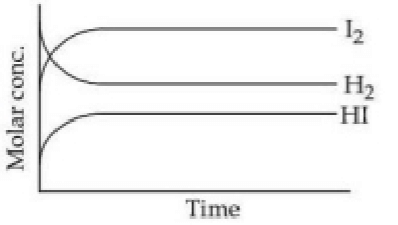
Consider the elements Mg, Al, S, P and Si, the correct increasing order of their first ionization enthalpy is :
1
2
3
4
Official Solution
Correct Option: (1)
Step 1: Generally, IE increases across a period (Mg to P).
Step 2: Mg ( ) has a stable fully filled subshell, so its IE is higher than Al ( ).
Step 3: P ( ) has a stable half-filled subshell, so its IE is higher than S ( ).
Step 4: Therefore, the order is Al
02
PYQ 2021
medium
chemistryID: jee-main
The ionic radii of , , and are in the order :
1
2
3
4
Official Solution
Correct Option: (3)
Step 1: Understanding the Concept: Ionic radius depends on the number of shells and the effective nuclear charge. For isoelectronic species (ions with the same number of electrons), the radius decreases as the atomic number increases. Step 2: Key Formula or Approach: 1. Identify isoelectronic ions. 2. Apply the rule: Radius . 3. Compare ions from different periods based on shell count. Step 3: Detailed Explanation: 1. , , and all have 10 electrons (isoelectronic). - Atomic numbers: . - Order: . 2. has 18 electrons and belongs to a higher period (3rd shell for the ion, vs 2nd shell for the others). - Ions with more shells are significantly larger. - Thus, is the largest among the four. Combining these, we get: . Step 4: Final Answer: The correct order is .
03
PYQ 2021
medium
chemistryID: jee-main
The ionic radius of Na⁺ ion is 1.02 Å. The ionic radii (in Å) of Mg²⁺ and Al³⁺, respectively, are :
1
0.85 and 0.99
2
0.72 and 0.54
3
0.68 and 0.72
4
1.05 and 0.99
Official Solution
Correct Option: (2)
Step 1: Na⁺, Mg²⁺, and Al³⁺ are **isoelectronic species** (all have 10 electrons).
Step 2: For isoelectronic species, as the nuclear charge (atomic number ) increases, the nucleus pulls electrons more strongly.
Step 3: for Na=11, Mg=12, Al=13. Step 4: Therefore, ionic radius decreases: Na⁺>Mg²⁺>Al³⁺.
The only option following this trend with values significantly smaller than 1.02 is (B).
04
PYQ 2021
medium
chemistryID: jee-main
The CORRECT order of first ionisation enthalpy is :
1
Mg
2
Mg
3
Al
4
Al
Official Solution
Correct Option: (4)
First ionisation enthalpy is the energy required to remove the most loosely bound electron from a neutral gaseous atom. The general trend is that it increases across a period from left to right. However, there are exceptions due to electronic configurations. Let's look at the elements and their configurations:
Mg (Z=12): [Ne] 3s . It has a fully filled and stable 's' orbital.
Al (Z=13): [Ne] 3s 3p . Removing the single 3p electron results in a stable [Ne] 3s configuration. This is relatively easy.
P (Z=15): [Ne] 3s 3p . It has a half-filled and stable 'p' orbital.
S (Z=16): [Ne] 3s 3p . Removing one electron results in a stable half-filled 3p configuration. This is easier than removing an electron from P. Comparing Mg and Al: Removing an electron from Al's 3p orbital is easier than from Mg's stable 3s orbital. Thus, IE (Al) (Mg). Comparing P and S: Removing an electron from S's 3p configuration is easier than from P's stable 3p half-filled configuration. Thus, IE (S) (P). Combining these with the general trend, the overall order is:
Al
05
PYQ 2024
medium
chemistryID: jee-main
The electron affinity values are negative for: A. Be → Be− B. N → N− C. O → O2− D. Na → Na− E. Al → Al− Choose the most appropriate answer from the options given below:
1
D and E only
2
A, B, D and E only
3
A and D only
4
A, B and C only
Official Solution
Correct Option: (1)
To determine which elements have negative electron affinity values, we need to understand the concept of electron affinity. Electron affinity refers to the energy change that occurs when an electron is added to a neutral atom in the gas phase. A negative value indicates that energy is released when an electron is added, making the process exothermic.
Let's analyze each given option:
A. Be → Be−: Beryllium has a completely filled s-subshell, making it less likely to accept an additional electron. It has a positive electron affinity because adding an electron increases electron-electron repulsion without gaining significant stability.
B. N → N−: Nitrogen has a half-filled p-subshell, which is stable due to symmetrical electron distribution. Adding an electron to nitrogen introduces repulsion, resulting in a positive electron affinity.
C. O → O2−: Oxygen generally gains energy when forming a single anion (O−). However, adding a second electron (forming O2−) involves significant electron-electron repulsion, resulting in a positive electron affinity.
D. Na → Na−: Sodium has one electron in its outer shell. Losing this electron (to form Na+) is favorable, while adding an electron (to form Na−) is not, leading to a positive electron affinity.
E. Al → Al−: Aluminum has a similar situation to sodium where adding an electron is not favorable, resulting in a positive electron affinity.
Thus, the elements where electron affinity values are negative (indicating energy is required to add an electron) are Sodium (Na) and Aluminum (Al), i.e., options D and E.
Hence, the correct answer is: D and E only.
06
PYQ 2024
medium
chemistryID: jee-main
Given below are two statements: Statement (I): and are acidic while and are amphoteric in nature. Statement (II): Allotropic forms of carbon are due to property of catenation and bond formation. In the light of the above statements, choose the most appropriate answer from the options given below:
1
Both Statement I and Statement II are false
2
Both Statement I and Statement II are true
3
Statement I is true but Statement II is false
4
Statement I is false but Statement II is true
Official Solution
Correct Option: (3)
To determine the validity of the given statements about chemical properties and allotropic forms, let's analyze each statement individually.
Statement I: and are acidic while and are amphoteric in nature.
is known to be an acidic oxide. It reacts with bases to form silicates.
also shows acidic properties, reacting with alkalis to form germanates.
and are amphoteric, meaning they can react with both acids and bases. For instance, reacts with hydrochloric acid to form and with sodium hydroxide to form sodium stannate.
Thus, Statement I is accurate.
Statement II: Allotropic forms of carbon are due to the property of catenation and bond formation.
Catenation is indeed a property of carbon that allows it to form multiple allotropes, such as diamond, graphite, and fullerenes, through chains or rings.
However, bond formation is not typically associated with carbon allotropes. Carbon primarily forms bonds.
Therefore, Statement II is incorrect.
Based on the analysis:
Statement I is true: and are acidic, whereas and are amphoteric.
Statement II is false: While catenation is a reason for carbon allotropy, the bond formation is not a characteristic property of carbon for its allotropes.
Thus, the most appropriate answer is that Statement I is true but Statement II is false.
07
PYQ 2024
medium
chemistryID: jee-main
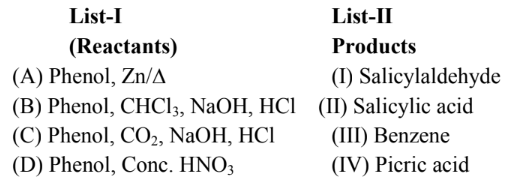
Match List - I with List - II.Choose the correct answer from the options given below.
1
(A)-(IV), (B), (II), (C)-(I), (D)-(III)
2
(A)-(IV), (B)-(I), (C)-(II), (D)-(III)
3
(A)-(III), (B)-(I), (C)-(II), (D)-(IV)
4
(A)-(III), (B)-(IV), (C)-(I), (D)-(II)
Official Solution
Correct Option: (3)
To solve the matching problem, we need to understand the chemical reactions between the reactants in List-I and their corresponding products in List-II. Let's analyze each pair:
(A) Phenol, Zn/Δ: The reaction of phenol with zinc dust upon heating leads to the removal of the hydroxyl group, yielding benzene as the product. Thus, (A) matches with (III).
(B) Phenol, CHCl3, NaOH, HCl: This is the Reimer-Tiemann reaction, where phenol reacts with chloroform in the presence of a base and then acid, giving salicylaldehyde. Thus, (B) matches with (I).
(C) Phenol, CO2, NaOH, HCl: This is the Kolvbe-Schmitt reaction, where phenol reacts with carbon dioxide in the presence of a base to form salicylic acid. Thus, (C) matches with (II).
(D) Phenol, Conc. HNO3: Nitration of phenol using concentrated nitric acid produces picric acid. Thus, (D) matches with (IV).
Based on the above explanation, the correct matching of List-I with List-II is:
(A) - (III)
(B) - (I)
(C) - (II)
(D) - (IV)
Therefore, the correct answer is: (A)-(III), (B)-(I), (C)-(II), (D)-(IV).
08
PYQ 2024
hard
chemistryID: jee-main
Match List I with List II
List-I
List-II
A. Melting point [K]
I. Tl > In > Ga > Al > B
B. Ionic Radius [M3/pm]
II. B > Tl > Al ≈ Ga ≈ In
C. ΔiH1 [kJ mol-1]
III. Tl > In > Al > Ga > B
D. Atomic Radius [pm]
IV. B > Al > Tl > In > Ga
Choose the correct answer from the options given below:
1
A-III, B-IV, C-I, D-II
2
A-II, B-III, C-IV, D-I
3
A-IV, B-I, C-II, D-III
4
A-I, B-II, C-III, D-IV
Official Solution
Correct Option: (3)
To match the items from List I with List II: A. Melting point [K]: Based on the trend, Tl > In > Ga > Al > B. (Matches I). B. Ionic Radius [M /pm]: Boron has the smallest ionic size, followed by Tl > Al Ga > In (Matches II). C. [kJ mol ]: Ionization enthalpy follows the trend Tl > In > Al > Ga > B.(Matches III). D. Atomic Radius [pm]: Atomic radius increases as B > Al > Tl > In > Ga.(Matches IV). Correct Answer: (3)
09
PYQ 2024
medium
chemistryID: jee-main
The transition metal having highest ionisation enthalpy is:
1
Cr
2
Mn
3
V
4
Fe
Official Solution
Correct Option: (2)
To determine which transition metal has the highest third ionization enthalpy, we need to consider the electronic configurations and the stability of the resulting ions upon successive ionizations.
The electronic configuration for each element is as follows:
Chromium (Cr):
Manganese (Mn):
Vanadium (V):
Iron (Fe):
The third ionization enthalpy refers to the energy required to remove the third electron after removing the first two. When evaluating this, the stability of half-filled d-orbitals plays a significant role.
For manganese (Mn), removing the first two electrons results in a configuration of , which is a stable half-filled configuration.
This stability makes it significantly more challenging to remove a third electron from manganese than from the other elements.
Therefore, the element with the highest third ionization enthalpy is: Mn (Manganese).
10
PYQ 2024
medium
chemistryID: jee-main
Given below are two statements : Statement I: In group 13, the stability of +1 oxidation state increases down the group. Statement II: The atomic size of gallium is greater than that of aluminium. In the light of the above statements. Choose the most appropriate answer from the options given below:
1
Statement I is incorrect but Statement II is correct
2
Both Statement I and Statement II are correct
3
Both Statement I and Statement II are incorrect
4
Statement I is correct but Statement II is incorrect
Official Solution
Correct Option: (4)
Statement I: Number of d and f electrons increases down the group and due to poor shielding of d and f electrons, stability of lower oxidation states increases down the group.
Statement II: The atomic size of aluminium is greater than that of gallium. Thus, Statement I is correct, but Statement II is incorrect.
11
PYQ 2024
medium
chemistryID: jee-main
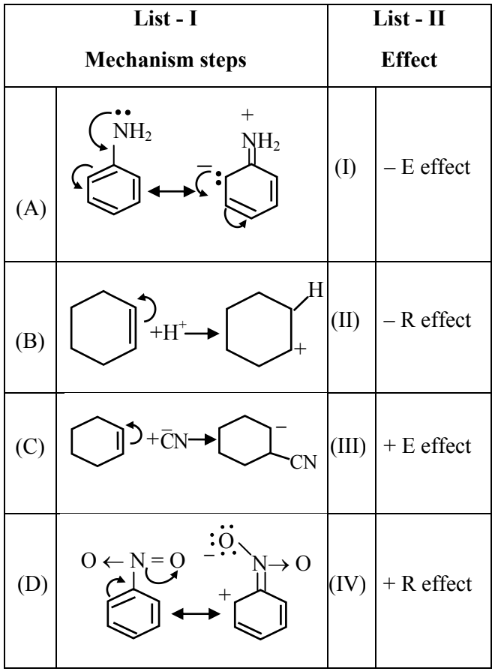
Match List -I with List II:
Choose the correct answer from the options given below :
1
(A) – (IV), (B) – (III), (C) – (I), (D) – (II)
2
(A) – (III), (B) – (I), (C) – (II), (D) – (IV)
3
(A) – (II), (B) – (IV), (C) – (III), (D) – (I)
4
(A) – (I), (B) – (II), (C) – (IV), (D) – (III)
Official Solution
Correct Option: (1)
Understand the Effects (Inductive, Resonance, and Electromeric):
E Effect (Electromeric Effect): A temporary effect where a pi bond shifts to one of the atoms in the presence of an attacking reagent.
R Effect (Resonance Effect): The delocalization of electrons in a conjugated system.
+E Effect (Positive Electromeric Effect): Electron pair movement towards the attacking atom.
+R Effect (Positive Resonance Effect): Electron-donating resonance effect, often seen in groups with lone pairs that can donate electron density.
Match Each Mechanism with the Correct Effect:
(A) Shows a nucleophile attacking and shifting a lone pair, which is a +R effect (IV).
(B) Shows protonation that increases electron density through resonance, an R effect (II).
(C) Shows cyanide attaching and shifting electron density, representing +E effect (III).
(D) Shows electron density shift due to a nitro group, indicating E effect (I).
Conclusion:
The correct matching is:
which corresponds to Option (1).
12
PYQ 2024
medium
chemistryID: jee-main
Match List-I with List-II.
List-I (Elements)
List-II (Properties in their respective groups)
(A) Cl,S
(I) Elements with highest electronegativity
(B) Ge, As
(II) Elements with largest atomic size
(C) Fr, Ra
(III) Elements which show properties of both metals and non metal
(D) F, O
(IV) Elements with highest negative electron gain enthalpy
Choose the correct answer from the options given below:
1
A-II, B-III, C-IV, D-I
2
A-III, B-II, C-I, D-IV
3
A-IV, B-III, C-II, D-I
4
A-II, B-I, C-IV, D-III
Official Solution
Correct Option: (3)
To solve the given question, we must match elements in List-I with their corresponding properties in List-II.
First, examine each option in List-I:
(A) Cl, S: Chlorine (Cl) and Sulfur (S) are non-metals. Both are known for their high electron gain enthalpies, especially chlorine, which often has the highest negative electron gain enthalpy in its group.
(B) Ge, As: Germanium (Ge) and Arsenic (As) are metalloids, showcasing properties of both metals and non-metals.
(C) Fr, Ra: Francium (Fr) and Radium (Ra) are metals with large atomic sizes. They are found in the alkali metal and alkaline earth metal groups, respectively.
(D) F, O: Fluorine (F) and Oxygen (O) are known for their high electronegativity values, with fluorine being the most electronegative element.
Now, map each element pair to the correct property in List-II:
(A) Cl, S aligns with (IV) Elements with highest negative electron gain enthalpy.
(B) Ge, As fits with (III) Elements which show properties of both metals and non-metals.
(C) Fr, Ra matches with (II) Elements with largest atomic size.
(D) F, O corresponds to (I) Elements with highest electronegativity.
The correct matching is: A-IV, B-III, C-II, D-I.
This matches with the given option:
A-IV, B-III, C-II, D-I
13
PYQ 2024
medium
chemistryID: jee-main
Identify the incorrect statements about group 15 elements: (A) Dinitrogen is a diatomic gas which acts like an inert gas at room temperature. (B) The common oxidation states of these elements are −3, +3 and +5. (C) Nitrogen has unique ability to form p -p multiple bonds. (D) The stability of +5 oxidation states increases down the group. (E) Nitrogen shows a maximum covalency of 6. Choose the correct answer from the options given below.
1
(A), (B), (D) only
2
(A), (C), (E) only
3
(B), (D), (E) only
4
(D) and (E) only
Official Solution
Correct Option: (4)
Let's analyze each statement about group 15 elements to determine their correctness:
Statement (A): "Dinitrogen is a diatomic gas which acts like an inert gas at room temperature." Nitrogen typically exists as a diatomic molecule ( ). It is relatively inert under normal conditions due to the strong triple bond between the nitrogen atoms, making it stable and unreactive. Thus, Statement (A) is correct.
Statement (B): "The common oxidation states of these elements are −3, +3 and +5." The group 15 elements indeed commonly show these oxidation states. For example, nitrogen can exhibit −3 (in ammonia), +3 (in nitrous acid), and +5 (in nitric acid). Statement (B) is correct.
Statement (C): "Nitrogen has unique ability to form p -p multiple bonds." Nitrogen is capable of forming multiple bonds like -bonds due to its small size and ability to undergo p -p overlap. This is correct, as seen in compounds like nitrogen gas ( ). Statement (C) is correct.
Statement (D): "The stability of +5 oxidation states increases down the group." The stability of the +5 oxidation state actually decreases down the group. Elements like bismuth prefer lower oxidation states due to the inert pair effect. Statement (D) is incorrect.
Statement (E): "Nitrogen shows a maximum covalency of 6." Nitrogen, with its electron configuration of 1s2 2s2 2p3, can form a maximum of 4 covalent bonds (in compounds like ammonium ion, ). Statement (E) is incorrect.
Thus, the incorrect statements are: (D) and (E).
Therefore, the correct answer is (D) and (E) only.
14
PYQ 2024
medium
chemistryID: jee-main
Anomalous behaviour of oxygen is due to its
1
Large size and high electronegativity
2
Small size and low electronegativity
3
Small size and high electronegativity
4
Large size and low electronegativity
Official Solution
Correct Option: (3)
The anomalous behavior of oxygen can be attributed to its small size and high electronegativity. Let us understand why:
Small Size:
Oxygen is one of the smaller atoms due to its position in the periodic table (it is a second-period element).
The smaller atomic size results in a stronger attraction between the nucleus and the valence electrons, increasing its ability to attract electrons towards itself.
High Electronegativity:
Oxygen is the second most electronegative element after fluorine. This high electronegativity leads to the formation of highly polar covalent bonds.
The high electronegativity is due to the strong pull from the nucleus due to the small atomic radius, making oxygen excel at attracting shared electrons in a chemical bond.
These characteristics distinguish oxygen from other elements in its group, leading to its unique or anomalous behavior. As a result, oxygen is able to form multiple types of oxides and has distinctive reactivity patterns compared to its group counterparts like sulfur, selenium, etc.
Thus, the correct answer is: Small size and high electronegativity.
Options Analysis:
Large size and high electronegativity: Oxygen does not have a large size; hence this option is incorrect.
Small size and low electronegativity: While the size is correct, oxygen exhibits high electronegativity, not low; thus, this option is incorrect.
Large size and low electronegativity: Both characteristics are incorrect for oxygen, making this option incorrect.
15
PYQ 2024
medium
chemistryID: jee-main
Given below are two statements: Statement I: Fluorine has most negative electron gain enthalpy in its group. Statement II: Oxygen has least negative electron gain enthalpy in its group. In the light of the above statements, choose the most appropriate from the options given below.
1
Both Statement I and Statement II are true
2
Statement I is true but Statement II is false
3
Both Statement I and Statement II are false
4
Statement I is false but Statement II is true
Official Solution
Correct Option: (4)
To analyze the statements given in the question, we need to understand the concept of electron gain enthalpy within the groups of the periodic table.
Statement I: "Fluorine has the most negative electron gain enthalpy in its group."
Explanation: Electron gain enthalpy refers to the energy change when an electron is added to an isolated gaseous atom. In general, as we move across a period from left to right, electron gain enthalpy becomes more negative. However, this trend doesn't hold perfectly in a group. For Group 17 (halogens), chlorine actually has a more negative electron gain enthalpy than fluorine. This is due to the smaller atomic size of fluorine, resulting in a higher electron-electron repulsion in its compact structure, making chlorine's electron addition more favorable. Therefore, Statement I is false.
Statement II: "Oxygen has the least negative electron gain enthalpy in its group."
Explanation: Oxygen is part of Group 16. Within this group, oxygen does indeed have the least negative electron gain enthalpy. This is because, like with fluorine, the small size of the oxygen atom leads to increased electron-electron repulsion upon gaining an additional electron. Thus, Statement II is true.
Conclusion: Based on the explanations above, the most appropriate choice is: "Statement I is false but Statement II is true."
16
PYQ 2024
medium
chemistryID: jee-main
The element having the highest first ionization enthalpy is
1
Si
2
Al
3
N
4
C
Official Solution
Correct Option: (3)
The question is about finding the element with the highest first ionization enthalpy among the given options. Ionization enthalpy is the energy required to remove an electron from a gaseous atom or ion.
Explanation:
The given options are Silicon (Si), Aluminium (Al), Nitrogen (N), and Carbon (C).
Ionization enthalpy generally increases across a period in the periodic table because the nuclear charge increases, making it more difficult to remove an electron.
Ionization enthalpy decreases down a group as the atomic size increases, the outer electrons are further from the nucleus, and the increase in shielding reduces the effective nuclear charge felt by the valence electrons, making them easier to remove.
Let's analyze each element:
Silicon (Si): It is in the same group as Carbon but below it in the periodic table. Its ionization enthalpy is lower than C because it's further down the group.
Aluminium (Al): It is in Group 13, after Nitrogen and Carbon in the periodic table. Its first ionization enthalpy is less than that of N and C due to its position.
Nitrogen (N): It is in Group 15 and has one more proton than Carbon, making it more efficiently hold on to its electrons than Al or Si. Its ionization enthalpy is quite high due to its small atomic size and half-filled p orbital, making it stable.
Carbon (C): It lies before Nitrogen in the periodic table and has fewer protons, thus its ionization enthalpy is lower than that of Nitrogen.
From the above analysis, Nitrogen (N) has the highest first ionization enthalpy among the given elements due to its position in the periodic table, small atomic size, and stable half-filled configuration.
Conclusion: The correct answer is .
17
PYQ 2024
easy
chemistryID: jee-main
Lowest oxidation number of an atom in a compound is -2. The number of electrons in its valence shell is:
Official Solution
Correct Option: (1)
The problem asks for the number of valence electrons of an atom B, given that its lowest possible oxidation number in a compound A₂B is -2.
Concept Used:
The oxidation number (or oxidation state) of an atom in a compound represents its degree of oxidation. For a non-metal element, the lowest (most negative) possible oxidation number is related to the number of electrons it needs to gain to achieve a stable electron configuration, typically an octet (8 electrons in its valence shell).
The relationship between the minimum oxidation number and the number of valence electrons ( ) for a main group element is given by the formula:
This formula arises because the lowest oxidation state is achieved when the atom gains enough electrons to complete its octet.
Step-by-Step Solution:
Step 1: Identify the given information.
We are given that the lowest oxidation number of atom B is -2.
Step 2: Apply the formula relating the lowest oxidation number to the number of valence electrons.
Let be the number of electrons in the valence shell of atom B. Using the formula:
Step 3: Substitute the given value and solve for .
Final Computation & Result:
To find the number of valence electrons, we rearrange the equation:
This means that atom B has 6 electrons in its valence shell. Such elements belong to Group 16 of the periodic table (e.g., Oxygen, Sulfur), and their most common negative oxidation state is indeed -2.
The number of electrons in its valence shell is 6.
18
PYQ 2024
medium
chemistryID: jee-main
The number of element from the following that do not belong to lanthanoids is : Eu, Cm, Er, Tb, Yb and Lu
1
3
2
4
3
1
4
5
Official Solution
Correct Option: (3)
The given question requires identification of elements among the given list that do not belong to the lanthanoid series. The lanthanoids, also known as the lanthanides, consist of 15 elements ranging from atomic numbers 57 (Lanthanum, La) to 71 (Lutetium, Lu).
Let's evaluate each element in the list:
Eu (Europium): Europium is a lanthanoid with an atomic number of 63.
Cm (Curium): Curium is an actinoid with an atomic number of 96. It does not belong to the lanthanoid series.
Er (Erbium): Erbium is a lanthanoid with an atomic number of 68.
Tb (Terbium): Terbium is a lanthanoid with an atomic number of 65.
Yb (Ytterbium): Ytterbium is a lanthanoid with an atomic number of 70.
Lu (Lutetium): Lutetium is the last element of the lanthanoid series with an atomic number of 71.
From this evaluation, we can see that the element Cm (Curium) is the only one that does not belong to the lanthanoid series.
Conclusion: The correct answer is option , as Cm (Curium) is the only element that is not a lanthanoid.
19
PYQ 2024
medium
chemistryID: jee-main
The statement(s) that are correct about the species O 2– , F – , Na+ and Mg2+. (A) All are isoelectronic (B) All have the same nuclear charge (C) O2– has the largest ionic radii (D) Mg2+ has the smallest ionic radii Choose the most appropriate answer from the options given below :
1
(B), (C) and (D) only
2
(A), (B), (C) and (D)
3
(C) and (D) only
4
(A), (C) and (D) only
Official Solution
Correct Option: (4)
- are isoelectronic (same number of electrons = 10).
- has the largest ionic radius due to its lowest effective nuclear charge ( ).
- has the smallest ionic radius due to its highest effective nuclear charge. Hence, statements (A), (C), and (D) are correct.
20
PYQ 2024
medium
chemistryID: jee-main
In case of isoelectronic species the size of F– , Ne and Na+ is affected by:
1
Principal quantum number (n)
2
None of the factors because their size is the same
3
Electron-electron interaction in the outer orbitals
4
Nuclear charge (z)
Official Solution
Correct Option: (4)
The question asks to identify the primary factor that affects the size of the isoelectronic species F⁻, Ne, and Na⁺.
Concept Used:
The key concepts for determining the size of isoelectronic species are:
Isoelectronic Species: These are atoms or ions that have the same number of electrons.
Nuclear Charge (Z): This is the total positive charge of the nucleus, which is equal to the number of protons in the atom.
Effective Nuclear Charge (Zeff): This is the net positive charge experienced by an electron in a multi-electron atom. The electrons in the outer shells are shielded from the full nuclear charge by the inner-shell electrons. The effective nuclear charge is approximately the nuclear charge minus the screening constant ( ), .
For an isoelectronic series, the number of electrons is constant. Therefore, the screening effect from the inner electrons is also roughly constant. The size of the species is then primarily determined by the magnitude of the nuclear charge (number of protons). A higher nuclear charge exerts a stronger electrostatic pull on the same number of electrons, causing the electron cloud to contract and resulting in a smaller atomic or ionic radius.
Step-by-Step Solution:
Step 1: Determine the number of protons (Nuclear Charge, Z) and electrons for each species.
For Fluoride ion (F⁻):
The atomic number of Fluorine (F) is Z = 9. So, it has 9 protons.
The charge is -1, meaning it has gained one electron.
Number of electrons = 9 (protons) + 1 = 10 electrons.
For Neon atom (Ne):
The atomic number of Neon (Ne) is Z = 10. So, it has 10 protons.
It is a neutral atom.
Number of electrons = 10 (protons) = 10 electrons.
For Sodium ion (Na⁺):
The atomic number of Sodium (Na) is Z = 11. So, it has 11 protons.
The charge is +1, meaning it has lost one electron.
Number of electrons = 11 (protons) - 1 = 10 electrons.
Since all three species (F⁻, Ne, Na⁺) have 10 electrons, they are isoelectronic.
Step 2: Compare the nuclear charge of the species.
The number of protons (nuclear charge) for each species is:
F⁻: Z = 9
Ne: Z = 10
Na⁺: Z = 11
The nuclear charge increases in the order F⁻ < Ne < Na⁺.
Step 3: Relate nuclear charge to ionic/atomic size.
All three species have the same number of electrons (10) arranged in the same electronic configuration (1s²2s²2p⁶). However, they have different numbers of protons in their nuclei.
The Na⁺ ion, with 11 protons, has the highest nuclear charge. It will exert the strongest electrostatic attraction on its 10 electrons, pulling them closer to the nucleus. This results in the smallest radius.
The F⁻ ion, with only 9 protons, has the lowest nuclear charge. Its nucleus exerts the weakest attraction on the 10 electrons, resulting in the largest radius.
The Ne atom is intermediate with 10 protons and 10 electrons.
Thus, the order of size is: Na⁺ < Ne < F⁻.
Final Result:
For the isoelectronic species F⁻, Ne, and Na⁺, the number of electrons is the same, but the nuclear charge is different. The electrostatic attraction between the nucleus and the electrons increases with the increase in nuclear charge. Therefore, the size of these species is primarily affected by the nuclear charge (number of protons).
21
PYQ 2025
medium
chemistryID: jee-main
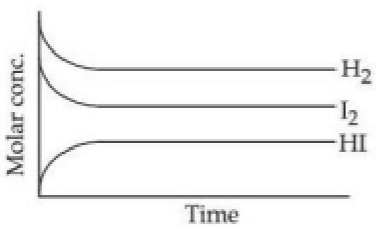
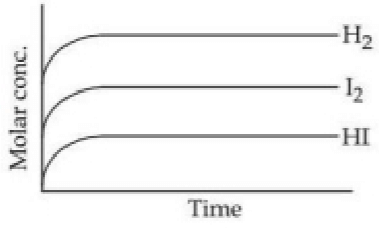
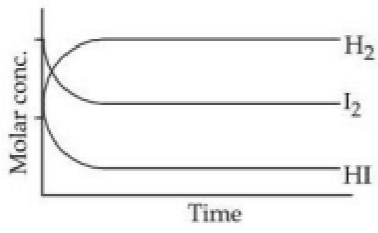
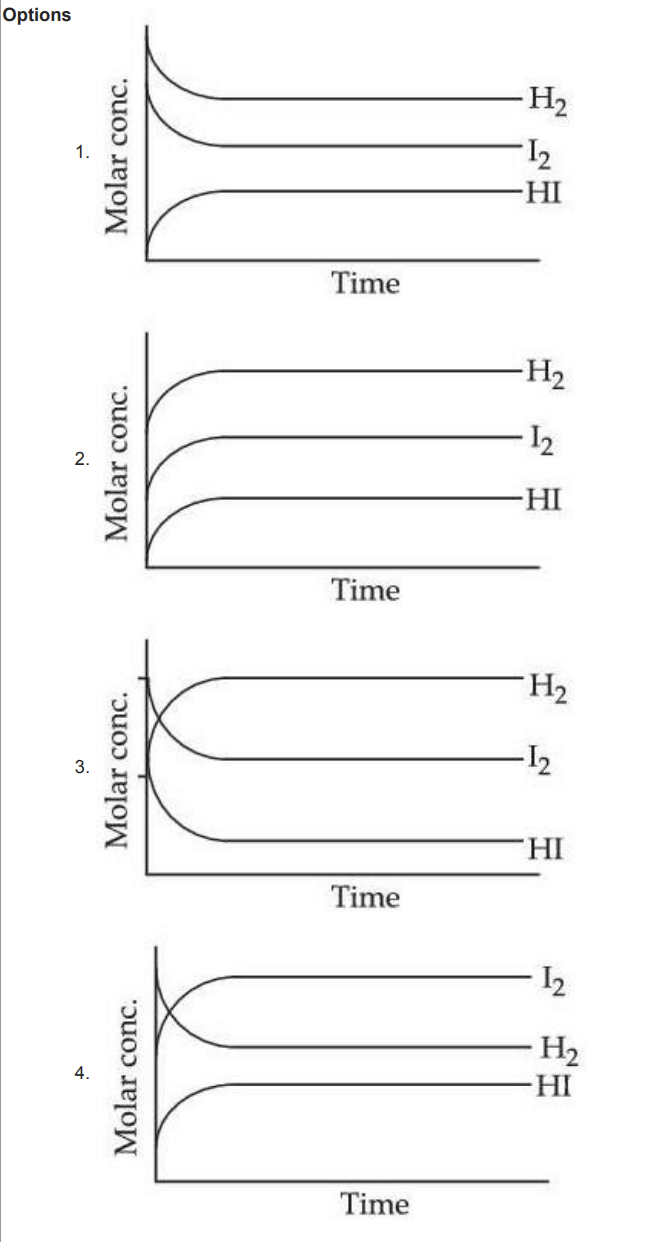
For the reaction,
Attainment of equilibrium is predicted correctly by:
1
A
2
B
3
C
4
D
Official Solution
Correct Option: (3)
- For the reaction at equilibrium, the concentrations of the reactants ( and ) decrease, and the concentration of the product ( ) increases over time.
- As the system reaches equilibrium, the concentration of the reactants will stabilize and the product concentration will also stabilize. Thus, the graph where the concentrations of and decrease and the concentration of increases correctly represents the attainment of equilibrium. Final Answer: Option (3).
22
PYQ 2025
medium
chemistryID: jee-main
Choose the incorrect trend in the atomic radii (r) of the elements :
1
2
3
4
Official Solution
Correct Option: (2)
To determine the incorrect trend among the given atomic radii, let's review the basic concept of atomic radii trends in the periodic table:
Atomic radius generally decreases across a period from left to right due to the increase in nuclear charge which pulls the electrons closer to the nucleus, thereby decreasing the size.
Atomic radius generally increases down a group due to the addition of electron shells, which outweighs the effect of increased nuclear charge, resulting in a larger size.
Now, let's evaluate each option:
: Bromine ( ) is located to the right of Potassium ( ) in the periodic table, and both elements are in the same period. Thus, will have a smaller atomic radius than . This trend is correct.
: Magnesium ( ) and Aluminum ( ) are in the same period, with located to the left of . Therefore, should have a smaller atomic radius than due to the increased nuclear charge. Thus, the given trend is incorrect.
: Rubidium ( ) and Cesium ( ) are in the same group with below . Therefore, should have a larger atomic radius than due to the additional electron shell. This trend is correct.
: Astatine ( ) is below Bromine and is a halogen, while Cesium ( ) is an alkali metal. Despite their group differences, Cesium is known to have one of the largest atomic radii in its period and is generally larger than Astatine. This trend is correct.
The correct answer is the option where the stated trend is wrong: .
23
PYQ 2025
medium
chemistryID: jee-main
Consider the following elements In, Tl, Al, Pb, and Ge. The most stable oxidation states of elements with highest and lowest first ionisation enthalpies, respectively, are:
1
+2 and +3
2
+4 and +1
3
+4 and +3
4
+1 and +4
Official Solution
Correct Option: (2)
Given elements are: Indium (In), Thallium (Tl), Aluminum (Al), Lead (Pb), Tin (Sn), and Germanium (Ge).
We need to determine the most stable oxidation states of the elements with the highest and lowest first ionization enthalpies from this group.
Position in the periodic table:
Aluminum (Al): Group 13, Period 3
Germanium (Ge): Group 14, Period 4
Tin (Sn): Group 14, Period 5
Indium (In): Group 13, Period 5
Lead (Pb): Group 14, Period 6
Thallium (Tl): Group 13, Period 6
Ionization enthalpy trends: - Ionization enthalpy generally increases across a period and decreases down a group. - Among these elements, **Aluminum (Al)** has the highest first ionization enthalpy because it is the lightest and topmost element in its group. - Thallium (Tl) has the lowest first ionization enthalpy due to its position in Period 6, where the inert pair effect becomes significant.
Oxidation states:
Aluminum (Al), with the highest ionization enthalpy, typically shows a +3 oxidation state. This is the most stable oxidation state for Al, as it readily loses all three valence electrons.
Thallium (Tl), with the lowest ionization enthalpy, shows both +3 and +1 oxidation states. However, due to the **inert pair effect**, the +1 oxidation state is more stable than +3.
This trend is also seen in other heavier p-block elements like Pb and Sn, where the +2 oxidation state becomes more stable compared to the +4 state because of the inert pair effect.
Conclusion: - The element with the highest first ionization enthalpy is **Aluminum (Al)**, which has a most stable oxidation state of **+3**. - The element with the lowest first ionization enthalpy is **Thallium (Tl)**, which has a most stable oxidation state of **+1**.
Final Answer: The final answer is .
24
PYQ 2025
medium
chemistryID: jee-main
For the reaction, $ $ Attainment of equilibrium is predicted correctly by:
1
2
3
4
Official Solution
Correct Option: (3)
- For the reaction at equilibrium, the concentrations of the reactants ( and ) decrease, and the concentration of the product ( ) increases over time. - As the system reaches equilibrium, the concentration of the reactants will stabilize and the product concentration will also stabilize. Thus, the graph where the concentrations of and decrease and the concentration of increases correctly represents the attainment of equilibrium.
Final Answer: Option (3).
25
PYQ 2025
medium
chemistryID: jee-main
The correct option with order of melting points of the pairs (Mn, Fe), (Tc, Ru) and (Re, Os) is:
1
Fe < Mn, Ru < Tc and Re < Os
2
Mn < Fe, Tc < Ru and Os < Re
3
Mn < Fe, Tc < Ru and Re < Os
4
Fe < Mn, Ru < Tc and Os < Re
Official Solution
Correct Option: (3)
The question involves determining the order of melting points for pairs of elements (Mn, Fe), (Tc, Ru), and (Re, Os). We have four options to consider. Let's analyze each pair:
Mn (Manganese) and Fe (Iron): Manganese has a lower melting point compared to Iron. Therefore, Mn < Fe.
Tc (Technetium) and Ru (Ruthenium): Technetium, being in the same column group earlier than Ruthenium, has a lower melting point. Thus, Tc < Ru.
Re (Rhenium) and Os (Osmium): Rhenium has a lower melting point compared to Osmium, so Re < Os.
Based on the analysis, the correct order of the melting points is Mn < Fe, Tc < Ru and Re < Os.
This corresponds to the correct option given: Mn < Fe, Tc < Ru and Re < Os
26
PYQ 2025
medium
chemistryID: jee-main
Consider the following statements: Statement I: is more acidic than Statement II: has higher bond dissociation enthalpy In light of the above statements, choose the correct option.
1
Statement-I is true & Statement-II is false
2
Statement-I is false & Statement-II is true
3
Both Statement-I & Statement-II are true
4
Both Statement-I & Statement-II are false
Official Solution
Correct Option: (1)
Let's evaluate both statements one by one:
Statement I: is more acidic than :** is more acidic than because selenium is in the same group as oxygen but below sulfur in the periodic table. As we move down a group, the bond strength between the hydrogen and the element (e.g., Se-H) decreases, making it easier to lose the proton (H ) and thus increasing acidity. On the other hand, in , iron has a much stronger bond with hydrogen, making it less acidic. Hence, Statement I is **true**. Statement II: has higher bond dissociation enthalpy:** Bond dissociation enthalpy increases with increasing bond strength. Since Se-H bonds in are weaker than Fe-H bonds in , has lower bond dissociation enthalpy. Thus, Statement II is **false**.
Therefore, the correct answer is (1) Statement-I is true & Statement-II is false.
27
PYQ 2025
medium
chemistryID: jee-main
Correct order of electronegativity in below elements:
1
(N)
2
(O)
3
(F)
4
(Ne)
Official Solution
Correct Option: (4)
Electronegativity is the tendency of an atom to attract a bonding pair of electrons. The electronegativity increases as you move across a period (from left to right) and decreases as you move down a group (from top to bottom). Let's analyze the given elements: - (Nitrogen) has an electronegativity value of 3.04.
- (Oxygen) has an electronegativity value of 3.44.
- (Fluorine) has the highest electronegativity value of 3.98.
- (Neon) is a noble gas and does not readily form bonds, so it does not have a defined electronegativity in typical cases. The correct order of electronegativity from highest to lowest is . Hence, the correct answer is option (4) .
28
PYQ 2025
hard
chemistryID: jee-main
Consider the following elements In, Tl, Al, Pb, and Ge. The most stable oxidation states of elements with highest and lowest first ionisation enthalpies, respectively, are:
1
+2 and +3
2
+1 and +4
3
+4 and +3
4
+4 and +1
Official Solution
Correct Option: (2)
Aluminum typically has the highest ionisation enthalpy among the given elements and commonly exhibits a +3 oxidation state. Lead, with the lowest ionisation enthalpy, shows stability in the +4 oxidation state due to inert pair effect.
29
PYQ 2025
medium
chemistryID: jee-main
An element 'E' has the ionisation enthalpy value of 374 kJ mol . 'E' reacts with elements A, B, C, and D with electron gain enthalpy values of , , , and kJ mol , respectively. The correct order of the products EA, EB, EC, and ED in terms of ionic character is:
1
2
3
4
Official Solution
Correct Option: (3)
The ionic character of a compound depends on the difference in ionisation enthalpy and electron gain enthalpy. The larger the difference, the greater the ionic character. A compound with a more negative electron gain enthalpy will result in a stronger ionic bond. Given that the electron gain enthalpy values for elements A, B, C, and D are as follows: - has - has - has - has The order of ionic character is given by the electron gain enthalpy, where has the highest ionic character and has the least. Thus, the correct order is (3): .
30
PYQ 2026
medium
chemistryID: jee-main
Given below are two statements: Statement I: is the correct order in terms of metallic character. Statement II: Atomic radius is always greater than the ionic radius for any element. In the light of the above statements, choose the correct answer from the options given below:
1
Statement I is false but Statement II is true
2
Statement I is true but Statement II is false
3
Both Statement I and Statement II are false
4
Both Statement I and Statement II are true
Official Solution
Correct Option: (2)
Step 1: Analysis of Statement I. Metallic character increases down a group and decreases from left to right across a period. Potassium is the most metallic, followed by magnesium, aluminium and then boron. Hence, the order is correct. Statement I is true. Step 2: Analysis of Statement II. Atomic radius is not always greater than ionic radius. For cations, ionic radius is smaller than atomic radius. For anions, ionic radius is larger than atomic radius. Hence, the statement is incorrect. Statement II is false. Step 3: Conclusion. Statement I is true but Statement II is false.
31
PYQ 2026
easy
chemistryID: jee-main
The correct order of C, N, O and F in terms of second ionisation potential is
1
C < N < F < O
2
F < N < C < O
3
C < O < N < F
4
C < F < N < O
Official Solution
Correct Option: (1)
Step 1: Understanding second ionisation potential. Second ionisation potential refers to the energy required to remove an electron from a singly charged positive ion. The stability of the resulting ion plays a crucial role. Step 2: Electronic configurations after first ionisation. C : N : O : (half-filled, extra stable) F : Step 3: Comparing stability. O has a half-filled configuration, making removal of the next electron difficult. Hence, oxygen has the highest second ionisation potential among the given elements. Step 4: Conclusion. Therefore, the correct increasing order of second ionisation potential is: C < N < F < O
32
PYQ 2026
hard
chemistryID: jee-main
Given below are two statements: Statement I: The first ionization enthalpy of Cr is lower than that of Mn. Statement II: The second and third ionization enthalpies of Cr are higher than those of Mn. In the light of the above statements, choose the correct answer from the options given below:
1
Both Statement I and Statement II are true
2
Statement I is true but Statement II is false
3
Statement I is false but Statement II is true
4
Both Statement I and Statement II are false
Official Solution
Correct Option: (1)
Step 1: Analyze Statement I. Electronic configurations: In chromium, removal of one electron leads to the particularly stable half-filled configuration. Hence, the first ionization enthalpy of Cr is lower than that of Mn. Therefore, Statement I is true.
Step 2: Analyze Statement II. After the first ionization, chromium forms with configuration , which is highly stable. Removing the second and third electrons from this stable half-filled configuration requires more energy. In contrast, manganese does not gain such exceptional stability after the first ionization. Therefore, the second and third ionization enthalpies of Cr are higher than those of Mn. Hence, Statement II is also true.
Step 3: Final conclusion. Both Statement I and Statement II are true.
Final Answer:
33
PYQ 2026
easy
chemistryID: jee-main
Which of the following is the correct order with respect to the property indicated?
1
(Ionisation energy)
2
(Basic nature)
3
(Metallic character)
4
None of these
Official Solution
Correct Option: (2)
Option (A): Incorrect. Ionisation energy decreases down a group, hence:
Option (B): Correct. Basic nature of metal oxides decreases from left to right across a period:
Option (C): Incorrect. Metallic character decreases across a period. Correct order is:
Option (D): Incorrect since option (B) is correct.
34
PYQ 2026
medium
chemistryID: jee-main
Consider the following statements about group 13 elements of the periodic table. (A) Electronegativity decreases down the group.
(B) Size increases down the group.
(C) Ionization energy decreases down the group.
(D) Boiling point of Boron is maximum.
(E) Melting point of Boron is maximum.
1
A, B, C are correct
2
A, D, E are correct
3
D and E are correct
4
A, B, C, D and E are correct
Official Solution
Correct Option: (3)
Step 1: Understanding the properties of group 13 elements. - Electronegativity decreases down the group due to the increase in size of atoms. - The size of atoms increases as we go down the group due to the addition of electron shells. - Ionization energy decreases down the group as the outer electrons are farther from the nucleus and are more easily removed. - The boiling and melting points of Boron are higher than those of other elements in the group due to its small atomic size and strong covalent bonds. Step 2: Conclusion. Therefore, the correct answer is (3) D and E are correct.
35
PYQ 2026
easy
chemistryID: jee-main
The correct order of electron gain enthalpy (magnitude only) for group 16 elements is:
1
2
3
4
Official Solution
Correct Option: (2)
Concept: Electron gain enthalpy is the enthalpy change when an electron is added to a neutral gaseous atom. Since the values are generally negative, magnitude only means we compare how strongly atoms attract an extra electron, ignoring the sign. Key factors affecting electron gain enthalpy: Atomic size Effective nuclear charge Electron--electron repulsion in small orbitals Step 1: Trend in group 16 elements. Group 16 elements are:
On moving down the group: Atomic size increases Electron gain enthalpy generally becomes less negative However, oxygen is an exception due to its very small size. Step 2: Comparing oxygen with sulfur. Oxygen has a very small orbital. When an extra electron enters, there is strong electron--electron repulsion, which reduces its tendency to gain an electron. Sulfur has a larger orbital, so it can accommodate an extra electron more easily. Hence:
Step 3: Comparing sulfur, selenium, and tellurium. As we move down from sulfur to selenium to tellurium: Atomic size increases Attraction for incoming electron decreases Therefore:
Step 4: Final order (magnitude only). Combining all comparisons:
36
PYQ 2026
medium
chemistryID: jee-main
Correct order of ionisation enthalpy is:
1
2
3
4
Official Solution
Correct Option: (4)
Concept: Ionisation enthalpy is the energy required to remove an electron from a gaseous species. Key points: Smaller atomic size higher ionisation enthalpy Anions have lower ionisation enthalpy than their neutral atoms due to extra electron–electron repulsion Step 1: Compare neutral atoms and . Fluorine is smaller than chlorine, so its valence electron is held more strongly. Step 2: Compare anions and . Although both are anions: is smaller Extra electron experiences less shielding Hence, removing an electron from requires more energy than from . Step 3: Compare atoms with their respective anions. Anions always have lower ionisation enthalpy than their neutral atoms due to increased electron–electron repulsion. Step 4: Final order. Combining all comparisons:
37
PYQ 2026
medium
chemistryID: jee-main
The correct order of ionisation energy of Cl, S, P, Al, Si is:
1
2
3
4
Official Solution
Correct Option: (1)
Concept:
Ionisation energy is the minimum energy required to remove the most loosely bound electron from a gaseous atom.
General trends: Ionisation energy increases across a period from left to right. It decreases down a group. Half-filled and fully filled orbitals are more stable and have higher ionisation energy. Step 1: All given elements belong to the 3rd period of the periodic table. Across a period, ionisation energy generally increases due to: Increasing nuclear charge Decreasing atomic size Step 2: Exception between phosphorus and sulfur. Electronic configurations:
Phosphorus has a half-filled -subshell, which is extra stable. Sulfur has one paired electron in the -orbital, causing increased electron–electron repulsion. Step 3: Final order of ionisation energy:
38
PYQ 2026
medium
chemistryID: jee-main
Out of , number of valence electrons in the {least metallic element and most metallic element respectively is:
}
1
2
3
4
Official Solution
Correct Option: (2)
Concept:
Metallic character:
Increases down a group
Decreases from left to right across a period
Valence electrons are determined by the group number of the element. Step 1: Identify the Least Metallic Element Among the given elements:
Fluorine ( ) is the most electronegative element. Hence, it is the least metallic .
Fluorine belongs to Group 17:
Step 2: Identify the Most Metallic Element
Phosphorus ( ) lies below nitrogen in Group 15. Metallic character increases down the group.
Hence, is the most metallic among the given elements. Phosphorus belongs to Group 15:
Final Conclusion:
39
PYQ 2026
medium
chemistryID: jee-main
Four elements from the second period Boron to Oxygen can have the following IE values (in kJ mol ): 1086.5, 800.6, 1313.9, 1402.3. The value of IE for Nitrogen is:
1
1086.5
2
800.6
3
1402.3
4
1313.9
Official Solution
Correct Option: (3)
Step 1: Identifying the elements. The elements from Boron to Oxygen have the following trend in IE : Boron (B) → 1086.5, Carbon (C) → 800.6, Nitrogen (N) → 1402.3, Oxygen (O) → 1313.9
Step 2: Analyzing the trends. The ionization energies for Nitrogen (N) are higher than those for Carbon (C) and Oxygen (O) due to the stability of its half-filled p-orbital configuration.
Step 3: Conclusion. The value of IE for Nitrogen is 1402.3 kJ/mol, corresponding to option (3).
40
PYQ 2026
medium
chemistryID: jee-main
Given below are two statements:Statement-I: The correct order for radius is Statement-II: Atomic size always depends on electronegativity. In the light of the above statements, choose the correct option.
1
Statement-I and Statement-II are correct
2
Both Statement-I and Statement-II are incorrect
3
Statement-I is correct but Statement-II is incorrect
4
Statement-I is incorrect but Statement-II is correct
Official Solution
Correct Option: (2)
Concept: Atomic and ionic radii depend on several factors such as:
Nuclear charge
Number of shells
Shielding effect
Charge on the ion
Electronegativity is not the sole deciding factor for atomic size.
Analysis of Statement-I:
Consider neutral atoms and :
and lie in the same period (Period 3).
Across a period, atomic radius decreases due to increasing nuclear charge.
Hence, the given order is incorrect because of the trend of atomic radius across a period.
Now consider the ions:
Cations are smaller than their parent atoms, so .
Higher the positive charge, smaller the ionic radius.
The correct ionic order should be:
Thus, the overall order should be , and Statement-I is incorrect.
Analysis of Statement-II:
The statement says: and
However, the statement is incorrect because:
Atomic size primarily depends on nuclear charge and shielding effect.
Electronegativity is a consequence of atomic size, not the controlling factor.
The word "always" makes the statement absolutely false.
Thus, Statement-II is also incorrect.
Final Conclusion:
Both Statement-I and Statement-II are incorrect.
41
PYQ 2026
medium
chemistryID: jee-main
In period 4 of the periodic table which elements have the lowest and highest atomic radii respectively?
1
K and Br
2
Na and Cl
3
K and Se
4
Rb and Br
Official Solution
Correct Option: (1)
Concept:
Atomic radius in a period generally:
Decreases from left to right due to increasing nuclear charge. Electrons are added to the same shell while effective nuclear charge increases. Noble gases are usually excluded when comparing atomic radii due to van der Waals radius.
Step 1: Identify the elements of period 4. Step 2: Determine the element with the highest atomic radius. In a period, the alkali metal (first element) has the largest atomic radius. Step 3: Determine the element with the lowest atomic radius. Atomic radius decreases across the period. Excluding noble gases, the smallest atomic radius in period 4 is of the halogen. Conclusion:
Hence, the correct answer is (1) K and Br.
42
PYQ 2026
medium
chemistryID: jee-main
Given below are two statements: Statement I: The correct order for radius is . Statement II: Atomic size always depends on electronegativity. In the light of the above statements, choose the correct option.
1
Both Statement I and Statement II are correct
2
Both Statement I and Statement II are incorrect
3
Statement I is correct but Statement II is incorrect
4
Statement I is incorrect but Statement II is correct
Official Solution
Correct Option: (3)
Step 1: Analyzing Statement I. The given order for radii is . This order is correct because:
- (atomic radius of aluminum) is larger than (atomic radius of magnesium) due to fewer protons in Al's nucleus compared to Mg.
- (Mg ion) has a smaller radius than Mg due to the loss of electrons and increased nuclear attraction.
- (Al ion) has the smallest radius due to the even higher nuclear charge and fewer electrons. So, Statement I is correct. Step 2: Analyzing Statement II. Statement II says atomic size always depends on electronegativity. However, atomic size primarily depends on factors like nuclear charge, electron shielding, and quantum levels, rather than just electronegativity. Therefore, Statement II is incorrect. Thus, the correct answer is (3).
43
PYQ 2026
easy
chemistryID: jee-main
Electronegativity difference between a group 15 element and is less than electronegativity difference between another group 15 element and . Those group 15 elements respectively are :
1
2
3
4
Official Solution
Correct Option: (1)
The Group 15 elements are . Electronegativity ( ) generally decreases down the group. Approximate Pauling EN values: , , , , . We calculate difference with : 1. . 2. . 3. . 4. . Let be the element with smaller EN difference, and be the element with larger EN difference. Smallest difference with is (0.1). Second smallest is or (0.2). Largest difference with is (0.9). We need a pair (Element 1, Element 2) such that . Checking Option (1): . . . . The first element ( ) has a smaller than the second element ( ). (1) is Correct.