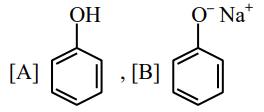
Consider the following reactions:The products [A] and [B], respectively are:
1
and
2
and
3
and
4
and
Official Solution
Correct Option: (3)
To solve this question, we need to analyze the given chemical reactions step-by-step and determine the products [A] and [B]. Let's go through the reactions:
The first reaction is:
In this reaction, potassium dichromate reacts with potassium hydroxide under heat. The product formed, [A], is potassium chromate . This involves a change from the dichromate anion to the chromate anion.
The second reaction is:
In this reaction, [A] (which we identified as ) reacts with sulfuric acid . This reaction converts the chromate ion back to the dichromate ion. The product [B] is potassium dichromate, , and potassium sulfate is also formed.
Therefore, the correct products for the reactions are:
[A]:
[B]:
Given these deductions, the correctly matched products according to the options provided are:
and
02
PYQ 2025
medium
chemistryID: jee-main
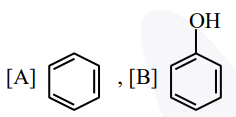
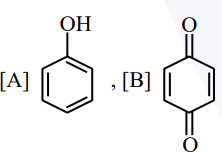
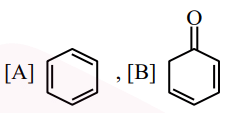
Identify the products [A] and [B] respectively in the following reaction:
1
2
3
4
Official Solution
Correct Option: (3)
To determine the products [A] and [B] in the given reaction, let's analyze each step:
The initial reactant is chlorobenzene (C6H5Cl). The reaction with is typical of a nucleophilic aromatic substitution. Under these harsh conditions, the chlorine atom is replaced by an OH group, forming phenol (C6H5OH).
Next, phenol (C6H5OH) is oxidized using . This is a classic oxidation reaction where phenol is oxidized to benzoquinone.
So, the products are:
[A] is phenol (C6H5OH)
[B] is benzoquinone
The correct answer matches the provided option with products , which indicates phenol followed by oxidation to benzoquinone.
03
PYQ 2026
medium
chemistryID: jee-main
Correct statements from the following are: A. Potassium dichromate is an oxidising agent and it oxidises FeSOβ to Feβ(SOβ)β in acidic medium. B. Sodium dichromate can be used as primary standard in volumetric estimation. C. CrOβΒ²β» and CrβOβΒ²β» are interconvertible in aqueous solution by varying the pH of the solution. D. Cr-O-Cr bond angle in CrβOβΒ²β» is 126Β°. Choose the correct answer:
1
A, B and C Only
2
A, C and D Only
3
A and C Only
4
B and D Only
Official Solution
Correct Option: (2)
Step 1: Understanding the Concept:
Dichromates are powerful oxidizing agents in acidic media. Their chemical properties involve pH-dependent equilibria and specific structural parameters in the solid state.
Step 2: Key Formula or Approach:
1. Reaction: .
2. Equilibrium: .
Step 3: Detailed Explanation:
1. Statement A analysis: is a well-known oxidant in acidic medium and converts (ferrous) to (ferric). This is true.
2. Statement B analysis: Sodium dichromate ( ) is hygroscopic (absorbs moisture), which prevents it from being a primary standard. Potassium dichromate is used instead because it is non-hygroscopic. This is false.
3. Statement C analysis: Chromate ( , yellow) and dichromate ( , orange) exist in equilibrium. Low pH (acidic) favors dichromate; high pH (basic) favors chromate. This is true.
4. Statement D analysis: The dichromate ion consists of two tetrahedra sharing an oxygen atom, with a bond angle of 126Β°. This is true.
Step 4: Final Answer:
Statements A, C, and D are correct.
04
PYQ 2026
medium
chemistryID: jee-main
Consider the following molecules/species:
The correct order of carbon - oxygen double bond length is :
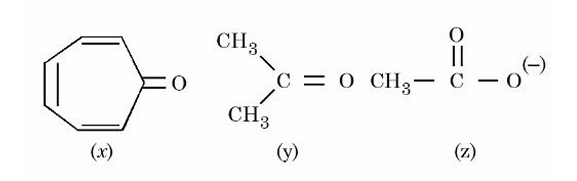
1
2
3
4
Official Solution
Correct Option: (3)
Step 1: Understanding the Concept: The bond length of a covalent bond is inversely proportional to its bond order. A pure double bond is shorter than a bond that has partial single bond character due to resonance or conjugation.
Step 2: Key Formula or Approach: Analyze the resonance and conjugation in each species: 1. (y) Propanone: Isolated double bond (Bond order ). 2. (x) Benzoquinone-like structure: is in conjugation with the ring system (Bond order ). 3. (z) Acetate ion: is in complete resonance with the other oxygen atom (Bond order ).
Step 3: Detailed Explanation: In species (y), the carbonyl group is localized, making it a strong double bond with the highest bond order and shortest length. In species (x), the carbonyl oxygen is conjugated with the cyclohexadiene ring. Resonance slightly reduces the double bond character, increasing the bond length relative to (y). In species (z), the acetate ion ( ) exhibits equivalent resonance structures where the negative charge is delocalized over both oxygen atoms. The bond order for each C-O bond is exactly 1.5, which is much lower than 2. This results in the longest bond length among the three. Therefore, the length order is: .
Step 4: Final Answer: The correct order of bond length is .