Class XII students were asked to prepare one litre of buffer solution of pH by their Chemistry teacher. The amount of ammonium chloride to be dissolved by the student in M ammonia solution to make one litre of the buffer is (Given : = , Molar mass of = g , Molar mass of = )
1
53.5 g
2
72.3 g
3
107.0 g
4
126.0 g
Official Solution
Correct Option: (3)
For basic Buffer,
Moles of
Weight of =
02
PYQ 2023
hard
chemistryID: jee-main
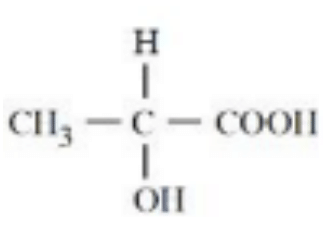
If the pKa of lactic acid is 5, then the pH of 0.005 M calcium lactate solution at is (Nearest integer). Lactic Acid
Official Solution
Correct Option: (1)
The concentration of calcium lactate is given as 0.005 M. Since calcium lactate dissociates completely, the concentration of lactate ions is:
Calcium lactate is a salt of a weak acid (lactic acid) and a strong base (calcium hydroxide). Therefore, hydrolysis of the salt will take place, and the pH can be calculated as:
Substituting the values:
Simplify:
Thus, the pH is:
03
PYQ 2023
easy
chemistryID: jee-main
A litre of buffer solution contains mole of each of and On the addition of mole of by dissolving gaseous , the of the solution is found to be ____ (Nearest integer) [Given :
Official Solution
Correct Option: (1)
The correct answer is 9079. In resultant solution nNH3ββ=0.1β0.02=0.08 nNH4βClβ=nNH4+ββ=0.1+0.02=0.12 pOH=pKbβ+log[NH3β][NH4+β]β =4.745+log0.080.12β =4.745+log23β =4.745+0.477β0.301 pOH=4.921 pH=14βpH =9.079
04
PYQ 2024
medium
chemistryID: jee-main
Given below are two statements: Statement (I) : A Buffer solution is the mixture of a salt and an acid or a base mixed in any particular quantities. Statement (II) : Blood is naturally occurring buffer solution whose pH is maintained by concentrations. In the light of the above statements, choose the correct answer from the options given below.
1
Statement I is false but Statement II is true
2
Both Statement I and Statement II is true
3
Both Statement I and Statement II is false
4
Statement I is true but Statement II is false
Official Solution
Correct Option: (1)
Let's analyze the given statements and their validity concerning buffer solutions and physiological examples such as blood.
Statement I: "A Buffer solution is the mixture of a salt and an acid or a base mixed in any particular quantities."
This statement is false because a buffer solution is not just any mixture of a salt and an acid or base. It specifically consists of a weak acid and its conjugate base (or a weak base and its conjugate acid) in a suitable ratio. This combination helps maintain a stable pH upon the addition of small amounts of acid or base.
Statement II: "Blood is naturally occurring buffer solution whose pH is maintained by concentrations."
This statement is true. Blood is indeed a natural buffer system primarily maintained by a carbonic acid ( ) and bicarbonate ( ) buffer system. This mechanism is efficient in regulating the pH of blood around 7.4, crucial for physiological processes.
In conclusion, the correct option is that Statement I is false but Statement II is true. This correctly identifies the nature of buffers and recognizes the specific biological example of blood as a buffering system.
05
PYQ 2025
medium
chemistryID: jee-main
Only litre buffer solution was prepared by adding 0.10 mol each of and in deionised water. The change in pH on addition of 0.05 mol of HCl to the above solution is _____ , (Nearest integer) (Given : of and )
Official Solution
Correct Option: (1)
Step 1: Calculate the initial pH of the buffer solution. Using the Henderson-Hasselbalch equation for a basic buffer: $ M, M \) $ The magnitude of the change is . Expressing this in the required format: . Rounding to the nearest integer gives 48.
06
PYQ 2026
medium
chemistryID: jee-main
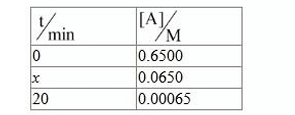
For a first order reaction ,
x = _______ min. (Nearest integer)
Official Solution
Correct Option: (1)
Step 1: Understanding the Concept:
For a first-order reaction, the rate constant is given by . The time required for a certain percentage of completion depends only on , not the initial concentration.
Step 2: Key Formula or Approach:
Use the integrated rate law: .
Step 3: Detailed Explanation:
Step 1: Find using the data at min.
.
Step 2: Use to find .
.
Substituting :
Nearest integer = 7.
Step 4: Final Answer:
The value of x is 7 min.
07
PYQ 2026
medium
chemistryID: jee-main
The pH of a solution obtained by mixing 5 mL of 0.1 M solution with 250 mL of 0.1 M solution is ______ Γ 10β»Β². (Nearest integer) Given: = 4.74
Official Solution
Correct Option: (1)
Step 1: Understanding the Concept:
A mixture of a weak base ( ) and its salt ( ) forms a basic buffer. The is calculated using the Henderson-Hasselbalch equation, and then converted to .
Step 2: Key Formula or Approach:
1.
2.
Step 3: Detailed Explanation:
1. Moles of Base ( ) =
2. Moles of Salt ( ) =
3. Calculate :
4. Calculate :
5. Final value: .
Step 4: Final Answer:
The value is 756.
08
PYQ 2026
medium
chemistryID: jee-main
At 298 K, the mole percentage of N (g) in air is 80%. Water is in equilibrium with air at a pressure of 10 atm. What is the mole fraction of N (g) in water at 298 K? ( for N = mm Hg)
1
2
3
4
Official Solution
Correct Option: (1)
Step 1: Partial pressure of N .
Step 2: Using Henryβs law.
Converting atm to mm Hg: mm Hg
09
PYQ 2026
medium
chemistryID: jee-main
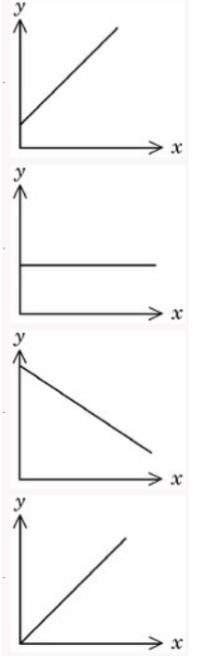
Consider a solution of CO (g) dissolved in water in a closed container. Which one of the following plots correctly represents variation of (partial pressure of CO in vapour phase above water) [y-axis] with (mole fraction of CO in water) [x-axis] at C?
1
A
2
B
3
C
4
D
Official Solution
Correct Option: (1)
Step 1: Apply Henry's law. For a gas dissolved in a liquid at constant temperature:
where is the partial pressure of the gas and is its mole fraction in solution. Step 2: Take logarithm of both sides. This is a linear equation of the form:
Step 3: Interpret the graph. - Slope
- Straight line
- Positive intercept on y-axis Thus, the correct plot is a straight line with positive slope and non-zero intercept. Final Answer:
10
PYQ 2026
hard
chemistryID: jee-main
Given below are two statements: Statement I: The Henryβs law constant is constant with respect to variations in solution concentration over the range for which the solution is ideally dilute. Statement II: does not differ for the same solute in different solvents. In the light of the above statements, choose the correct answer from the options given below.
1
Both Statement I and Statement II are false
2
Statement I is false but Statement II is true
3
Both Statement I and Statement II are true
4
Statement I is true but Statement II is false
Official Solution
Correct Option: (3)
Step 1: Analyze Statement I. Henryβs law states that the partial pressure of a gas is directly proportional to its mole fraction in a solution for dilute solutions. Within the ideal dilute range, the Henryβs law constant remains constant. Thus, Statement I is true. Step 2: Analyze Statement II. The value of Henryβs law constant depends on the nature of both the solute and the solvent. For the same solute, different solvents interact differently with the gas molecules, leading to different values. Hence, Statement II is false. Step 3: Final conclusion. Statement I is true but Statement II is false. Final Answer: