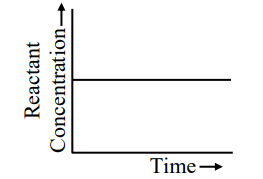
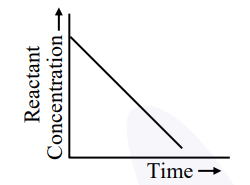
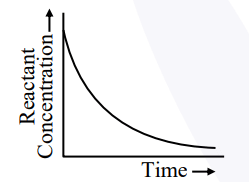
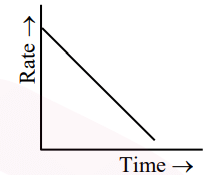
Which of the following graphs most appropriately represents a zero-order reaction?
1
2
3
4
Official Solution
Correct Option: (2)
To solve this problem, we need to understand the characteristics of a zero-order chemical reaction. In a zero-order reaction, the rate of reaction is constant and independent of the concentration of the reactants.
The rate equation for a zero-order reaction can be expressed as:
where is the rate constant.
The integrated rate law for a zero-order reaction is given by:
where is the concentration of the reactant at time , is the initial concentration, is the rate constant, and is the time elapsed.
This equation resembles the equation of a straight line:
In this context, the concentration acts as , time as , as the slope , and as the intercept .
Therefore, for a zero-order reaction, a plot of vs. will be a straight line with a negative slope. Given the options, the correct graph that represents a zero-order reaction is:
This graph clearly shows a linear decrease in concentration over time, indicating a zero-order reaction.
Let's summarize why other options are incorrect:
Other graphs would represent different order reactions (like first or second order) typically showing a nonlinear relationship between the concentration and time.
02
PYQ 2025
medium
chemistryID: jee-main
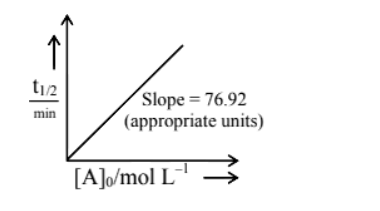
For the reaction products, The reaction was started with 2.5 mol L of A.
Official Solution
Correct Option: (1)
From the graph, we know that is proportional to . The slope is given as 76.92. Thus, using the equation for zero-order reaction: Thus, Now, applying the formula for zero-order reaction: Thus, the concentration of A at 10 minutes is .
03
PYQ 2026
medium
chemistryID: jee-main
The correct set that contains all kinds (basic, acidic, amphoteric and neutral) of oxides is:
1
and
2
and
3
and
4
and
Official Solution
Correct Option: (2)
- Basic oxides are oxides that react with acids to form salts and water. Example: , .
- Acidic oxides react with bases to form salts and water. Example: , .
- Amphoteric oxides can react with both acids and bases. Example: , .
- Neutral oxides do not react with either acids or bases. Example: . Therefore, the correct set is:
Final Answer: (B) and
04
PYQ 2026
medium
chemistryID: jee-main
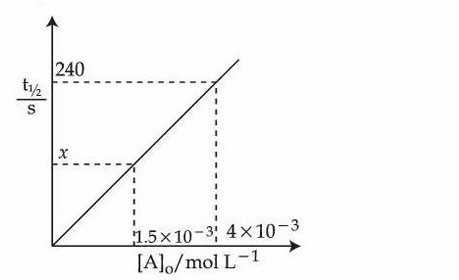
For a reaction at K, the half life ( ) is plotted as a function of initial concentration of A as given below. The value of in the given figure is ______ s (Nearest integer)}
Official Solution
Correct Option: (1)
Step 1: Understanding the Concept:
The graph of versus is a straight line passing through the origin. This implies that , which is the defining characteristic of a zero-order reaction. : Key Formula or Approach:
For a zero-order reaction: .
Since the graph is a straight line through the origin, the slope is constant:
Slope = . Step 2: Detailed Explanation:
We have two points from the graph:
Point 1: .
Point 2: .
Using the constant slope property:
.
.
. Step 3: Final Answer:
The value of is 90.
05
PYQ 2026
medium
chemistryID: jee-main
is the time required for 100% completion of a reaction, while is the time required for 50% completion of the reaction. Which of the following correctly represents the relation between and for zero order and first order reactions respectively
1
2
3
4
Official Solution
Correct Option: (2)
Concept:
Zero order reaction Thus,
First order reaction In first order reactions, reactant concentration approaches zero asymptotically, so the reaction never reaches exactly completion. Thus,