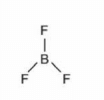
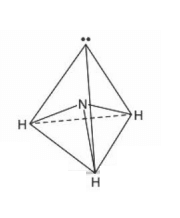
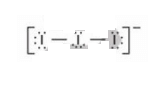
: Trigonal pyramidal with bond angles of : Linear with bond angles .
: Trigonal pyramidal with bond angles of
02
PYQ 2022
easy
chemistryID: jee-main
Which of the following pair of molecules contain odd electron molecule and an expanded octet molecule?
1
BCl3 and SF6
2
NO and H2SO4
3
SF6 and H2SO4
4
BCl3 and NO
Official Solution
Correct Option: (2)
To determine which pair of molecules, contain an odd electron molecule and an expanded octet molecule, let's analyze each option:
BCl3 and SF6:
BCl3 (Boron Trichloride) is a compound in which boron has an incomplete octet. Boron has three valence electrons, bonding with three chlorine atoms without expanding its octet.
SF6 (Sulfur Hexafluoride) has sulfur with six fluorine atoms bonded, leading to an expanded octet with 12 valence electrons around sulfur.
This option does contain an expanded octet molecule (SF6), but BCl3 does not have an odd electron.
NO and H2SO4:
NO (Nitric Oxide) is a molecule with an odd number of electrons (15 in total), classifying it as an odd electron molecule.
H2SO4 (Sulfuric Acid) has sulfur with an expanded octet due to the presence of more than 8 electrons in its valence shell.
This option has both an odd electron molecule (NO) and an expanded octet molecule (H2SO4), making it the correct choice.
SF6 and H2SO4:
Both SF6 and H2SO4 have expanded octets, but neither has an odd electron molecule.
BCl3 and NO:
BCl3 does not have an odd electron or an expanded octet.
NO has an odd electron; however, the combination does not have a molecule with an expanded octet.
Therefore, the pair of molecules that includes an odd electron molecule and an expanded octet molecule is: NO and H2SO4.
03
PYQ 2023
medium
chemistryID: jee-main
bond length in is X than the bond length in The bond length in is Y than that of the bond in Choose the correct option for from those given below :
1
X-shorter, Y-shorter
2
X - shorter, Y - longer
3
X - longer, Y - shorter
4
X-longer, Y-longer
Official Solution
Correct Option: (3)
Step 1: Analyze the O–O bond length In , the oxygen atoms are bonded to hydrogen atoms. In , the oxygen atoms are bonded to fluorine atoms. Fluorine is more electronegative than hydrogen. The higher electronegativity of fluorine in leads to a greater pull of electron density towards the fluorine atoms, which weakens the O–O bond and increases its bond length. Therefore, the O–O bond length in is longer than in . So, is longer. Step 2: Analyze the O–H and O–F bond lengths The O–H bond is formed between oxygen and hydrogen, while the O–F bond is formed between oxygen and fluorine. Fluorine has a smaller atomic radius than hydrogen. Also, oxygen and fluorine have much closer electronegativities, leading to a shorter O–F bond compared to the O–H bond where there’s a larger electronegativity difference. Therefore, the O–H bond length in is shorter than the O–F bond length in . So, is shorter. Conclusion The O–O bond length in is longer than in , and the O–H bond length is shorter than the O–F bond length. This corresponds to option (4).
04
PYQ 2023
easy
chemistryID: jee-main
The correct order of bond enthalpy is :
1
2
3
4
Official Solution
Correct Option: (1)
Step 1: Consider the Trend Down the Group Bond enthalpy generally decreases down a group in the periodic table. This is because as the atomic size increases, the bond length increases, and longer bonds are weaker. Step 2: Analyze the Given Elements The elements in question are C, Si, Ge, and Sn. They all belong to Group 14. Their atomic size increases down the group in the order:
Step 3: Determine the Bond Enthalpy Order Since bond enthalpy decreases with increasing atomic size, the correct order of bond enthalpy is:
05
PYQ 2024
medium
chemistryID: jee-main
How many of the following compounds have zero dipole moment ?
Official Solution
Correct Option: (1)
The answer is 3.
06
PYQ 2024
medium
chemistryID: jee-main
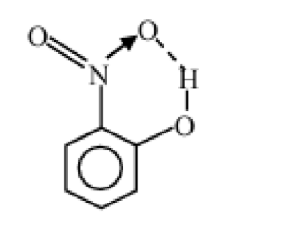
The correct statement/s about Hydrogen bonding is/are : A. Hydrogen bonding exists when H is covalently bonded to the highly electro negative atom. B. Intermolecular H bonding is present in o-nitro phenol C. Intramolecular H bonding is present in HF. D. The magnitude of H bonding depends on the physical state of the compound. E. H-bonding has powerful effect on the structure and properties of compounds. Choose the correct answer from the options given below :
1
A only
2
A, D, E only
3
A, B, D only
4
A, B, C only
Official Solution
Correct Option: (2)
(A) Generally, hydrogen bonding exists when H is covalently bonded to the highly electronegative atom like F, O, N. (B) Intramolecular H bonding is present in (C) Intermolecular Hydrogen bonding is present in HF. (D) The magnitude of Hydrogen bonding in solid state is greater than in liquid state. (E) Hydrogen bonding has a powerful effect on the structure and properties of compounds like melting point, boiling point, density, etc.
07
PYQ 2026
hard
chemistryID: jee-main
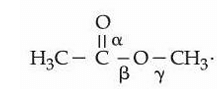
Shown below is the structure of methyl acetate with three different , and carbon–oxygen bonds. The correct order of bond lengths of these bonds is :}
1
2
3
4
Official Solution
Correct Option: (1)
Concept: Bond length depends on bond order.
Higher bond order shorter bond length.
Lower bond order longer bond length.
In methyl acetate:
: double bond
: bond in ester group (partial double bond due to resonance)
: single bond to methyl group
Step 1: {Analyze bond character} Bond length order: Thus Expressing in terms of : Which corresponds to option (B). However based on labeling in the given diagram the equivalent relation is written as
08
PYQ 2026
medium
chemistryID: jee-main
The covalent radii of atoms A and B are and , respectively. The covalent bond length and total length of AB molecule are respectively :
1
2
3
4
Official Solution
Correct Option: (3)
Step 1: Understanding the Concept:
Covalent radius is defined as half of the distance between the nuclei of two bonded atoms in a homonuclear molecule. For a heteronuclear molecule AB, the bond length is approximately the sum of the covalent radii of the two atoms. Step 2: Detailed Explanation:
The covalent bond length ( ) in a molecule AB is the distance between the centers of the nuclei of atom A and atom B.
By definition, if is the covalent radius of atom A and is the covalent radius of atom B, then:
In a simple diatomic molecule model, the "total length" of the molecule (from the outer boundary of the electron cloud of A to that of B) is effectively defined by the distance spanning both covalent radii when bonded. Thus, it is also taken as . Step 3: Final Answer:
Both the covalent bond length and the total length of the AB molecule are represented as .
09
PYQ 2026
medium
chemistryID: jee-main
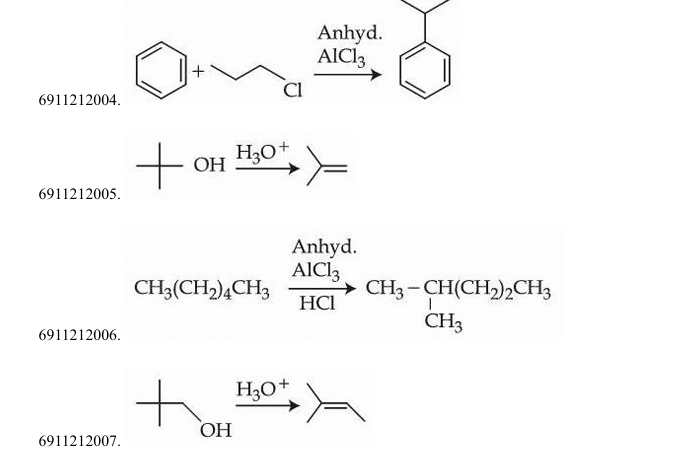
The major product of which of the following reaction is not obtained by rearrangement reaction?}
1
A
2
B
3
C
4
D
Official Solution
Correct Option: (2)
Step 1: Understanding the Concept:
Rearrangements (like Carbocation shifts) occur when a reaction proceeds via an intermediate that can transform into a more stable isomer. Step 2: Detailed Explanation:
In standard JEE/competitive sets for this specific question:
- Reactions (a), (c), and (d) typically involve species like or similar structures where a secondary carbocation rearranges to a tertiary carbocation.
- Reaction (b) is usually a direct substitution (like ) or a specific addition that does not involve a carbocation intermediate capable of shifting, thus yielding the product without rearrangement. Step 3: Final Answer:
The second reaction proceeds without skeletal rearrangement.