Classification Of Colloids
6 previous year questions.
High-Yield Trend
Chapter Questions 6 MCQs
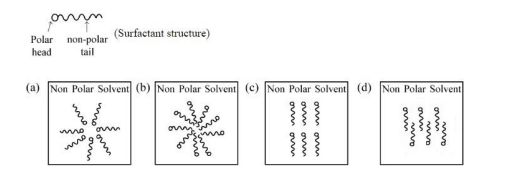
Adding surfactants in non polar solvent, the micelles structure will look like
(A) Micelle formation is an exothermic process
(B) Micelle formation is an endothermic process
(C) The entropy change is positive
(D) The entropy change is negative
| List II | List II |
|---|---|
| A. Osmosis | I. Solvent molecules pass through semi permeable membrane towards solvent side. |
| B. Reverse osmosis | II. Movement of charged colloidal particles under the influence of applied electric potential towards oppositely charged electrodes. |
| C. Electro osmosis | III. Solvent molecules pass through semi permeable membrane towards solution side. |
| D. Electrophoresis | IV. Dispersion medium moves in an electric field. |
About Classification Of Colloids - JEE-MAIN
Classification Of Colloids is a vital chapter for JEE-MAIN aspirants. Mastering the concepts covered in this chapter is essential for securing a top rank.
By rigorously practicing the previous year questions associated with this chapter, you can identify high-yield topics, understand the examiner's perspective, and boost your confidence during the actual exam.
Frequently Asked Questions
Why focus on Classification Of Colloids PYQs?
Analyzing PYQs for this specific chapter reveals the most frequently tested concepts and the typical complexity of questions, allowing you to tailor your study plan efficiently.
How to best use this analysis?
Review the topic breakdown to see which sub-topics within Classification Of Colloids carry the most weight. Then, tackle the questions iteratively to solidify your understanding.