List - II: (I) β-C1-C4 plant (II) α-C1-C4 animal (III) α-C1-C4 α-C1-C6 plant (IV) α-C1-C4 plant
1
(A)-(IV),(B)-(II),(C)-(III),(D)-(I)
2
(A)-(IV),(B)-(I),(C)-(III),(D)-(II)
3
(A)-(III),(B)-(II),(C)-(I),(D)-(IV)
4
(A)-(IV),(B)-(I),(C)-(III),(D)-(II)
Official Solution
Correct Option: (2)
To solve this matching problem, we need to understand the relationships between the elements in List - I and List - II.
List - I Elements and Their Descriptions:
Amylase: An enzyme that catalyzes the hydrolysis of starch into sugars. It acts on α-C1-C4 glycosidic bonds, typically found in plants.
Cellulose: A polysaccharide consisting of β-C1-C4 glycosidic bonds, found in plant cell walls. It is structurally different from starch due to its β-linkages.
Glycogen: A storage form of glucose in animals, characterized by α-C1-C4 and α-C1-C6 glycosidic linkages. It serves as an energy reserve similar to starch in plants but with more branching.
Amylopectin: A component of starch, characterized by α-C1-C4 main chains with α-C1-C6 branching points, found in plants.
List - II Descriptions:
β-C1-C4 plant: Represents the structure of cellulose.
α-C1-C4 animal: Typically related to simple α-linkages found in animal polysaccharides without branching.
α-C1-C4 α-C1-C6 plant: Represents amylopectin's structure, an α-linked polysaccharide with branches, found in plants.
α-C1-C4 plant: Describes the action of amylase, which acts on α-C1-C4 bonds in plant starches.
Matching:
The correct match is determined as follows:
(A) Amylase: Matches with (IV) α-C1-C4 plant.
(B) Cellulose: Matches with (I) β-C1-C4 plant.
(C) Glycogen: Matches with (III) α-C1-C4 α-C1-C6 plant.
(D) Amylopectin: Matches with (II) α-C1-C4 animal
Correct Option:
(A)-(IV), (B)-(I), (C)-(III), (D)-(II)
06
PYQ 2025
easy
chemistryID: jee-main
Given below are two statements: Statement I: Fructose does not contain an aldehydic group but still reduces Tollen’s reagent. Statement II: In the presence of base, fructose undergoes rearrangement to give glucose. In the light of the above statements, choose the correct answer from the options given below.
1
Statement I is false but Statement II is true
2
Both Statement I and Statement II are true
3
Both Statement I and Statement II are false
4
Statement I is true but Statement II is false
Official Solution
Correct Option: (2)
To solve the given question, we need to analyze both statements separately and determine their validity based on our knowledge of chemistry.
Statement I: Fructose does not contain an aldehydic group but still reduces Tollen’s reagent.
Explanation: Fructose is a ketohexose, meaning it contains a ketone group (rather than an aldehyde group). The Tollen's reagent test is traditionally used to identify aldehydes, which can reduce it to metallic silver. However, fructose is known to reduce Tollen's reagent even though it lacks an aldehyde group. This occurs because, in a basic solution (like that in the Tollen's test), fructose can isomerize (via an enediol rearrangement) to glucose and mannose, both of which contain aldehyde groups and can reduce the Tollen's reagent. Hence, fructose indirectly participates in the reduction.
Therefore, Statement I is true.
Statement II: In the presence of base, fructose undergoes rearrangement to give glucose.
Explanation: In basic conditions, fructose can undergo an isomerization process known as the Lobry de Bruyn–Van Ekenstein transformation. This process allows fructose to convert into glucose and mannose through enediol intermediates. This transformation supports the idea that although fructose initially doesn't have an aldehyde group, it rearranges into glucose, which has an aldehyde group.
Thus, Statement II is true.
Both statements are supported by known chemical processes, which confirms that both statements are indeed true.
Conclusion: Therefore, the correct answer is that Both Statement I and Statement II are true.
07
PYQ 2025
medium
chemistryID: jee-main
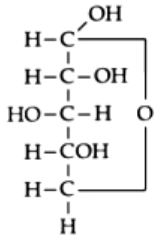
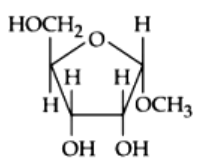
The carbohydrates “Ribose” present in DNA is A. A pentose sugar B. Present in pyranose form C. In “D” configuration D. A reducing sugar, when free E. In -anomeric form
1
A, C and D Only
2
A, B and E Only
3
B, D and E Only
4
A, D and E Only
Official Solution
Correct Option: (1)
To answer the question regarding the characteristics of the carbohydrate "Ribose" present in DNA, let's examine each option:
A. A pentose sugar
Ribose is indeed a pentose sugar. A pentose sugar has five carbon atoms in its molecule. Ribose, in particular, contains an aldehyde group, which classifies it as an aldopentose. In the context of DNA, Deoxyribose, a derived form of ribose with one less oxygen atom, is the sugar present. However, in its basic form, ribose is a pentose sugar. Therefore, this option is correct.
B. Present in pyranose form
Ribose generally exists in a furanose form, which is a five-membered ring structure. Pyranose refers to a six-membered ring, which is not typical for ribose. Thus, this statement is incorrect.
C. In "D" configuration
Ribose in biological systems usually exists in the D-configuration. The D and L designations refer to the orientation of the asymmetric carbon furthest from the aldehyde or keto group in Fischer projection. Hence, this option is correct.
D. A reducing sugar, when free
Ribose, like other aldoses, is a reducing sugar when it is in its free form due to the presence of a free aldehyde group that can be oxidized. Therefore, this option is correct.
E. In -anomeric form
The anomeric form ( or ) depends on the specific molecule's configuration in solution. While ribose can exist in both configurations in its cyclic form, specifying " -anomer" as a characteristic of ribose in DNA is not accurate. Hence, this option is incorrect.
Based on the above analysis, the correct options are A, C, and D only. The characteristic features of ribose that are consistent with the options provided are as a pentose sugar, with D-configuration, and it being a reducing sugar when in free form.
08
PYQ 2026
medium
chemistryID: jee-main
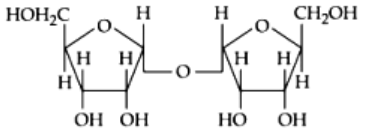
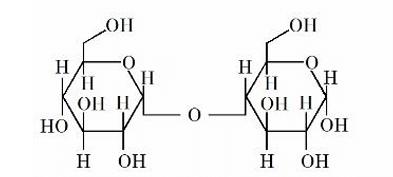
Statement I: The structure of Maltose is given below: Maltose is a non-reducing sugar.
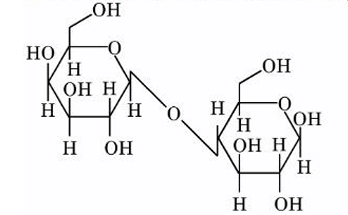
Statement II: The structure of Lactose is given below: Lactose is a reducing sugar.
In the light of the above statements, choose the correct answer:
1
Both Statement I and Statement II are true
2
Both Statement I and Statement II are false
3
Statement I is true but Statement II is false
4
Statement I is false but Statement II is true
Official Solution
Correct Option: (4)
Step 1: Understanding the Concept:
A sugar is "reducing" if it has a free hemiacetal group (an anomeric carbon not involved in a glycosidic bond). This allows the ring to open into an aldehyde form that can reduce Tollen's or Fehling's reagents.
Step 3: Detailed Explanation:
1. Maltose analysis: In maltose, the C1 of the first glucose is bonded to the C4 of the second glucose. The C1 of the second glucose is free. Therefore, maltose is a reducing sugar. Statement I is false.
2. Lactose analysis: In lactose, the C1 of galactose is bonded to the C4 of glucose. The C1 of the glucose unit is free. Therefore, lactose is a reducing sugar. Statement II is true.
Step 4: Final Answer:
Statement I is false, but Statement II is true.
09
PYQ 2026
medium
chemistryID: jee-main
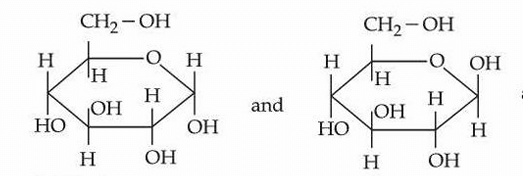
Given below are two statements :
Statement I : and D-(+)-glucose are two anomers of D-(+)-glucose.
Statement II : The open chain forms of D-glucose and D-fructose contain three similar chiral carbons at and .
In the light of the above statements, choose the correct answer from the options given below :}
1
Both Statement I and Statement II are true
2
Both Statement I and Statement II are false
3
Statement I is true but Statement II is false
4
Statement I is false but Statement II is true
Official Solution
Correct Option: (1)
Step 1: Understanding the Concept:
Statement I deals with the cyclic structure of carbohydrates. Statement II compares the configurations of the lower carbons in aldohexoses and ketohexoses. Step 2: Detailed Explanation: Statement I: Anomers are cyclic diastereomers that differ in configuration only at the hemiacetal/hemiketal carbon ( for glucose). and glucose are indeed anomers. Thus, Statement I is True. Statement II: In the open chain structures of D-glucose and D-fructose, the chiral centers at , and have identical configurations (OH on right, H on left for and OH on left for in Fischer projection). This is why they yield the same osazone. Thus, Statement II is True. Step 3: Final Answer:
Both Statement I and Statement II are true.
10
PYQ 2026
medium
chemistryID: jee-main
Identify the correct statements. A. Glucose exists in two anomeric forms. B. Anomers of glucose differ in configuration at C-1 in cyclic hemiacetal structure. C. Melting point of -anomer of glucose is greater than -anomer. D. Specific rotation of -anomer is while for -anomer is . E. and anomers of glucose are prepared by crystallization of saturated glucose solution at and respectively.
1
A and B Only
2
B and C Only
3
A, B and D Only
4
A, B and E Only
Official Solution
Correct Option: (4)
Step 1: Understanding the Question: The question asks to identify correct facts regarding the anomers of D-glucose. Step 2: Detailed Explanation: - Statement A: Correct. Glucose exists as -D-glucose and -D-glucose. - Statement B: Correct. Anomers are diastereomers that differ in configuration only at the hemiacetal carbon (C-1 for glucose). - Statement C: Incorrect. The melting point of the -anomer ( ) is higher than that of the -anomer ( ). - Statement D: Incorrect. The values are swapped; the -anomer has a specific rotation of and the -anomer has . - Statement E: Correct. -glucose is obtained by crystallization from concentrated solution of glucose at , while -form is obtained by crystallization from hot and saturated aqueous solution at . Step 3: Final Answer: Statements A, B, and E are correct.
11
PYQ 2026
hard
chemistryID: jee-main
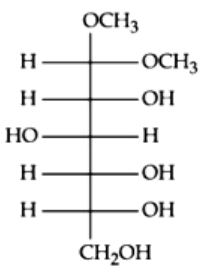
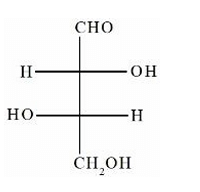
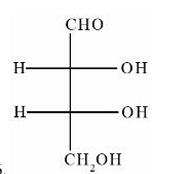
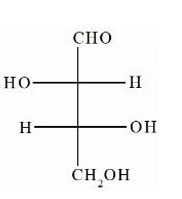
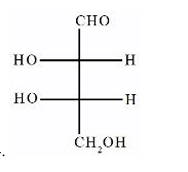
A D-aldotetrose on oxidation with concentrated resulted in optically inactive dicarboxylic acid. The structure of the D-aldotetrose is:
1
2
3
4
Official Solution
Correct Option: (1)
Step 1: Understanding the Concept:
Oxidation of an aldose with concentrated converts both the aldehyde ( ) and primary alcohol ( ) groups into carboxylic acid groups ( ), forming a saccharic/aldaric acid. If the resulting diacid has a plane of symmetry, it is a meso compound and thus optically inactive.
Step 3: Detailed Explanation:
There are two D-aldotetroses: D-Erythrose and D-Threose.
- In D-Erythrose, both hydroxyl groups are on the same side in the Fischer projection. Oxidation produces meso-tartaric acid, which has a plane of symmetry and is optically inactive.
- In D-Threose, the hydroxyl groups are on opposite sides. Oxidation produces D-tartaric acid, which is chiral and optically active.
The question specifies an optically inactive product, which identifies the starting material as D-Erythrose.
Step 4: Final Answer:
The correct structure is D-Erythrose (both -OH groups on the right side).
12
PYQ 2026
hard
chemistryID: jee-main
Given below are two statements: Statement I: Sucrose is dextrorotatory. However, sucrose upon hydrolysis gives a solution having mixture of products. This solution shows laevorotation. Statement II: Hydrolysis of sucrose gives glucose and fructose. Since the laevorotation of glucose is more than the dextrorotation of fructose, the resulting solution becomes laevorotatory. In the light of the above statements, choose the correct answer from the options given below.
1
Statement I is false but Statement II is true
2
Statement I is true but Statement II is false
3
Both Statement I and Statement II are false
4
Both Statement I and Statement II are true
Official Solution
Correct Option: (4)
Step 1: Analysis of Statement I. Sucrose is dextrorotatory in nature. On hydrolysis, sucrose breaks down into equimolar amounts of glucose and fructose, forming invert sugar. The resulting solution shows laevorotation. Hence, Statement I is correct. Step 2: Analysis of Statement II. Glucose is dextrorotatory, whereas fructose is strongly laevorotatory. The magnitude of laevorotation of fructose is greater than the dextrorotation of glucose. Therefore, the net rotation of the mixture becomes laevorotatory. Hence, Statement II is also correct. Step 3: Final conclusion. Both Statement I and Statement II are true. Final Answer:
13
PYQ 2026
medium
chemistryID: jee-main
Statement-I: Sucrose is dextrorotatory and upon hydrolysis, it becomes laevorotatory. Statement-II: Sucrose on hydrolysis gives glucose and fructose such that the laevorotation of glucose is more than dextrorotation of fructose. Which of the following is correct?
1
Both Statement-I and Statement-II are correct
2
Both Statement-I and Statement-II are incorrect
3
Statement-I is correct, Statement-II is incorrect
4
Statement-II is correct, Statement-I is incorrect
Official Solution
Correct Option: (3)
Step 1: Statement-I analysis. Sucrose is indeed dextrorotatory, meaning it rotates plane-polarized light to the right. Upon hydrolysis, it becomes laevorotatory due to the presence of glucose and fructose, which individually rotate light in the opposite direction. Step 2: Statement-II analysis. Statement-II is not correct. While glucose is laevorotatory and fructose is dextrorotatory, the overall effect of hydrolysis on sucrose is a net change in the direction of rotation, not that the laevorotation of glucose is greater than the dextrorotation of fructose. Step 3: Conclusion. Thus, Statement-I is correct and Statement-II is incorrect. Final Answer: