Surface Chemistry
42 previous year questions.
High-Yield Trend
Chapter Questions 42 MCQs
Select the graph that correctly describes the adsorption isotherms at two temperatures and ( ) for a gas : (x - mass of the gas adsorbed, m - mass of adsorbent, P - pressure) 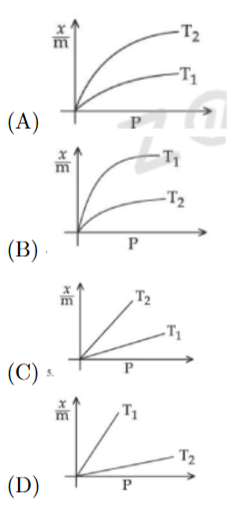
In Freundlich adsorption isotherm, slope of AB line is : 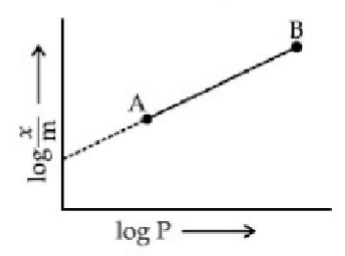
(a) Deacon's process
(b) Contact process
(c) Cracking of hydrocarbons
(d) Hydrogenation of vegetable oils List - II (Catalyst)
(i) ZSM-5
(ii) CuCl₂
(iii) Particles 'Ni'
(iv) V₂O₅
Assertion A : SO (g) is adsorbed to a larger extent than H (g) on activated charcoal.
Reason R : SO (g) has a higher critical temperature than H (g).
In the light of the above statements, choose the most appropriate answer from the options given below.
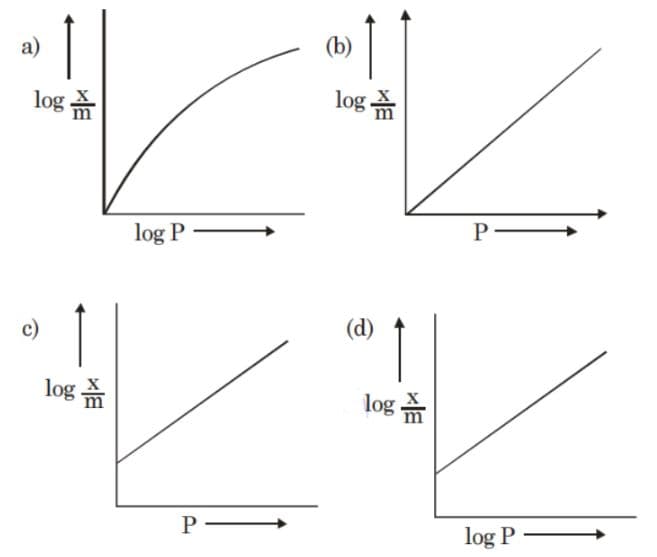
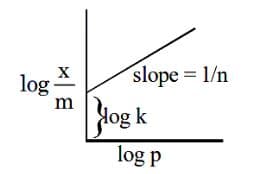
| Column I (Chemical reactions) | Column II (Enzymes used) | ||
| (i) | Glucose → CO2 + Ethanol | a | Pepsin |
| (ii) | Sucrose→Glucose + Fructose | b | Diastase |
| (iii) | Starch →Maltose | c | Zymase |
| (iv) | Protein→Amino acids | d | Invertase |
i c, ii d, iii b, iv a
i d, ii c, iii b, iv a
i c, ii d, iii a, iv b
i c, ii b, iii d, iv a
Which compound is added to cement to increase its setting time?
Gypsum
Lime stone
Clay
Calcium carbonate
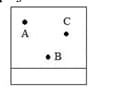
The correct order of elution in the silica gel column chromatography is .
Given below are two statements: one is labelled as Assertion (A) and the other is labelled as Reason (R).
Assertion (A): In expensive scientific instruments, silica gel is kept in watch-glasses or in semipermeable membrane bags.
Reason (R): Silica gel adsorbs moisture from air via adsorption, thus protects the instrument from water corrosion (rusting) and/or prevents malfunctioning.
In the light of the above statements, choose the correct answer from the options given below:
A is false but (R) is true
Both (A) and (R) are true and (R) is the correct explanation of (A)
A is true but (R) is false
Both (A) and (R) are true but (R) is not the correct explanation of (A)
A. The catalyst is diffused over the surface of reactants.
B. Reactants are adsorbed on the surface of the catalyst.
C. Occurrence of chemical reaction on the catalysts surface through formation of an intermediate.
D. It is a combination of intermediate compound formation theory and the old adsorption theory
E. It explains the action of the catalyst as well as those of catalytic promoters and poisons.
(PNi (density of Nickel) is 10 gmL-1, Molar mass of Nickel is 60 gmol-1 F = 96500 C mol-1)
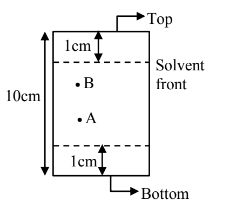
In the given TLC, the distance of spot and are 5 cm and 7 cm, from the bottom of the TLC plate, respectively. The value of is times more than . The value of is _________ .
A. silica gel
B. alumina
C. quick lime
D. magnesia
Choose the most appropriate answer from the options given below :
(Given: and )
About Surface Chemistry - JEE-MAIN
Surface Chemistry is a vital chapter for JEE-MAIN aspirants. Mastering the concepts covered in this chapter is essential for securing a top rank.
By rigorously practicing the previous year questions associated with this chapter, you can identify high-yield topics, understand the examiner's perspective, and boost your confidence during the actual exam.
Frequently Asked Questions
Why focus on Surface Chemistry PYQs?
Analyzing PYQs for this specific chapter reveals the most frequently tested concepts and the typical complexity of questions, allowing you to tailor your study plan efficiently.
How to best use this analysis?
Review the topic breakdown to see which sub-topics within Surface Chemistry carry the most weight. Then, tackle the questions iteratively to solidify your understanding.