Electronic Configurations Of Elements And The Periodic Table
13 previous year questions.
Volume: 13 Ques
Yield: Medium
High-Yield Trend
3
2024
2
2023
8
2022
Chapter Questions
13 MCQs
01
PYQ 2022
medium
chemistryID: jee-main
Outermost electronic configurations of four elements A,B,C,D are given below: (A) 3s2 (B) s23p1 (C) 3s23p3 (D) 3s23p4 The correct order of fist ionization enthalpy for them is:
1
(A)< (B)< (C) < (D)
2
(B)< (A)< (D)< (C)
3
(B) <(D)< (A)< (C)
4
(B)< (A)< (C) < (D)
Official Solution
Correct Option: (2)
The correct answer is (B): (B)< (A)< (D)< (C) Orbitals with fully filled and half-filled electronic configuration are stable, and require more energy for ionization Elements with greater electronegativity require more energy for ionisation
02
PYQ 2022
medium
chemistryID: jee-main
The IUPAC nomenclature of an element with electronic configuration [Rn] 5f146d17s2 is
1
Unnilbium
2
Unnilunium
3
Unnilquadium
4
Unniltrium
Official Solution
Correct Option: (4)
The element with electronic configuration [Rn] 5f146d17s2 has atomic number → 103 ∴ Its IUPAC name is :Unniltrium
03
PYQ 2022
hard
chemistryID: jee-main
The electronic configuration of Pt(atomic number 78) is:
1
[Xe] 4f14 5d9 6s1
2
[Kr] 4f14 5d10
3
[Xe] 4f14 5d10
4
[Xe] 4f14 5d8 6s2
Official Solution
Correct Option: (1)
The correct option is(A): Pt = [Xe] 4f14 5d9 6s1
04
PYQ 2022
easy
chemistryID: jee-main
When the excited electron of a H atom from n = 5 drops to the ground state, the maximum number of emission lines observed are ____.
Official Solution
Correct Option: (1)
Since there is a single hydrogen atom, so only 5 → 4, 4 → 3, 3 → 2, 2 → 1 lines are obtained.
05
PYQ 2022
medium
chemistryID: jee-main
The number of bridged oxygen atoms present in compound B formed from the following reactions is
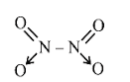
1
0
2
1
3
2
4
3
Official Solution
Correct Option: (1)
The correct option is(A): 0
Hence no bridged oxygen atom is present in N2O4.
06
PYQ 2022
medium
chemistryID: jee-main
In series, the metal having the highest standard electrode potential is
1
Cr
2
Fe
3
Cu
4
Zn
Official Solution
Correct Option: (1)
Metal
The metal having highest standard reduction potential is .
07
PYQ 2022
medium
chemistryID: jee-main
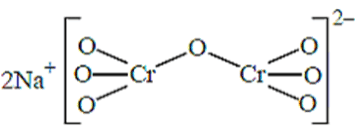
The number of terminal oxygen atoms present in the product B obtained from the following reaction is ______. FeCr2O4 + Na2CO3 + O2 → A + Fe2O3 + CO2 A + H+ → B + H2O + Na+
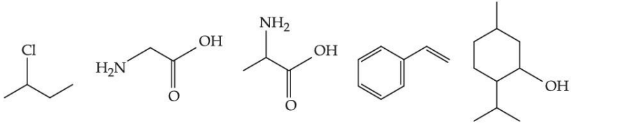
Observe structures of the following compounds The total number of structures/compounds which possess asymmetric carbon atoms is _____.
Official Solution
Correct Option: (1)
09
PYQ 2023
easy
chemistryID: jee-main
The d-electronic configuration of in tetrahedral crystal field is Sum of " " and "number of unpaired electrons" is
Official Solution
Correct Option: (1)
Given: - Oxidation state of Co: ( ). - Geometry: Tetrahedral crystal field, where weak field ligands ( ) cause small splitting. - Electronic configuration in tetrahedral field: . Step 1: Determine ‘m’. - -orbital contains 4 electrons ( ). Step 2: Determine unpaired electrons. - In , the total number of unpaired electrons is 3. Final Calculation: Sum of .
10
PYQ 2023
medium
chemistryID: jee-main
The IUPAC nomenclature of an element with electronic configuration is :
1
Unnilbium
2
Unnilunium
3
Unnilquadium
4
Unniltrium
Official Solution
Correct Option: (4)
The given electronic configuration is . This configuration can be deciphered as follows:
refers to the noble gas Radon, which is used here as a core reference for electronic configuration.
indicates the f-block is completely filled in the 5th energy level.
shows that there is one electron in the d sub-shell in the 6th energy level.
means there are two electrons in the s sub-shell in the 7th energy level.
To find the element's identity, we calculate its atomic number. The atomic number of Radon is 86, and the additions from the configuration are:
adds 14 electrons.
adds 1 electron.
adds 2 electrons.
Thus, the total atomic number is:
The element with atomic number 103 is Lawrencium (Lr). In the IUPAC naming system for elements beyond 100, each digit of the atomic number is translated into a syllable:
'1' is translated to "Un".
'0' is translated to "nil".
'3' is translated to "trium".
Combining these syllables, the systematic IUPAC name for element 103 is "Unniltrium". Therefore, the correct answer is:
Unniltrium
11
PYQ 2024
medium
chemistryID: jee-main
Match List-I with the List-II
List-I Tetrahedral Complex
List-II Electronic configuration
(A) TiCl4
(I) e2, t20
(B) [FeO4]2-
(II) e4, t23
(C) [FeCl4]-
(III) e0, t22
(D) [CoCl4]2-
(IV) e2, t23
Choose the correct answer from the options given below:
1
(A)-(I), (B)-(III), (C)-(IV), (D)-(II)
2
(A)-(IV), (B)-(III), (C)-(I), (D)-(II)
3
(A)-(III), (B)-(IV), (C)-(II), (D)-(I)
4
(A)-(III), (B)-(I), (C)-(IV), (D)-(II)
Official Solution
Correct Option: (4)
To match the tetrahedral complexes in List-I with their corresponding electronic configurations in List-II, we need to consider the oxidation states of the metal ions and their electronic configurations:
Titanium Tetrachloride, TiCl4:
Titanium is in the +4 oxidation state in TiCl4, resulting in an electron configuration of d0.
Electronic configuration: e0, t22 (Configuration III matches d0 state with unpaired electrons being first placed in e).
Ferrate Ion, [FeO4]2-:
Iron in [FeO4]2- typically occurs in the +6 oxidation state, which removes all 3d electrons, giving a vacant orbital.
Electronic configuration: e2, t20 (Configuration I is a match considering vacant t2 orbitals filled e).
Tetrachloroferrate(III), [FeCl4]-:
Iron is in the +3 oxidation state in [FeCl4]-, giving a d5 electronic configuration.
Electronic configuration: e2, t23 (Configuration IV aligns with high spin d5 configuration).
Tetrachlorocobaltate(II), [CoCl4]2-:
Cobalt in the +2 oxidation state in this complex has a d7 configuration.
Electronic configuration: e4, t23 (Configuration II matches with high spin d7 configuration, distinguishing between paired and unpaired).
Consequently, the correct matching of List-I with List-II is:
(A) TiCl4 - (III) e0, t22
(B) [FeO4]2- - (I) e2, t20
(C) [FeCl4]- - (IV) e2, t23
(D) [CoCl4]2- - (II) e4, t23
Thus, the correct answer is: (A)-(III), (B)-(I), (C)-(IV), (D)-(II)
12
PYQ 2024
medium
chemistryID: jee-main
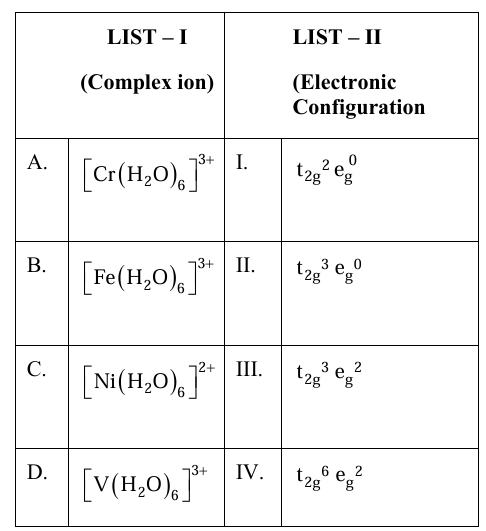
Match List I with List II Choose the correct answer from the options given below :
1
A-III, B-II, C-IV, D-I
2
A-IV, B-I, C-II, D-III
3
A-IV, B-III, C-I, D-II
4
A-II, B-III, C-IV, D-I
Official Solution
Correct Option: (4)
To solve this question, we need to match the complex ions from List I with their correct electronic configurations in List II.
We'll examine each complex ion and determine its electronic configuration based on the oxidation state of the central metal and the coordination chemistry.
A.
The oxidation state of Cr is +3.
Electronic configuration of Cr:
Cr3+ loses 3 electrons:
In octahedral complexes, the electron configuration is .
So, this matches with II.
B.
The oxidation state of Fe is +3.
Electronic configuration of Fe:
Fe3+ loses 3 electrons:
In octahedral complexes, the electron configuration is .
So, this matches with III.
C.
The oxidation state of Ni is +2.
Electronic configuration of Ni:
Ni2+ loses 2 electrons:
In octahedral complexes, the electron configuration is .
So, this matches with IV.
D.
The oxidation state of V is +3.
Electronic configuration of V:
V3+ loses 3 electrons:
In octahedral complexes, the electron configuration is .
So, this matches with I.
Based on the analysis, the correct matching is:
A-II, B-III, C-IV, D-I
Thus, the correct answer is:
A-II, B-III, C-IV, D-I
13
PYQ 2024
medium
chemistryID: jee-main
Number of molecules/species from the following having one unpaired electron is ________.
Official Solution
Correct Option: (1)
According to Molecular Orbital Theory (M.O.T.):
For :
Number of unpaired electrons = 2
For :
Number of unpaired electrons = 1
For NO:
Number of unpaired electrons = 1
For :
Number of unpaired electrons = 0
For :
Number of unpaired electrons = 0
Therefore, the number of species having exactly one unpaired electron is 2 ( and NO).