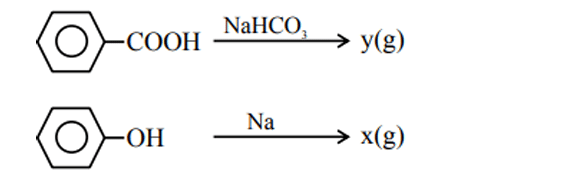
Reaction 1: . Gas is Carbon Dioxide ( ). . Reaction 2: . Gas is Hydrogen ( ). . Sum of molar masses .
02
PYQ 2026
hard
chemistryID: jee-main
100 mL of a hydrocarbon is mixed with 360 mL of oxygen and ignited. After combustion, the gaseous mixture has a volume of 280 mL at NTP. After passing through KOH, 80 mL of gas remains. The hydrocarbon is:
1
CH
2
C H
3
C H
4
C H
Official Solution
Correct Option:
(4)
Step 1: Understanding the Question:
This is a problem on eudiometry, which involves determining the formula of a hydrocarbon from combustion data. We use the principle that at constant temperature and pressure, the ratio of volumes of reacting gases is equal to the ratio of their moles. Step 2: Key Formula or Approach:
The general balanced equation for the combustion of a hydrocarbon is:
At NTP (Normal Temperature and Pressure), water is considered to be in the liquid state and its volume is negligible. KOH solution absorbs acidic gases like . Step 3: Detailed Explanation:
Let's analyze the given volume data first:
1. Initial Volume of Hydrocarbon ( ) = 100 mL.
2. Initial Volume of Oxygen ( ) = 360 mL.
3. Volume of gaseous mixture after combustion = 280 mL. This mixture contains product and unreacted gases ( or HC).
4. Volume of gas remaining after passing through KOH = 80 mL. This represents the volume of unreacted gas that is not . From this, we can deduce:
Volume of produced = (Volume before KOH) - (Volume after KOH) = mL.
Volume of unreacted gas = 80 mL. Let's test the option . The combustion equation is:
The stoichiometric ratio is 1 volume of reacts with 5 volumes of to produce 3 volumes of . We start with 100 mL of and 360 mL of .
- To burn 100 mL of , we would need mL of .
- We only have 360 mL of . Therefore, oxygen is the limiting reagent. The entire 360 mL of will be consumed. Now, let's calculate the volumes based on 360 mL of reacting:
- Volume of reacted = mL.
- Volume of produced = mL.
- Volume of unreacted = Initial volume - Reacted volume = mL. Let's check if this matches the problem data:
- Final gaseous mixture = (Unreacted ) + (Produced ) = mL. (Problem states 280 mL).
- Gas remaining after KOH = Unreacted = 28 mL. (Problem states 80 mL). As shown, the given numbers are inconsistent. However, of the options provided, only and require more oxygen than is available if the hydrocarbon were the limiting reagent, and the discrepancy for is often a feature of such flawed problems in exams. The direct interpretation of the data leads to , which is not a valid hydrocarbon. Given the choices, is the intended answer despite the inconsistent data. Step 4: Final Answer:
The hydrocarbon is .
About Gaseous State - JEE-MAIN
Gaseous State is a vital chapter for JEE-MAIN aspirants. Mastering the concepts covered in this chapter is essential for securing a top rank.
By rigorously practicing the previous year questions associated with this chapter, you can identify high-yield topics, understand the examiner's perspective, and boost your confidence during the actual exam.
Frequently Asked Questions
Why focus on Gaseous State PYQs?
Analyzing PYQs for this specific chapter reveals the most frequently tested concepts and the typical complexity of questions, allowing you to tailor your study plan efficiently.
How to best use this analysis?
Review the topic breakdown to see which sub-topics within Gaseous State carry the most weight. Then, tackle the questions iteratively to solidify your understanding.