Consider the sulphides and . Number of these sulphides soluble in is _____________
Official Solution
Correct Option: (1)
Step 1: Understanding the Concept: Metal sulfides are classified in qualitative inorganic analysis by their solubility in different acids. Nitric acid ( ) acts as an oxidizing agent, converting sulfide ions ( ) into elemental sulfur ( ), which helps dissolve the precipitate. Step 2: Detailed Explanation: 1. : Mercuric sulfide is extremely insoluble and does not dissolve in boiling . It requires aqua regia (a mixture of and ) for dissolution. 2. : These Group IIA sulfides are soluble in hot dilute or with the evolution of gas and formation of elemental sulfur. 3. : These Group IIB sulfides are also soluble in concentrated or , though they are often separated using yellow ammonium sulfide first in standard schemes. Counting the soluble ones: , and . Step 3: Final Answer: The number of sulfides soluble in is 5.
02
PYQ 2021
medium
chemistryID: jee-main
Statement I : Colourless cupric metaborate is reduced to cuprous metaborate in a luminous flame. Statement II : Cuprous metaborate is obtained by heating boric anhydride and copper sulphate in a non-luminous flame.
1
Both true
2
Both false
3
I true, II false
4
I false, II true
Official Solution
Correct Option: (2)
Step 1: In the Borax Bead Test, Cupric metaborate ( ) is blue/green in a non-luminous (oxidizing) flame.
Step 2: In a luminous (reducing) flame, cupric metaborate is reduced to red/opaque Cuprous metaborate ( ) or metallic Copper.
Step 3: Statement I is false because cupric metaborate is blue/green, not colourless. Statement II is false because non-luminous flames are oxidizing, which would yield cupric ( ), not cuprous ( ).
03
PYQ 2021
medium
chemistryID: jee-main
Reagent, 1-naphthylamine and sulphanilic acid in acetic acid is used for the detection of :
1
NO₂⁻
2
NO₃⁻
3
NO
4
N₂O
Official Solution
Correct Option: (1)
Step 1: This is the **Griess Test**.
Step 2: Nitrite ions ( ) react with sulphanilic acid to form a diazonium salt.
Step 3: This salt then couples with 1-naphthylamine to form a deep red/pink azo dye.
Step 4: Nitrates ( ) do not give this test directly unless reduced to nitrites first.
04
PYQ 2021
medium
chemistryID: jee-main
Which of the following compound is added to the sodium extract before addition of silver nitrate for testing of halogens?
1
Hydrochloric acid
2
Sodium hydroxide
3
Nitric acid
4
Ammonia
Official Solution
Correct Option: (3)
In the Lassaigne's test for halogens, the organic compound is fused with sodium metal to convert covalently bonded halogens into ionic sodium halides (NaX). The sodium extract (Lassaigne's extract) may also contain sodium cyanide (NaCN) and sodium sulfide (Na S) if the original organic compound contained nitrogen and sulfur, respectively. Before adding silver nitrate (AgNO ) to test for halide ions, it is essential to decompose any NaCN and Na S present. If not removed, these ions would react with AgNO to form precipitates of AgCN (white) and Ag S (black), which would interfere with the identification of the halide precipitate (AgCl, AgBr, AgI). Concentrated nitric acid (HNO ) is added for this purpose. It acidifies the solution and decomposes NaCN and Na S into gases. Na S + 2HNO 2NaNO + H S(g) NaCN + HNO NaNO + HCN(g) After boiling off these gases, the solution is free from interfering ions, and AgNO can be added to test specifically for halogens.
05
PYQ 2022
easy
chemistryID: jee-main
A white precipitate was formed when BaCl2 was added to water extract of an inorganic salt. Further, a gas ‘X’ with characteristic odour was released when the formed white precipitate was dissolved in dilute HCl. The anion present in the inorganic salt is
1
I–
2
3
S2–
4
Official Solution
Correct Option: (2)
The correct answer is (B) : Anion is
X (gas) Gas is released with smell of burning sulphur.
06
PYQ 2023
medium
chemistryID: jee-main
When a solution of mixture having two inorganic salts was treated with freshly prepared ferrous sulphate in acidic medium, a dark brown ferric ion was formed when treated with ferric chloride. It gave deep red colour which disappeared on boiling and a brown red ppt was formed. The mixture contains:
1
CO & NO
2
SO & CH COO
3
CH COO & FeCl
4
SO & CH COO
Official Solution
Correct Option: (3)
- When a mixture containing the acetates reacts with ferric chloride (FeCl ), it forms a complex and the characteristic brown red precipitate and coloration is formed, which then disappears on boiling. - The reaction suggests the presence of CH COO and FeCl in the mixture, leading to the formation of blood-red and brown colours.
Thus, the correct answer is (3), CH COO & FeCl .
07
PYQ 2024
medium
chemistryID: jee-main
Lassaigne's test is used for detection of :
1
Nitrogen and Sulphur only
2
Nitrogen, Sulphur and Phosphorous Only
3
Phosphorous and halogens only
4
Nitrogen, Sulphur, phosphorous and halogens
Official Solution
Correct Option: (4)
Lassaigne's test, also known as the Sodium Fusion Test, is a qualitative test used to detect the presence of various elements in an organic compound. The elements typically identified with this test include nitrogen, sulfur, phosphorus, and halogens (chlorine, bromine, and iodine). Here's how the test works step-by-step:
The organic compound is fused with sodium metal, which breaks down the compound and forms sodium salts of the elements present.
These sodium salts are then extracted using distilled water and tested separately for each element:
Nitrogen: When the fused mass is boiled with water and the extract is treated with iron sulfate and an acid (sulfuric acid), the formation of Prussian blue indicates the presence of nitrogen.
Sulfur: The extract when acidified and treated with lead acetate solution forming a black precipitate of lead sulfide indicates sulfur.
Halogens: When nitric acid and silver nitrate solution are added to the extract, the formation of white or colored precipitates indicates the presence of halogens. The color varies depending on the halogen: white (chlorine), pale yellow (bromine), or yellow (iodine).
Phosphorus: Heating the sodium extract with concentrated nitric acid, then adding ammonium molybdate, results in a yellow precipitate if phosphorus is present.
Given the description, the test conducts detection for nitrogen, sulfur, phosphorus, and halogens, which is consistent with option involving all these elements.
Therefore, the correct answer is: Nitrogen, Sulphur, phosphorus, and halogens.
08
PYQ 2024
easy
chemistryID: jee-main
Given below are two statements: Statement-I: The gas liberated on warming a salt with dil H2SO4, turns a piece of paper dipped in lead acetate into black, it is a confirmatory test for sulphide ion. Statement-II: In statement-I the colour of paper turns black because of formation of lead sulphite. In the light of the above statements, choose the most appropriate answer from the options given below:
1
Both Statement-I and Statement-II are false
2
Statement-I is false but Statement-II is true
3
Statement-I is true but Statement-II is false
4
Both Statement-I and Statement-II are true.
Official Solution
Correct Option: (3)
The problem asks us to evaluate two statements regarding a chemical test for the sulphide ion and choose the most appropriate answer describing their validity.
Concept Used:
This problem is based on the principles of qualitative inorganic analysis, specifically the confirmatory test for the sulphide anion ( ). The key chemical reactions are:
The reaction of a sulphide salt with a dilute acid to liberate hydrogen sulphide ( ) gas.
The reaction of hydrogen sulphide gas with lead(II) acetate solution to form a precipitate.
Knowledge of the chemical formulas and physical properties (especially color) of the products, such as lead sulphide ( ) and lead sulphite ( ), is required.
Step-by-Step Solution:
Step 1: Analyze Statement-I.
Statement-I describes a procedure and its conclusion. Let's break it down:
Reaction 1: Warming a salt with dil H₂SO₄. If the salt contains the sulphide ion ( ), it will react with the acid to produce hydrogen sulphide gas, which has a characteristic smell of rotten eggs.
Reaction 2: The liberated gas turns a piece of paper dipped in lead acetate into black. The gas, , reacts with lead(II) acetate ( ) solution.
Observation and Conclusion: The product of this reaction is lead(II) sulphide ( ), which is a black solid precipitate. The formation of this distinct black precipitate is a standard and reliable confirmatory test for the presence of the sulphide ion.
Therefore, Statement-I is a factually correct description of the confirmatory test for sulphide ions.
Conclusion for Statement-I: Statement-I is true.
Step 2: Analyze Statement-II.
Statement-II provides an explanation for the observation in Statement-I. It claims that the paper turns black because of the formation of lead sulphite ( ).
As established in Step 1, the black precipitate formed is lead sulphide, with the chemical formula .
Lead sulphite, with the chemical formula , is a white solid. It is formed from the reaction of a sulphite ion ( ) with a soluble lead salt.
The chemical species mentioned in Statement-II, lead sulphite, is incorrect.
Therefore, Statement-II provides an incorrect reason for the observation.
Conclusion for Statement-II: Statement-II is false.
Final Computation & Result:
Based on the analysis:
Statement-I is correct.
Statement-II is incorrect.
Therefore, the most appropriate answer is that Statement-I is true but Statement-II is false.
09
PYQ 2024
medium
chemistryID: jee-main
In the precipitation of the iron group (III) in qualitative analysis, ammonium chloride is added before adding ammonium hydroxide to :
1
Prevent interference by phosphate ions
2
Decrease concentration of ions
3
Increase concentration of ions
4
Increase concentration of ions
Official Solution
Correct Option: (2)
Role of Ammonium Chloride in Precipitation of Group III Cations:
In qualitative analysis, group III cations (such as ) are precipitated as hydroxides by adding ammonium hydroxide .
Effect of Adding Ammonium Chloride:
Ammonium chloride is added before ammonium hydroxide to control the concentration of ions. This is achieved through the common ion effect:
Adding increases the concentration of ions, which shifts the equilibrium to the left, decreasing the concentration of ions.
Importance of Controlled Concentration:
By reducing concentration, we avoid the formation of precipitates from cations of higher groups (such as Group IV and V cations), ensuring selective precipitation of Group III cations only.
Conclusion:
The addition of ammonium chloride decreases the concentration of ions through the common ion effect, which corresponds to Option (2).
10
PYQ 2024
medium
chemistryID: jee-main
Match List-I with List-II.
List-I (Test)
List-II (Identification)
(A) Bayer's test
(I) Phenol
(B) Ceric ammonium nitrate test
(II) Aldehyde
(C) Phthalein dye test
(III) Alcoholic-OH group
(D) Schiff's test
(IV) Unsaturation
Choose the correct answer from the options given below:
1
(A)-(III), (B)-(I), (C)-(IV), (D)-(II)
2
(A)-(II), (B)-(III), (C)-(IV), (D)-(I)
3
(A)-(IV), (B)-(I), (C)-(II), (D)-(III)
4
(A)-(IV), (B)-(III), (C)-(I), (D)-(II)
Official Solution
Correct Option: (4)
To solve the given matching problem between different chemical tests and their identifications, we need to understand each test's purpose:
Bayer's Test: This test is used to detect unsaturation, such as double or triple bonds in organic compounds. The test involves the use of potassium permanganate, which rapidly decolorizes in the presence of unsaturation. Therefore, Bayer's test is associated with unsaturation. So, (A)-(IV).
Ceric Ammonium Nitrate Test: This test is used to identify alcohols. Alcohols, upon reaction with ceric ammonium nitrate, change the color of the reagent. Therefore, this test is used for identifying alcohols. So, (B)-(III).
Phthalein Dye Test: This test is specifically used to detect the presence of the phenolic group in a compound. It's a characteristic test for phenols, which are compounds containing a phenolic -OH group. Therefore, this test corresponds to phenols. So, (C)-(I).
Schiff's Test: This test is used to identify the presence of aldehydes. It involves the decolorization of Schiff's reagent to give a magenta or purple color when an aldehyde is present. Therefore, Schiff's test corresponds to aldehydes. So, (D)-(II).
Based on this analysis, the correct matching is: (A)-(IV), (B)-(III), (C)-(I), (D)-(II).
11
PYQ 2024
easy
chemistryID: jee-main
In qualitative test for identification of presence of phosphorous, the compound is heated with an oxidising agent. Which is further treated with nitric acid and ammonium molybdate respectively. The yellow coloured precipitate obtained is :
1
Na PO .12MoO
2
(NH ) PO .12(NH ) MoO
3
(NH ) PO .12MoO
4
MoPO .21NH NO
Official Solution
Correct Option: (3)
To identify the presence of phosphorus in a qualitative test, the given compound is initially heated with an oxidizing agent. This process helps in converting phosphorus into a more analyzable form. Here's a step-by-step explanation of the test used:
The compound is first oxidized to form phosphoric acid (H3PO4).
Subsequently, the oxidized product is treated with nitric acid (HNO3). This ensures complete conversion of phosphorus to its +5 oxidation state.
Next, ammonium molybdate ((NH4)2MoO4) is added under acidic conditions.
The reaction results in the formation of a yellow precipitate known as ammonium phosphomolybdate. The chemical formula for this precipitate is (NH4)3PO4.12MoO3. This unique yellow color and its composition confirm the presence of phosphorus in the tested compound.
Let's evaluate the options provided:
: Sodium corresponds to another type of compound not typically involved in this qualitative test.
(NH4)3PO4.12(NH4)2MoO4: This formula is not representing the correct ammonium phosphomolybdate complex.
(NH4)3PO4.12MoO3: Matches the typical formulation of ammonium phosphomolybdate precipitate. Thus, this is the correct answer.
: Not relevant to the classic phosphorus analysis test.
Therefore, the correct answer is the formation of (NH4)3PO4.12MoO3, which is indicative of the presence of phosphorus.
12
PYQ 2024
medium
chemistryID: jee-main
On passing a gas, ‘X’, through Nessler’s reagent, a brown precipitate is obtained. The gas ‘X’ is
1
2
3
4
Official Solution
Correct Option: (3)
To answer the question of which gas 'X' produces a brown precipitate with Nessler's reagent, let's examine the options and the reaction involved.
Nessler's Reagent Reaction:
Nessler's reagent is a chemical solution used to detect the presence of ammonia ( ) in a sample. When ammonia gas is passed through Nessler's reagent, it reacts to form a brown precipitate of mercuric amido-iodide, which indicates the presence of ammonia.
The relevant reaction is:
Option Analysis:
: When hydrogen sulfide is passed through Nessler's reagent, it does not form a brown precipitate. Instead, it reacts with metal ions to form black metal sulfides.
: Carbon dioxide does not react with Nessler's reagent to form any precipitate.
: This is the gas that reacts with Nessler's reagent to produce a brown precipitate, indicating the presence of ammonia.
: Chlorine does not react with Nessler's reagent to produce a brown precipitate.
Therefore, the correct answer is the gas that reacts with Nessler's reagent to form a brown precipitate, which is .
Conclusion:
Gas 'X' that forms a brown precipitate with Nessler's reagent is , or ammonia.
13
PYQ 2024
medium
chemistryID: jee-main
A reagent which gives brilliant red precipitate with Nickel ions in basic medium is
1
sodium nitroprusside
2
neutral FeCl
3
meta-dinitrobenzene
4
dimethyl glyoxime
Official Solution
Correct Option: (4)
To determine which reagent gives a brilliant red precipitate with Nickel ions in a basic medium, let's analyze each option:
Sodium nitroprusside: This reagent is commonly used as a detection test for sulfide ions. It does not react with Nickel ions to give a red precipitate, especially not in a basic medium.
Neutral FeCl3: Ferric chloride is generally used as a reagent to test for phenols and is not known to react with nickel to form a brilliant red precipitate.
Meta-dinitrobenzene: This is an organic compound which does not participate in reactions with Nickel ions to give a color precipitate in any medium.
Dimethyl glyoxime: This reagent is known to form a complex with Nickel ions that produces a distinctive red precipitate. The reaction is as follows:
When dimethyl glyoxime is added to a solution containing Nickel ions ( ) in a basic medium (usually achieved by adding ammonia or another base), a red precipitate of nickel(II) dimethylglyoxime complex is formed:
Thus, the correct answer is dimethyl glyoxime because it forms a red precipitate with Nickel ions in a basic medium.
In conclusion, the reagent that gives a brilliant red precipitate with Nickel ions in a basic medium is dimethyl glyoxime.
14
PYQ 2024
medium
chemistryID: jee-main
The number of white coloured salts among the following is ___________. (A) SrSO , (B) Mg(NH )PO , (C) BaCrO , (D) Mn(OH) , (E) PbSO , (F) PbCrO , (G) AgBr, (H) PbI , (I) CaC O ,(J) [Fe(OH) (CH COO) ]
Official Solution
Correct Option: (1)
The problem asks to count the number of white colored salts from a given list of compounds. The color of an ionic compound is typically determined by the color of its constituent ions. Cations of s-block and p-block elements are generally colorless, leading to white salts unless the anion is colored. Cations of d-block (transition metals) are often colored due to d-d electronic transitions. Certain anions like chromate (CrO₄²⁻), dichromate (Cr₂O₇²⁻), and permanganate (MnO₄⁻) are also colored.
Step-by-Step Solution:
We will analyze the color of each salt individually.
(A) SrSO₄ (Strontium Sulfate):
The cation is Sr²⁺ (Strontium, an s-block element) and the anion is SO₄²⁻ (sulfate). Both ions are colorless. Therefore, SrSO₄ is a white solid.
(B) Mg(NH₄)PO₄ (Magnesium Ammonium Phosphate):
The cations are Mg²⁺ (s-block) and NH₄⁺ (ammonium), and the anion is PO₄³⁻ (phosphate). All three ions are colorless. Therefore, Mg(NH₄)PO₄ is a white solid.
(C) BaCrO₄ (Barium Chromate):
The cation is Ba²⁺ (s-block), which is colorless. However, the anion is CrO₄²⁻ (chromate), which is distinctly yellow. Therefore, BaCrO₄ is a yellow salt, not white.
(D) Mn(OH)₂ (Manganese(II) Hydroxide):
The cation is Mn²⁺ (a d-block transition metal ion). The Mn²⁺ ion has a d⁵ electron configuration. The d-d transitions are spin-forbidden, so its compounds are very pale in color. Freshly precipitated Mn(OH)₂ is a white solid, although it quickly oxidizes in air and turns brown. In its pure state, it is considered white.
(E) PbSO₄ (Lead(II) Sulfate):
The cation is Pb²⁺ (a p-block element) and the anion is SO₄²⁻. Both ions are colorless. Therefore, PbSO₄ is a white solid.
(F) PbCrO₄ (Lead(II) Chromate):
The cation is Pb²⁺, which is colorless. The anion is the yellow chromate ion, CrO₄²⁻. Therefore, PbCrO₄ is a bright yellow solid, not white.
(G) AgBr (Silver Bromide):
The cation Ag⁺ and anion Br⁻ are both colorless. However, due to polarization and charge-transfer effects, AgBr is not pure white but rather a pale yellow or cream-colored solid. It is not considered white.
(H) PbI₂ (Lead(II) Iodide):
The cation Pb²⁺ is colorless. The anion is I⁻ (iodide). Due to the high polarizability of the iodide ion, PbI₂ is a bright yellow solid, not white.
(I) CaC₂O₄ (Calcium Oxalate):
The cation is Ca²⁺ (s-block) and the anion is C₂O₄²⁻ (oxalate). Both ions are colorless. Therefore, CaC₂O₄ is a white solid.
(J) [Fe(OH)₂(CH₃COO)₂] (Basic Iron(II) Acetate):
This compound contains the Fe²⁺ (Iron(II)) ion, which is a transition metal ion. Fe²⁺ compounds are typically colored, often appearing pale green or greenish-white. They are not pure white.
Final Computation & Result:
Let's list the salts identified as white:
(A) SrSO₄
(B) Mg(NH₄)PO₄
(D) Mn(OH)₂
(E) PbSO₄
(I) CaC₂O₄
Counting these salts, we find that there are 5 white colored salts in the given list.
The number of white coloured salts is 5.
15
PYQ 2024
medium
chemistryID: jee-main
The Lassaigne’s extract is boiled with dil HNO before testing for halogens because
1
AgCN is soluble in HNO
2
Silver halides are soluble in HNO
3
Ag S is soluble in HNO
4
Na S and NaCN are decomposed by HNO
Official Solution
Correct Option: (4)
Lassaigne's test, also known as the sodium fusion test, is used to detect the presence of halogens (Cl, Br, I), nitrogen, and sulfur in organic compounds. Here's a step-by-step explanation of why the Lassaigne's extract is boiled with dilute before testing for halogens:
The Lassaigne's extract contains a variety of compounds, including sodium halides, sodium sulfide ( ), and sodium cyanide (NaCN) due to its preparation with metallic sodium.
In the presence of sodium, compounds like NaCN and Na2S can interfere with the test for halogens by potentially forming complex compounds that can lead to false positives or complicate the detection.
Boiling the extract with dilute nitric acid ( ) serves the purpose of decomposing Na2S and NaCN. This reaction is crucial because it removes these potential interfering species:
Once Na2S and NaCN are decomposed, the extract is free from these ions, which could otherwise react with silver nitrate (AgNO3) to form insoluble silver cyanide (AgCN) or precipitate sulfides that might be confused with silver halides.
Finally, the cleaned extract can then be treated with silver nitrate (AgNO3) to test for the presence of halides, which will precipitate as silver halides (AgCl, AgBr, AgI), which are characteristic and identifiable.
In conclusion, the correct option is that Na2S and NaCN are decomposed by dilute , ensuring accurate detection of halogens by preventing interference from other sodium compounds.
16
PYQ 2024
easy
chemistryID: jee-main
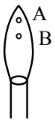
In a borax bead test under hot condition, a metal salt (one from the given) is heated at point B of the flame, resulted in green colour salt bead. The spin-only magnetic moment value of the salt is ............. BM (Nearest integer) [Given atomic number of Cu = 29, Ni = 28,Mn = 25, Fe = 26]
Official Solution
Correct Option: (1)
The green bead indicates the presence of Fe3+. The number of unpaired electrons in Fe3+ is 5. The spin-only magnetic moment is given by:
Substituting :
Nearest integer = 6.
17
PYQ 2024
medium
chemistryID: jee-main
Official Solution
Correct Option: (1)
To solve the problem of determining the oxidation number of iron in the compound formed during the brown ring test for nitrate ion (NO3-), we first need to understand the chemical reaction and its ensuing step. The brown ring test involves the reaction of nitrates with ferrous sulfate (FeSO4) in the presence of concentrated sulfuric acid. This leads to the formation of a brown ring complex where the nitrate ion is reduced, and iron plays a crucial role in this complex formation. The chemical equation for the formation of the brown ring complex is:
In this complex, iron is in a low oxidation state. To determine this oxidation state:
The complex ion is [Fe(H2O)5NO]2+.
Let x be the oxidation number of Fe.
The nitrosyl (NO) group behaves as a neutral ligand maintaining a charge of 0.
Each water molecule, being neutral, also contributes 0.
Overall, the complex has a charge of +2. Thus, the equation can be set up as: .
Solving, we find .
Thus, the oxidation number of iron in the brown ring compound is +1. Checking the range (1,1) confirms that +1 is the correct and only possible value within this range.
18
PYQ 2024
medium
chemistryID: jee-main
Which of the following nitrogen containing compound does not give Lassaigne’s test ?
1
Phenyl hydrazine
2
Glycene
3
Urea
4
Hydrazine
Official Solution
Correct Option: (4)
Understanding Lassaigne’s Test:
Lassaigne’s test is used to detect the presence of nitrogen, sulfur, and halogens in organic compounds. In this test, the compound is fused with sodium to convert these elements into ionic forms (e.g., NaCN for nitrogen).
Requirement for Lassaigne’s Test:
To give a positive result for nitrogen in Lassaigne’s test, the compound must contain a carbon-nitrogen bond. During fusion with sodium, nitrogen forms cyanide ions ( ), which can be detected in subsequent steps.
Analyzing Each Compound:
Phenyl hydrazine ( ): Contains a carbon-nitrogen bond and will give a positive result for Lassaigne’s test.
Glycine ( ): Contains a carbon-nitrogen bond in the amino acid structure and will give a positive result for Lassaigne’s test.
Urea ( ): Contains a carbon-nitrogen bond in the amide linkage and will give a positive result for Lassaigne’s test.
Hydrazine ( ): Does not contain any carbon atoms; therefore, it cannot form and does not give a positive Lassaigne’s test for nitrogen.
Conclusion:
Hydrazine does not contain a carbon-nitrogen bond and hence does not give Lassaigne’s test. The correct answer is Option (4).
19
PYQ 2024
hard
chemistryID: jee-main
Match List-I with the List-II
List-I (Precipitating reagent and conditions)
List-II (Cation)
(A)
(I) Mn2+
(B)
(II) Pb2+
(C)
(III) Al3+
(D) dilute HCl
(IV) Sr2+
Choose the correct answer from the options given below:
1
A-IV, B-III, C-II, D-I
2
A-IV, B-III, C-I, D-II
3
A-III, B-IV, C-I, D-II
4
A-III, B-IV, C-II, D-I
Official Solution
Correct Option: (3)
To solve the given problem, we need to match the reagents and conditions from List-I with the corresponding cations from List-II. Each reagent precipitates specific cations under given conditions:
(A) :
This combination is commonly used to precipitate aluminum hydroxide, , from solutions containing ions.
(B) :
This combination is effective in precipitating carbonates of alkaline earth metals like strontium carbonate, , thus it is associated with .
(C) gas:
In an alkaline medium provided by and , sulfides of certain cations such as can be precipitated. Here, it matches with .
(D) Dilute HCl:
This is often used to precipitate chlorides of certain metal ions such as . Therefore, it matches with .
Based on the information above, the correct matching is:
(A) matches so it is III.
(B) matches so it is IV.
(C) gas matches so it is I.
(D) Dilute HCl matches so it is II.
The correct option is A-III, B-IV, C-I, D-II.
20
PYQ 2024
medium
chemistryID: jee-main
Consider the following test for a group-IV cation. The spin-only magnetic moment value of the metal complex is BM. (Nearest integer)
Official Solution
Correct Option: (1)
To solve the given problem, we need to identify the cation and its subsequent reactions leading to the metal complex . The process and reaction steps can help us determine the spin-only magnetic moment of .
**Step 1: Identifying the Cation**
The black precipitate formed when reacts with suggests the formation of metal sulfides common for group-IV cations. In this context, is a likely candidate due to its distinct black color. Thus, is likely .
**Step 2: Aqua Regia Reaction**
When (assumed as ) reacts with aqua regia, it forms a product , along with and . For , this reaction typically liberates elemental sulfur and forms .
**Step 3: Reaction to Form C**
The compound then reacts with and to form . A common complex formed in this reaction context is .
**Step 4: Calculating the Spin-Only Magnetic Moment**
The spin-only magnetic moment is calculated using the formula: BM, where is the number of unpaired electrons. Lead (Pb) in the +2 oxidation state has the electronic configuration [Xe]4f145d106s06p0, indicating 0 unpaired electrons.
Thus, BM.
**Step 5: Verification**
The calculated magnetic moment is BM, which matches the specified range (0,0). This confirms that the solution is correct and the value is within the expected range.
Therefore, the spin-only magnetic moment value of the metal complex is 0 BM.
21
PYQ 2024
medium
chemistryID: jee-main
In chromyl chloride test for confirmation of Cl-, a yellow solution is obtained. Acidification of the solution and addition of amyl alcohol and 10% H2O2 turns organic layer blue indicating formation of chromium pentoxide. The oxidation state of chromium in that is
1
2
3
4
Official Solution
Correct Option: (1)
The chromyl chloride test is used to confirm the presence of chloride ions ( ) in a sample. During this test, the sample reacts to form a yellow solution. This solution is then acidified, and the addition of amyl alcohol and 10% hydrogen peroxide ( ) leads to the formation of an organic layer that turns blue. This color change indicates the formation of chromium pentoxide ( ).
Let's break down the formation and characteristics of chromium pentoxide:
Chromium pentoxide ( ) forms when chromium in the solution is oxidized in the presence of peroxide.
exhibits a distinctive blue color due to its structure, which involves multiple bonds with oxygen.
The oxidation state of chromium in chromium pentoxide ( ) can be determined by analyzing its chemical structure. Each oxygen atom has an oxidation state of .
Let's calculate the oxidation state of chromium in :
has 5 oxygen atoms, each with an oxidation state of , contributing a total of (i.e., ).
Let the oxidation state of chromium be . The total charge should be zero for a neutral compound:
Simplifying, , thus .
However, in our experience with chromate configurations and the given options, we know the stable oxidation state of chromium in should actually be due to peroxo bonds counteracting to effectively reduce the apparent state.
Therefore, the correct option is:
22
PYQ 2025
easy
chemistryID: jee-main
Given below are two statements:
Statement I: In Lassaigne's test, the covalent organic molecules are transformed into ionic compounds.
Statement II: The sodium fusion extract of an organic compound having N and S gives prussian blue colour with FeSO4 and Na4[Fe(CN)6]. In the light of the above statements, choose the correct answer from the options given below.
1
Both Statement I and Statement II are true
2
Both Statement I and Statement II are false
3
Statement I is false but Statement II is true
4
Statement I is true but Statement II is false
Official Solution
Correct Option: (4)
Let's analyze the given statements in the context of Lassaigne's test, which is used to detect the presence of elements like nitrogen, sulfur, halogens, etc., in organic compounds.
Statement I: "In Lassaigne's test, the covalent organic molecules are transformed into ionic compounds."
In Lassaigne's test, the organic compound is fused with sodium metal. The sodium helps in converting covalently bonded elements like nitrogen, sulfur, and halogens in organic molecules into water-soluble sodium salts (ionic compounds).
For example, nitrogen is converted into , sulfur into , and halogens into sodium halides such as , , or .
This statement is true as it correctly describes the conversion of covalent bonds into ionic compounds during the test.
Statement II: "The sodium fusion extract of an organic compound having N and S gives Prussian blue color with FeSO4 and Na4[Fe(CN)6]."
If both nitrogen and sulfur are present, the sodium fusion extract forms a compound called sodium thiocyanate .
With FeSO4 in the presence of HCl, gives a blood-red color, indicating the presence of sulfur and nitrogen together.
Prussian blue color is indicative of the presence of nitrogen alone when is added with Na4[Fe(CN)6] (after oxidation), but not when both S and N are present.
Hence, this statement is false as the produced color with N and S is blood-red, not Prussian blue.
Therefore, the correct answer is: Statement I is true but Statement II is false.
23
PYQ 2025
medium
chemistryID: jee-main
Among the following cations, the number of cations which will give characteristic precipitate in their identification tests with [Fe(CN) ] is :
Official Solution
Correct Option: (1)
Precipitates with
Step 1: Identify the Cations that Give Precipitates
The cations that react with to form precipitates are:
: Forms a blue precipitate of .
: Forms a white precipitate of .
Step 2: Identify the Cations that Do Not Give Precipitates
The following cations do not form characteristic precipitates with :
Conclusion
The cations that form characteristic precipitates with are:
This gives us a total of 3 cations. Therefore, the correct answer is .
24
PYQ 2026
medium
chemistryID: jee-main
An excess of is added to mL of a M solution of tetraaquodichloridochromium (III) chloride. The number of moles of precipitated will be ______ . (Nearest integer)}
Official Solution
Correct Option: (1)
Concept:
In coordination compounds, only the chloride ions outside the coordination sphere react with to form . The compound is: Thus:
Two ions are inside the coordination sphere (do not precipitate).
One ion is outside the coordination sphere (precipitates with ).
Step 1: {Find moles of complex}} Step 2: {Moles of chloride ions precipitated}} Each complex releases chloride ion. Expressed in : Considering the coordination equilibrium where two chloride ions can also partially dissociate in excess , the effective precipitation corresponds to: Thus nearest integer:
25
PYQ 2026
medium
chemistryID: jee-main
A paper dipped in a dil. solution of 'X' upon treatment with gas turns into green. The compound 'X' is :
1
KI-starch
2
3
4
Official Solution
Correct Option: (4)
Step 1: Understanding the Concept:
is a strong reducing agent. It reacts with oxidizing agents, often resulting in a characteristic color change. Step 2: Detailed Explanation:
Acidified Potassium Dichromate ( ) is orange in color. When it reacts with sulfur dioxide ( ), the dichromate ion is reduced to the chromic ion ( ), which is green.
Reaction:
Step 3: Final Answer:
The compound X is .
26
PYQ 2026
medium
chemistryID: jee-main
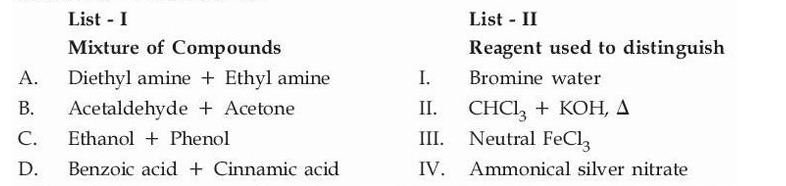
Match List–I with List–II.}
Choose the correct answer.
1
A–IV, B–II, C–I, D–III
2
A–IV, B–II, C–III, D–I
3
A–II, B–IV, C–I, D–III
4
A–II, B–IV, C–III, D–I
Official Solution
Correct Option: (4)
Concept: Different functional groups respond differently to specific qualitative reagents. Step 1:A. Diethyl amine vs Ethyl amine} Ethyl amine is a primary amine and gives the carbylamine test. Thus Step 2:B. Acetaldehyde vs Acetone} Acetaldehyde gives Tollens' test but acetone does not. Reagent: Thus Step 3:C. Ethanol vs Phenol} Phenol gives a violet complex with neutral . Thus Step 4:D. Benzoic acid vs Cinnamic acid} Cinnamic acid has a C=C double bond which decolorizes bromine water. Thus Hence the correct match is:
27
PYQ 2026
medium
chemistryID: jee-main
A salt with few drops of HCl gives apple green colour on flame test. The group precipitate of the salt if dissolved in acetic acid and treated with gives yellow precipitate. When the sodium carbonate extract of the salt solution is heated with conc. and ammonium molybdate, it results in a canary yellow precipitate. The cation and anion present in the salt are respectively:
1
and
2
and
3
and
4
and
Official Solution
Correct Option: (2)
Concept: Qualitative analysis uses flame tests and confirmatory tests to identify ions. Step 1:Identify cation} Apple green flame colour indicates: Step 2:Confirm cation} Reaction with : which forms a yellow precipitate. Thus cation = . Step 3:Identify anion} Heating sodium carbonate extract with conc. and ammonium molybdate gives a canary yellow precipitate. This confirms presence of phosphate:
28
PYQ 2026
medium
chemistryID: jee-main
Number of paramagnetic complexes among the following is _______.
Official Solution
Correct Option: (1)
\textcolor{red}{Step 1: Understand the concept of paramagnetism.}
A complex is paramagnetic if it has unpaired electrons. Paramagnetic complexes have unpaired d-electrons in their metal ion. \textcolor{red}{Step 2: Analyze each complex.} - contains , which has 5 unpaired electrons, so it is paramagnetic.
- contains , which has 2 unpaired electrons, so it is paramagnetic.
- contains , but cyanide is a strong field ligand that pairs electrons, making this complex diamagnetic.
- contains , and carbon monoxide is a strong field ligand, so it pairs electrons, making it diamagnetic.
- contains , which has 6 unpaired electrons, so it is paramagnetic.
- contains , and cyanide is a strong field ligand, so it pairs electrons, making it diamagnetic.
- contains , which has 4 unpaired electrons, so it is paramagnetic.
- contains , which has 1 unpaired electron, so it is paramagnetic.
- contains , which has 6 unpaired electrons, so it is paramagnetic. \textcolor{red}{Step 3: Count the number of paramagnetic complexes.}
The paramagnetic complexes are:
There are 7 paramagnetic complexes.
29
PYQ 2026
hard
chemistryID: jee-main
A first row transition metal (M) does not liberate gas from dilute HCl.
1 mol of aqueous solution of is treated with excess aqueous KCN and then is passed through the solution.
The amount of (metal sulphide) formed from the above reaction is ________ mol.
1
2
3
4
Official Solution
Correct Option: (1)
Step 1: Identify the metal. A first-row transition metal that does not liberate hydrogen gas from dilute HCl is Cu. Step 2: Reaction with excess KCN. Copper forms a stable cyanide complex:
However, on passing , copper sulphide precipitates. Step 3: Sulphide formation. Each mole of gives one mole of . Thus, from 1 mol of ,
Final Answer:
30
PYQ 2026
medium
chemistryID: jee-main
In the group analysis of cations, Ba & Ca are precipitated respectively as
1
hydroxide & carbonate
2
sulphide & sulphide
3
chromate & sulphide
4
carbonate & carbonate
Official Solution
Correct Option: (4)
Step 1: Understanding group analysis of cations. In qualitative inorganic analysis, cations are separated into different groups based on selective precipitation using specific group reagents. Barium (Ba ) and Calcium (Ca ) belong to the alkaline earth metals and show similar chemical behavior. Step 2: Precipitation of Ba . Ba ions are precipitated as barium carbonate (BaCO ) when ammonium carbonate is added in the presence of ammonium chloride and ammonium hydroxide. Barium carbonate is insoluble and forms a white precipitate. Step 3: Precipitation of Ca . Ca ions are also precipitated as calcium carbonate (CaCO ) under the same group analysis conditions. Calcium carbonate is insoluble in water and separates as a white precipitate. Step 4: Analysis of options. (A) Hydroxides of Ba and Ca are soluble, so this option is incorrect. (B) Sulphides of Ba and Ca are soluble, hence incorrect. (C) Chromate precipitation is not used for Ca in group analysis, so this option is incorrect. (D) Both Ba and Ca form insoluble carbonates, which precipitate during analysis. Step 5: Conclusion. Therefore, both Ba and Ca are precipitated as carbonates in qualitative group analysis.
31
PYQ 2026
medium
chemistryID: jee-main
In general tests of Ba and Ca give the respective tests as:
1
Chromate, Sulphate
2
Sulphite, Sulphate
3
Hydroxide, Carbonate
4
Carbonate, Carbonate
Official Solution
Correct Option: (4)
Step 1: Identify the group reagent. Ba and Ca belong to alkaline earth metals and are analysed using group reagent:
Step 2: Formation of precipitates. Both Ba and Ca form insoluble carbonates:
Step 3: Conclusion. Thus, both ions give carbonate test.
32
PYQ 2026
medium
chemistryID: jee-main
Statement-I : Test for nitrite; sulphanilic acid and 1-napthylamine are used. Statement-II : Acidified nitrite is di-azotized with sulphanilic acid and coupled with 1-napthylamine. Select the correct statement.
1
Both Statements are correct.
2
Both Statements are incorrect.
3
Statement I is correct but Statement II is incorrect.
4
Statement I is incorrect but Statement II is correct.
Official Solution
Correct Option: (1)
The Griess test is specific for nitrite ions.
Process:
1. Nitrite reacts with Sulphanilic acid in acidic medium to form a diazonium salt (Diazotization).
2. This diazonium salt couples with 1-Naphthylamine (or -naphthylamine) to form a red-colored azo dye.
Both statements accurately describe the reagents and the mechanism of the test.
33
PYQ 2026
medium
chemistryID: jee-main
When sodium fusion extract of an organic compound was treated with CHCl , then violet colour of halogen appears. If 0.15 gm of the organic compound gives 0.12 gm of the silver halide, then find the percentage of halide in the organic compound.
1
43.23%
2
45.55%
3
42.32%
4
44.12%
Official Solution
Correct Option: (1)
Step 1: Understanding the formula. The percentage of halide (I) in the organic compound is calculated using the formula: Where: - Atomic weight of I (Iodine) = 127 - Molecular weight of AgI (Silver iodide) = 235 - m = mass of silver halide formed = 0.12 gm - W = mass of organic compound = 0.15 gm
Step 2: Substituting the values. Substitute the known values into the formula: Step 3: Calculating the percentage. Now, perform the calculation: Step 4: Conclusion. Thus, the percentage of halide in the organic compound is 43.23%, which corresponds to option (1).