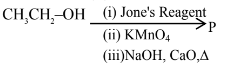
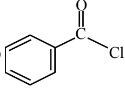
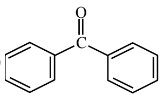
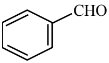
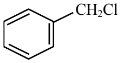
Consider the above reaction sequence and identify the major product P.
1
Methane
2
Methanal
3
Methoxymethane
4
Methanoic acid
Official Solution
Correct Option: (1)
The reaction sequence is as follows: Step 1: Oxidation using Jones Reagent Jones reagent ( ) oxidizes primary alcohols ( ) to carboxylic acids. Ethanol ( ) is oxidized to acetic acid ( ).
Step 2: Oxidation using The acetic acid ( ) is further oxidized to carbonic acid ( ) by . Carbonic acid is unstable and decomposes to and water.
Step 3: Decarboxylation using Soda Lime The carbon dioxide ( ) reacts with soda lime ( ) to form methane ( ) via decarboxylation.
Final Product: The major product is methane ( ). Final Answer: (1).
02
PYQ 2024
easy
chemistryID: jee-main
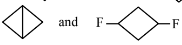
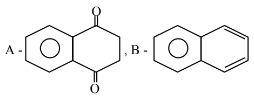
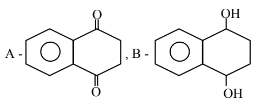
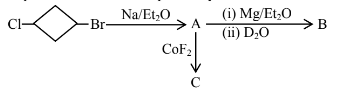
In the following sequence of reaction, the major products B and C respectively are :
1
2
3
4
Official Solution
Correct Option: (1)
To solve this sequence of reactions, let's analyze each step:
First Reaction:
The substrate is a cyclic compound with chlorine and bromine substituents. It reacts with sodium (Na) in the presence of diethyl ether (Et2O), which is typically used for a Wurtz reaction. This reaction will form an intermediate where two halogen atoms are removed, and a new carbon-carbon bond is formed, resulting in a ring structure with two additional carbon atoms.
Second Reaction:
The intermediate compound A is then treated with magnesium (Mg) in diethyl ether to form a Grignard reagent. The Grignard reagent is represented as RMgX where R is the organic group.
Third Reaction:
The Grignard reagent reacts with D2O (deuterium oxide) to replace the MgBr part with a deuterium atom (D), resulting in compound B, which is a deuterated hydrocarbon.
Fourth Reaction:
The compound A also reacts simultaneously via CoF2-catalyzed reaction to form compound C. CoF2 is used as a catalyst in some polymerization reactions, hinting that a new product formation may involve a fluorinated derivative or similar activity.
The reactions above indicate that compound B is the deuterated cyclopropane and compound C may involve some modifications due to CoF2. Based on the given options and the typical reactivities, the product matches the structure described by:
Thus, the major products B and C are identified as the ones shown in the correct answer option above.
03
PYQ 2024
medium
chemistryID: jee-main
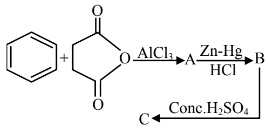
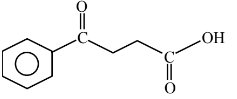
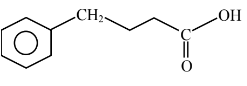
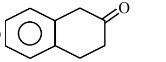
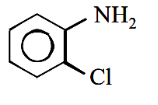
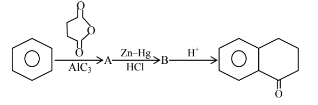
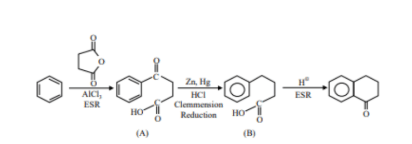
What is the structure of C ?
1
2
3
4
Official Solution
Correct Option: (1)
The given chemical reaction involves a sequence of reactions starting with a Friedel-Crafts acylation, followed by a Clemmensen reduction, and concluding with dehydration.
In the first step, benzene undergoes Friedel-Crafts acylation with succinic anhydride, facilitated by the catalyst . This reaction introduces an acyl group (in this case, a succinyl group) to the benzene ring, forming compound A.
Next, compound A undergoes Clemmensen reduction, which reduces the carbonyl group into a methylene group ( ). This step uses zinc amalgam (Zn-Hg) and hydrochloric acid (HCl), transforming compound A into compound B.
The final step involves the dehydration of the intermediate compound B using concentrated sulfuric acid ( ), resulting in the formation of compound C. This reaction typically removes a water molecule, leading to the formation of a double bond in the molecule structure.
Based on these reactions, compound C would be the final product of this series of transformations.
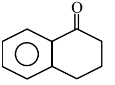
The correct structure of compound C matches the given option: Structure 1.
Thus, the final structure of compound C is represented by Structure 1, confirming it as the correct answer.
04
PYQ 2024
medium
chemistryID: jee-main
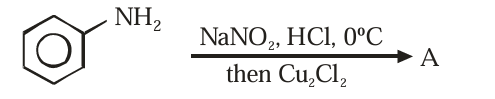
The product A formed in the following reaction is:
1
2
3
4
Official Solution
Correct Option: (3)
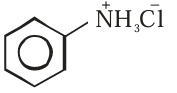
To solve this question, we need to identify the product "A" formed in the reaction shown in the image. The reaction involves the conversion of an aromatic amine into its corresponding diazonium salt, followed by a Sandmeyer reaction.
The starting compound is aniline, .
The reaction with and at converts aniline into a diazonium salt, .
The resulting diazonium salt then reacts with , a step in the Sandmeyer reaction, replacing the diazonium group with a chlorine atom.
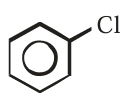
By the completion of these reactions, the diazonium group is replaced by chlorine, resulting in chlorobenzene, .
This yields chlorobenzene as the product "A". The correct option that represents chlorobenzene is shown below:
Conclusion: The product "A" formed in the reaction is chlorobenzene, represented by the correct option above.
05
PYQ 2024
easy
chemistryID: jee-main
Given below are two statements: one is labelled as Assertion (A) and the other is labelled as Reason (R): Assertion (A): SN reaction of C H CH Br occurs more readily than the SN reaction of CH CH Br. Reason (R): The partially bonded unhybridized p-orbital that develops in the trigonal bipyramidal transition state is stabilized by conjugation with the phenyl ring. In the light of the above statements, choose the most appropriate answer from the options given below:
1
(A) is not correct but (R) is correct
2
Both (A) and (R) are correct but (R) is not the correct explanation of (A)
3
Both (A) and (R) are correct and (R) is the correct explanation of (A)
4
(A) is correct but (R) is not correct
Official Solution
Correct Option: (3)
The given question involves understanding the mechanism and stability of SN2 reactions in organic chemistry, specifically comparing the reactivities between benzyl bromide (C6H5CH2Br) and ethyl bromide (CH3CH2Br).
SN2 Reaction Overview:
SN2 stands for substitution nucleophilic bimolecular reaction.
It proceeds with a backside attack by the nucleophile, resulting in inversion of configuration at the carbon center.
The reaction proceeds via a single transition state, which is a trigonal bipyramidal structure.
Explanation:
Assertion (A): SN2 reaction of C6H5CH2Br occurs more readily than the SN2 reaction of CH3CH2Br. The statement requires analyzing the SN2 reactivity of benzyl bromide and ethyl bromide. Benzyl bromide undergoes SN2 reactions more readily due to the stability provided by resonance. The benzyl group (C6H5CH2-) allows the transition state to stabilize through resonance with the phenyl ring, which lowers the activation energy necessary for the reaction.
Reason (R): The partially bonded unhybridized p-orbital that develops in the trigonal bipyramidal transition state is stabilized by conjugation with the phenyl ring. This statement accurately explains why the transition state of the benzyl bromide SN2 reaction is stabilized. The conjugation of the unhybridized p-orbital in the transition state with the phenyl ring provides resonance stabilization.
Conclusion: Given both the assertion and reason align with the fact that the benzyl bromide SN2 reaction is facilitated by stability through conjugation, both (A) and (R) are correct and (R) is the correct explanation of (A).
Therefore, the correct answer is: Both (A) and (R) are correct and (R) is the correct explanation of (A).
06
PYQ 2024
medium
chemistryID: jee-main
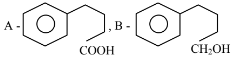
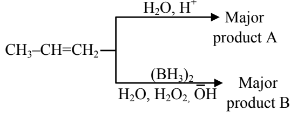
Identify the product A and product B in the following set of reactions.
1
A-CH CH CH OH ; B-CH CH CH CH OH
2
3
4
A-CH CH CH , B-CH CH CH
Official Solution
Correct Option: (3)
Let's analyze the given reaction to identify the products A and B.
The reaction involves two steps starting from a given alkene:
Product A: The first reaction involves the addition of water in the presence of an acid, . This is an example of acid-catalyzed hydration of alkenes. According to Markovnikov's rule, the hydroxyl group ( ) adds to the more substituted carbon. Thus, starting with propylene , the major product is , which is 2-propanol.
Product B: The second reaction is hydroboration-oxidation which involves , followed by hydrogen peroxide in the presence of a base . This reaction adds hydroxyl group ( ) to the less substituted carbon (anti-Markovnikov addition). For the same starting alkene , the product is , which is 1-propanol.
Hence, the products are:
Product A: 2-Propanol ( )
Product B: 1-Propanol ( )
Therefore, the correct answer matches the chemical structures shown in the option:
07
PYQ 2024
medium
chemistryID: jee-main
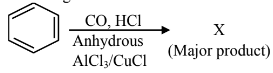
Identify major product "X" formed in the following reaction :
1
2
3
4
Official Solution
Correct Option: (3)
The reaction depicted in the image is known as the Gattermann-Koch reaction, which is a method for formylating aromatic rings, where benzene reacts with carbon monoxide (CO) and hydrochloric acid (HCl) in the presence of a catalyst such as anhydrous aluminum chloride (AlCl₃) and copper(I) chloride (CuCl). The reaction typically results in the introduction of a formyl group (-CHO) onto the aromatic ring.
Here, benzene is the starting material, and the formation of benzaldehyde is the major product. This is because the CO and HCl react together to form the formyl chloride (HCOCl) in situ, which then reacts with benzene to yield the formylated product, benzaldehyde.
To confirm this, let's examine why the given answer is correct and why other options are incorrect:
Compound 1: This option is incorrect because it does not represent a formylated product, i.e., lacks the aldehyde (-CHO) group.
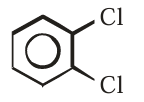
Compound 2: This compound is not expected from the Gattermann-Koch reaction. It typically relates to different reactions such as Friedel-Crafts acylation.
Compound 3 (Correct): This is benzaldehyde, the expected major product formed by the introduction of a formyl group onto benzene in the presence of AlCl₃/CuCl catalysts.
Compound 4: Similar to Compound 1, this option does not represent an aromatic aldehyde, which rules it out.
Hence, the major product "X" formed in this reaction is Benzaldehyde.
08
PYQ 2024
medium
chemistryID: jee-main
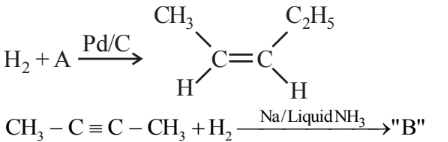
In the given reactions identify A and B.
1
A: 2–Pentyne B: trans–2–butene
2
A: n–Pentane B: trans–2–butene
3
A: 2–Pentyne B: Cis–2–butene
4
A: n–Pentane B: Cis–2–butene
Official Solution
Correct Option: (1)
To identify compounds A and B from the given reactions, we need to analyze the transformations shown:
The first reaction involves hydrogenation using Pd/C as a catalyst. Pd/C typically catalyzes the addition of hydrogen to alkynes, converting them into alkenes.
Here, compound A undergoes partial hydrogenation. Given that the product from this reaction is an alkene, A must be an alkyne.
The structural formula shown for the product suggests a symmetrical molecule with a trans configuration, which indicates trans–2–butene. This partial hydrogenation is specific to alkynes turning into trans alkenes when done via Lindlar's catalyst or related methods.
Now looking at the structure of A, the triple bond location confirms it to be 2–Pentyne, as any other location would not produce this product.
Therefore, for the given reactions, A is identified as 2–Pentyne and B as trans–2–butene, correlating with the correct option:
A: 2–Pentyne B: trans–2–butene
09
PYQ 2024
hard
chemistryID: jee-main
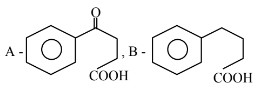
Identify A and B in the given chemical reaction sequence : -
1
2
3
4
Official Solution
Correct Option: (3)
The given sequence involves the following steps: Step 1: Friedel-Crafts Acylation Benzene ( ) reacts with acetyl chloride ( ) in the presence of , an electrophilic catalyst. This forms acetophenone ( ) as compound :
Step 2: Clemmensen Reduction Acetophenone ( ) undergoes Clemmensen reduction using zinc amalgam ( ) and hydrochloric acid ( ). The carbonyl group ( ) is reduced to a methylene group ( ), resulting in ethylbenzene ( ) as compound :
Step 3: Acidic Oxidation Ethylbenzene reacts with under oxidation conditions to form acetophenone again. This completes the reaction cycle. Final Products: (Acetophenone). (Ethylbenzene). Conclusion: The correct identification of and is given in option . Final Answer: (3).
10
PYQ 2024
hard
chemistryID: jee-main
Two moles of benzaldehyde and one mole of acetone under alkaline conditions using aqueous NaOH after heating gives as the major product. The number of bonds in the product is ................
Official Solution
Correct Option: (1)
The reaction shown below is an example of an aldol condensation, where benzaldehyde and acetone react in the presence of a base (OH-) and heat (Δ) to form a product.
$ $
11
PYQ 2024
medium
chemistryID: jee-main
Given below are two statements: Statement (I) : S 2 reactions are 'stereospecific', indicating that they result in the formation only one stereo-isomers as the product. Statement (II) : S 1 reactions generally result in formation of product as racemic mixtures. In the light of the above statements, choose the correct answer from the options given below :
1
Statement I is true but Statement II is false
2
Statement I is false but Statement II is true
3
Both Statement I and Statement II is true
4
Both Statement I and Statement II is false
Official Solution
Correct Option: (3)
To evaluate the given statements regarding SN2 and SN1 reactions, let's delve into the concepts:
Statement (I): SN2 reactions are 'stereospecific', indicating that they result in the formation of only one stereoisomer as the product.
Explanation: SN2 reactions involve a one-step, bimolecular nucleophilic substitution mechanism. The nucleophile attacks the carbon atom from the side opposite to the leaving group, leading to an inversion of configuration at the chiral center, known as the Walden inversion. Thus, the product is stereospecific as it results in a specific stereoisomer.
Statement (II): SN1 reactions generally result in the formation of products as racemic mixtures.
Explanation: SN1 reactions occur via a two-step mechanism where the first step involves the formation of a carbocation intermediate. Since the carbocation is planar, the nucleophile can attack from either face of the carbocation, leading to the formation of both enantiomers in equal proportion. As a result, the product is a racemic mixture.
Thus, both statements I and II are accurate as per the standard chemical reaction mechanisms for SN2 and SN1 reactions. Therefore, the correct answer is:
Both Statement I and Statement II is true
12
PYQ 2024
medium
chemistryID: jee-main
The shape of carbocation is :
1
trigonal planar
2
diagonal pyramidal
3
tetrahedral
4
diagonal
Official Solution
Correct Option: (1)
To determine the shape of a carbocation, we need to understand the electronic configuration and hybridization involved when a carbocation forms.
A carbocation is a positively charged carbon atom with only six electrons in its valence shell. Because it is electron-deficient, it lacks an octet and thus cannot exhibit tetrahedral geometry, which requires an electron pair for each bond in a 3D space.
The most stable configuration that a carbocation can achieve is trigonal planar. Here is the reasoning behind this:
The central carbon atom in a carbocation is sp² hybridized. This means that it uses three sp² hybrid orbitals to form sigma bonds with surrounding atoms.
Since there are only three sigma bonds, the atoms connected to the carbocation form a plane around the central carbon atom.
The unhybridized p orbital on the carbocation carbon is perpendicular to this plane, which is a distinctive feature of trigonal planar geometry.
Therefore, the correct answer, based on hybridization and geometry theory, is that a carbocation takes a trigonal planar shape.
Let's briefly consider why the other options are incorrect:
Diagonal pyramidal: This is not a recognized geometric term in molecular geometry.
Tetrahedral: This shape requires the carbon to have four regions of electron density (like in methane, ), which is not the case for electron-deficient carbocations.
Diagonal: Similar to diagonal pyramidal, this is not a term used in molecular geometry for describing the shape of molecules.
Thus, considering all the points, the shape of the carbocation is trigonal planar.
13
PYQ 2024
medium
chemistryID: jee-main
Which of the following reaction is correct ?
1
2
3
4
Official Solution
Correct Option: (2)
To determine which reaction is correct, we need to examine each option in relation to chemical principles such as reaction mechanisms, thermodynamics, or conservation of mass and charge. Let's analyze the options provided and justify the correct answer.
Firstly, we need to consider the reaction mechanisms. Analyze each reaction for correct conservation of mass and charge. Verify if the products are feasible given the starting materials and reaction conditions.
Review the balanced nature of the reactions. Each chemical equation should have the same number of each type of atom on both sides of the reaction.
Consider the practical validation of these reactions if any of them are based on well-known reactions in chemistry or are covered in the exam syllabus.
Therefore, Reaction 2 as depicted in "Fig 2" is correct. Typically, the logic behind selecting this option would be because it adheres to the established rules of chemistry principles mentioned above.
Conclusion: After reviewing each option through these criteria, "Fig 2" aligns correctly with chemical reaction principles and has been identified as the correct response. To master similar questions, focus on mastering fundamental reactions, understanding balancing techniques, and familiarizing yourself with common reaction types.
14
PYQ 2024
medium
chemistryID: jee-main
The number of correct reaction(s) among the following is ________.
Official Solution
Correct Option: (1)
Analyze Each Reaction:
Reaction (A): The reaction conditions suggest Friedel-Crafts acylation using anhydrous and a carboxylic acid chloride. This reaction should proceed correctly, forming the expected acylated aromatic product.
Reaction (B): In this reaction, (Rosenmund reduction conditions) is used to reduce an acyl chloride to an aldehyde. This reaction is incorrect.
Reaction (C): This reaction involves a carboxylic acid reacting with CO and HCl under anhydrous conditions with or CuCl. However, this is not a standard reaction for carboxylic acid conversion to an acyl chloride under these conditions, so this reaction is incorrect.
Reaction (D): The conditions involve the reaction of a benzene derivative with and HCl. However, these reagents are not compatible with producing an expected product under the given conditions, making this reaction incorrect.
Conclusion:
Only Reaction (A) is correct among the given reactions. Therefore, the number of correct reactions is 1, corresponding to Option (1).
15
PYQ 2024
medium
chemistryID: jee-main
Identify the correct set of reagents or reaction conditions ‘X’ and ‘Y’ in the following set of transformation.
1
2
3
4
Official Solution
Correct Option: (3)
Determine the Reaction with Reagent X: The starting compound, CH3 − CH2 − CH2 − CH2 − Br, is a 1-bromobutane. When treated with concentrated alcoholic NaOH at 80°C, an elimination reaction (dehydrohalogenation) occurs, leading to the formation of an alkene. The product after elimination is CH3 − CH = CH − CH3 (1-butene).
Reaction with Reagent Y: After the formation of 1-butene, adding HBr in the presence of acetic acid will convert it back into an alkyl halide by electrophilic addition. The final product is 1-bromo-2-butene.
Conclusion: The correct set of reagents for X and Y is: X = conc. alc. NaOH, 80°C Y = HBr/acetic acid This corresponds to Option (3).
16
PYQ 2024
easy
chemistryID: jee-main
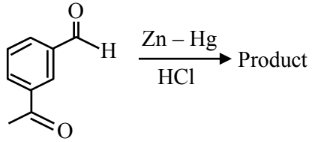
Identify the product in the following reaction :
1
2
3
4
Official Solution
Correct Option: (4)
Understanding the Clemmensen Reduction Reaction:
The reaction involves Zn-Hg and HCl, which is known as the Clemmensen reduction. Clemmensen reduction is typically used to reduce carbonyl groups (like aldehydes and ketones) to methylene (-CH2-) groups.
Analyzing the Given Compound:
The starting compound likely has a carbonyl (C=O) group. In the presence of Zn-Hg and HCl, the carbonyl group will be reduced to a -CH2- group.
Identifying the Product:
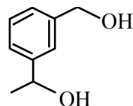
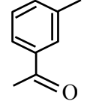
Based on the Clemmensen reduction, the product will have the carbonyl group replaced by a methylene (-CH2-) group. Among the given options, Option (4) represents the structure where the carbonyl group has been reduced to a -CH2- group.
Conclusion:
The correct product of the reaction is represented by Option (4).
17
PYQ 2024
medium
chemistryID: jee-main
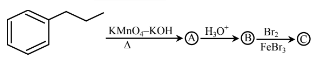
The product Ⓒ in the following sequence of reactions has _______ π bonds.
Official Solution
Correct Option: (1)
The reaction sequence proceeds as follows: Step 1: Oxidation of with and The side chain ethyl group of ethylbenzene is oxidized to a carboxylate salt:
Here, is , potassium benzoate. Step 2: Acidification with The carboxylate salt is acidified to form benzoic acid:
Here, is , benzoic acid. Step 3: Bromination with Bromination occurs at the para-position of the benzene ring relative to the carboxylic acid group, yielding:
Here, is para-bromobenzoic acid ( ). Step 4: Count the -bonds in - The benzene ring contributes 3 -bonds. - The group in the carboxylic acid contributes 1 -bond. Thus, the total number of -bonds in is:
Final Answer: 4.
18
PYQ 2024
medium
chemistryID: jee-main
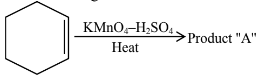
Consider the given chemical reaction : Product ''A'' is :
1
picric acid
2
oxalic acid
3
acetic acid
4
adipic acid
Official Solution
Correct Option: (4)
The reaction of cyclohexane with potassium permanganate ( ) in an acidic medium ( ) and heat results in the oxidation of cyclohexane to adipic acid. Step 1: Oxidation of cyclohexane Cyclohexane ( ) undergoes oxidation in the presence of and . - The oxidizes the groups in cyclohexane to carboxylic acid ( ) groups. - This results in the formation of adipic acid ( ).
Step 2: Conclusion The product is adipic acid. Final Answer: (4).
19
PYQ 2024
medium
chemistryID: jee-main
Which one of the following reactions is NOT possible?
1
2
3
4
Official Solution
Correct Option: (2)
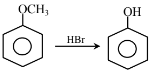
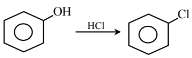
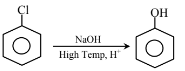
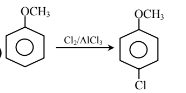
Step 1: Analyze each reaction 1. Reaction (1): The reaction involves the cleavage of the ether bond ( ) by , producing phenol ( ). This reaction is possible due to the nucleophilic substitution mechanism. 2. Reaction (2): The reaction involves the conversion of phenol ( ) to chlorobenzene ( ) by . However, this reaction is \textbf{NOT} possible because the hydroxyl group in phenol is directly attached to the benzene ring, and it does not undergo nucleophilic substitution to form . The lone pair on oxygen in phenol makes the group resistant to substitution by . 3. Reaction (3): The reaction involves the hydrolysis of chlorobenzene ( ) under high temperature and pressure in the presence of . This reaction is possible via nucleophilic aromatic substitution, producing phenol ( ). 4. Reaction (4): The reaction involves the electrophilic substitution of anisole ( ) with chlorine in the presence of . This reaction is possible, producing a mixture of ortho and para substituted products. Step 2: Conclusion Among the given reactions, only Reaction (2) is not possible because phenol does not undergo nucleophilic substitution with to form chlorobenzene. Final Answer: (2).
20
PYQ 2024
medium
chemistryID: jee-main
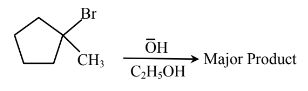
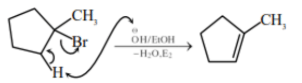
Identify the major product in the following reaction.
1
2
3
4
Official Solution
Correct Option: (3)
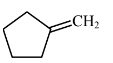
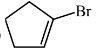
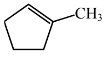
This is an elimination reaction (E2 mechanism) where the hydroxide ion acts as a strong base. The steps of the reaction are as follows: Step 1: Identify the base and leaving group In the presence of and EtOH, the bromine atom ( ) acts as the leaving group. The hydroxide ion abstracts a proton ( ) from the adjacent carbon atom, resulting in the formation of a double bond. Step 2: Formation of the double bond Since the reaction proceeds via the E2 mechanism, the elimination occurs in a single step. The base removes a -hydrogen atom (attached to the carbon next to the carbon with ), and the leaves, resulting in the formation of a double bond between the - and -carbons. Step 3: Determine the major product The double bond forms between the -carbon (the one originally bonded to the bromine atom) and the -carbon. Due to Zaitsev's rule, the most substituted alkene is the major product. Hence, the major product is cyclopentene with a methyl ( ) substituent. Final Answer: (3) Cyclopentene with a substituent.
21
PYQ 2024
medium
chemistryID: jee-main
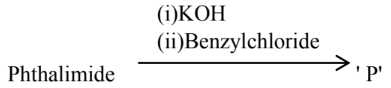
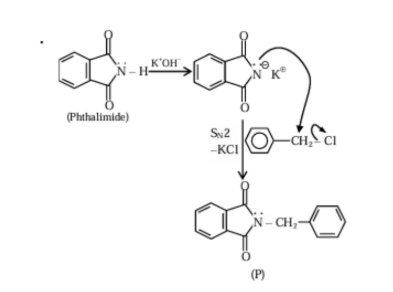
Phthalimide is made to undergo following sequence of reactions.Total number of bonds present in product 'P' is/are ______
Official Solution
Correct Option: (1)
Phthalimide undergoes the following transformations: In the presence of KOH, the acidic hydrogen of phthalimide is removed, forming the phthalimide anion. The phthalimide anion then reacts with benzyl chloride via an S reaction, leading to the formation of product 'P'. In product 'P': The benzene ring contributes -bonds. Each carbonyl group (C=O) provides -bonds, giving a total of -bonds for both groups. The benzyl group attached to nitrogen contributes additional -bond. Thus, the total number of -bonds in product 'P' is:
22
PYQ 2024
medium
chemistryID: jee-main
Ionic reactions with organic compounds proceed through: (A) Homolytic bond cleavage (B) Heterolytic bond cleavage (C) Free radical formation (D) Primary free radical (E) Secondary free radical Choose the correct answer from the options given below:

1
(A) only
2
(C) only
3
(B) only
4
(D) and (E) only
Official Solution
Correct Option: (3)
The question asks to identify the fundamental process through which ionic reactions with organic compounds proceed from the given options.
Concept Used:
Organic reactions are classified based on how the covalent bonds are broken. There are two primary types of covalent bond cleavage:
Homolytic Bond Cleavage (Homolysis): In this process, the shared pair of electrons in a covalent bond is distributed equally between the two separating atoms. This leads to the formation of highly reactive, neutral species with an unpaired electron, known as free radicals. Reactions involving this type of cleavage are called free-radical reactions.
Heterolytic Bond Cleavage (Heterolysis): In this process, the shared pair of electrons is transferred completely to one of the bonded atoms when the bond breaks. This results in the formation of a pair of oppositely charged ions: a cation and an anion. Reactions involving the formation and reaction of these charged species (ions) are called ionic reactions.
Step-by-Step Solution:
Step 1: Analyze the term "Ionic Reactions".
By definition, an "ionic reaction" is a reaction that proceeds through ionic intermediates. These intermediates are charged species, such as carbocations (positively charged carbon atoms) or carbanions (negatively charged carbon atoms).
Step 2: Evaluate the bond cleavage required for ionic reactions.
For an ionic reaction to occur, charged intermediates must be formed from a neutral organic molecule. This requires the unequal breaking of a covalent bond, where one atom retains the entire bonding pair of electrons, becoming an anion, and the other atom loses the electrons, becoming a cation. This process is, by definition, heterolytic bond cleavage.
Step 3: Evaluate the given options.
(A) Homolytic bond cleavage: This process forms free radicals, not ions. It is the basis for free-radical reactions, not ionic reactions.
(B) Heterolytic bond cleavage: This process forms ions (cations and anions), which are the key intermediates in ionic reactions. This is the correct mechanism.
(C) Free radical formation: Free radicals are the result of homolytic cleavage and are characteristic of free-radical reactions.
(D) Primary free radical: This is a specific type of free radical, an intermediate in free-radical reactions.
(E) Secondary free radical: This is also a specific type of free radical, an intermediate in free-radical reactions.
Therefore, options (A), (C), (D), and (E) all relate to free-radical mechanisms, while only option (B) correctly describes the bond-breaking mechanism essential for ionic reactions.
Final Result:
Ionic reactions are characterized by the involvement of charged intermediates (ions). The formation of these ions from covalent organic compounds occurs through the unequal breaking of a bond, which is known as heterolytic bond cleavage.
The correct answer is (B) Heterolytic bond cleavage.
23
PYQ 2024
medium
chemistryID: jee-main
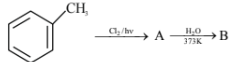
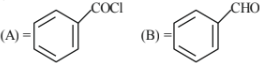
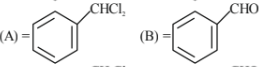
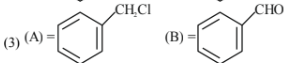
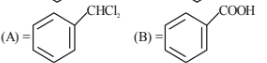
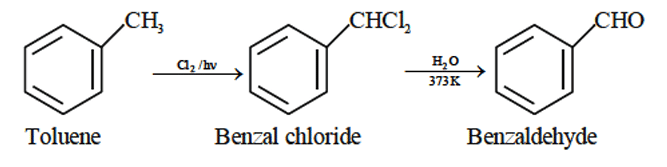
Identify A and B in the following sequence of reaction.
1
2
3
4
Official Solution
Correct Option: (2)
In the reaction, toluene undergoes chlorination in the presence of light to form benzyl chloride (A). On further oxidation with water, it forms benzaldehyde (B). Thus the correct answer is Option B.
24
PYQ 2025
medium
chemistryID: jee-main
The reaction follows the mechanism:The overall order of the reaction is:
1
3
2
1.5
3
2.5
4
2
Official Solution
Correct Option: (2)
The reaction mechanism consists of three steps:
(fast)
(slow, rate-determining step)
(fast)
To determine the overall order, focus on the rate-determining step, as it controls the reaction rate. The slow step rate law is expressed as: The breakdown of in the fast step achieves a rapid equilibrium, such that . Substitute in the rate law: The overall order is determined by the sum of the exponents: Hence, the overall order of the reaction is 1.5.
25
PYQ 2025
easy
chemistryID: jee-main
In the Claisen-Schmidt reaction to prepare dibenzalacetone from 5.3 g benzaldehyde, a total of 3.51 g of product was obtained. The percentage yield in this reaction was _____.
Official Solution
Correct Option: (1)
First, calculate the moles of benzaldehyde used:
The theoretical yield of the product can be calculated from the stoichiometry of the reaction (based on a 1:1 molar ratio for reactants and products):
Now, calculate the percentage yield: Thus, the percentage yield of the reaction is .
26
PYQ 2025
medium
chemistryID: jee-main
In the reaction , what is the role of potassium iodide (KI) in this reaction?
1
It acts as a catalyst.
2
It acts as a reducing agent.
3
It acts as an oxidizing agent.
4
It decomposes to release iodine.
Official Solution
Correct Option: (1)
In the decomposition reaction of hydrogen peroxide, potassium iodide (KI) acts as a catalyst. It speeds up the reaction without being consumed in the process.
27
PYQ 2026
medium
chemistryID: jee-main
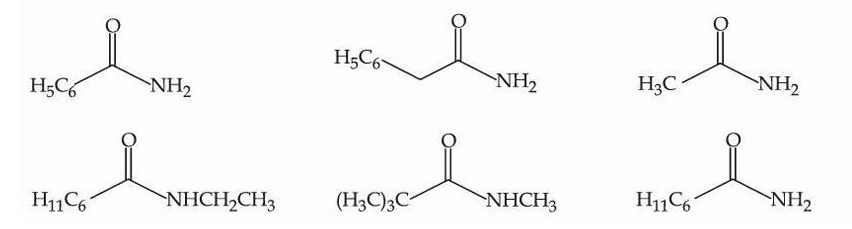
The number of compounds from the following which can undergo reaction with (alcoholic) to give respective products and these products can also be obtained separately by Gabriel phthalimide reaction is :}
1
5
2
4
3
3
4
6
Official Solution
Correct Option: (3)
Concept:
causes Hofmann bromamide degradation.
It converts an amide to a primary amine with one carbon less.
Gabriel phthalimide synthesis gives only primary amines.
Thus, the required conditions are:
The compound must be an amide
The product must be a primary amine
Step 1: Check the given structures. Compounds containing the group: undergo Hofmann rearrangement and produce primary amines.
Step 2: Exclude substituted amides. Compounds with: produce secondary amines, which cannot be prepared by Gabriel synthesis.
Step 3: Count valid compounds. Only those compounds which:
Have
Form primary amines
Number of such compounds: Final Answer:
28
PYQ 2026
medium
chemistryID: jee-main
An optically active alkyl bromide reacts with ethanolic KOH to form major compound [A] which reacts with bromine to give compound [B]. Compound [B] reacts with ethanolic KOH and sodamide to give compound [C]. One molecule of water adds to compound [C] on warming with mercuric sulphate and dilute sulphuric acid at to form compound [D]. The functional group in compound D is confirmed by :
1
Haloform test
2
Lucas test
3
Silver mirror test
4
Benedict test
Official Solution
Correct Option: (1)
Concept:
The sequence involves elimination, halogenation, double elimination and hydration of an alkyne. Step 1: {Identify compound A} Optically active is -bromobutane. With alcoholic KOH: Thus Step 2: {Reaction with bromine} Thus Step 3: {Double elimination} With alcoholic KOH and sodamide: Thus Step 4: {Hydration of alkyne} In presence of : Thus This contains a methyl ketone group. Step 5: {Test for methyl ketone} Methyl ketones give positive haloform test. Thus the functional group is confirmed by:
29
PYQ 2026
medium
chemistryID: jee-main
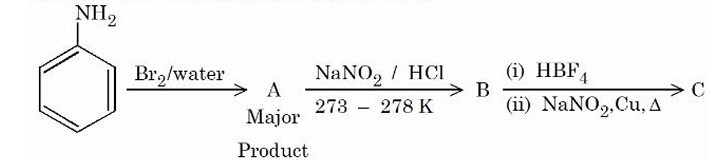
Product C of the following reaction sequence will be [assuming sequence: Aniline A B C]
1
1-Bromo-4-nitrobenzene
2
1, 3, 5-Tribromo-2-nitrobenzene
3
4-Bromo-1-nitrobenzene
4
1, 3, 5-Tribromobenzene
Official Solution
Correct Option: (4)
Step 1: Understanding the Concept:
Aniline is highly reactive towards electrophilic substitution. Bromine water causes poly-substitution. Subsequent diazotization and deamination allow for the removal of the amino group, leaving the substituted halogens on the ring.
Step 2: Key Formula or Approach:
1. Step 1: Bromination of Aniline.
2. Step 2: Diazotization ( ).
3. Step 3: Reduction (Deamination) using or Ethanol.
Step 4: Detailed Explanation:
1. Aniline + : The group is strongly activating. It directs bromine to both ortho and para positions, yielding 2,4,6-Tribromoaniline (Product A).
2. 2,4,6-Tribromoaniline + : The amino group is converted into a diazonium salt, yielding 2,4,6-Tribromobenzenediazonium chloride (Product B).
3. Product B + : Hypophosphorous acid reduces the diazonium group to a hydrogen atom.
4. The final product is 1,3,5-Tribromobenzene (Product C).
Step 5: Final Answer:
Product C is 1, 3, 5-Tribromobenzene.
30
PYQ 2026
medium
chemistryID: jee-main
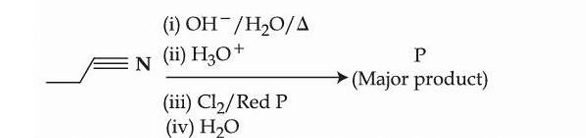
Complete the following reaction sequence and give the name of major product 'P'.
1
2-Chloropropanoic acid
2
3-Chloropropanoic acid
3
1-Chloropropane
4
2-Chloropropane
Official Solution
Correct Option: (1)
Step 1: Understanding the Concept:
The sequence involves the complete hydrolysis of a nitrile to a carboxylic acid, followed by the Hell-Volhard-Zelinsky (HVZ) reaction. Step 2: Detailed Explanation: Steps (i) and (ii): Nitriles ( ) undergo complete hydrolysis in the presence of acid or base and heat to form carboxylic acids.
(Propanoic acid). Steps (iii) and (iv): Carboxylic acids with -hydrogens react with followed by hydrolysis to substitute the -hydrogen with a chlorine atom. This is the HVZ reaction.
(2-Chloropropanoic acid). Step 3: Final Answer:
The major product P is 2-chloropropanoic acid.
31
PYQ 2026
medium
chemistryID: jee-main
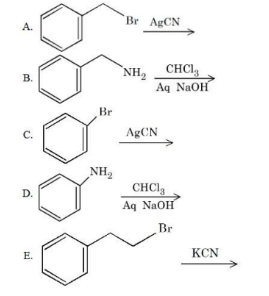
Benzyl isocyanide can be obtained from}
1
A and B Only
2
A and C Only
3
B and D Only
4
D and E Only
Official Solution
Correct Option: (1)
Step 1: Understanding the Question: The goal is to identify which reaction conditions produce benzyl isocyanide ( ). We evaluate each given reaction sequence based on the reagents provided. Step 2: Detailed Explanation: - Reaction A: Benzyl bromide ( ) reacting with . Since silver cyanide is covalent, the lone pair on nitrogen is more available for nucleophilic attack, leading to the formation of the isocyanide ( ). This is correct. - Reaction B: Benzylamine ( ) reacting with chloroform ( ) and aqueous . This is the Carbylamine reaction, which converts primary amines into isocyanides. It produces benzyl isocyanide. This is correct. - Reaction C: Aryl halide (Bromobenzene) reacting with . Aryl halides generally do not undergo nucleophilic substitution under standard conditions due to partial double bond character of the bond and steric hindrance. - Reaction D: Aniline reacting with . This produces phenyl isocyanide ( ), not benzyl isocyanide. - Reaction E: Benzyl bromide reacting with . is ionic and provides cyanide ions ( ), where the carbon is more nucleophilic. This produces benzyl cyanide ( ), not isocyanide. Step 3: Final Answer: Reactions A and B produce the desired product.
32
PYQ 2026
medium
chemistryID: jee-main
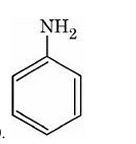
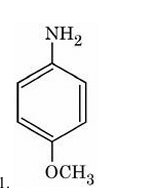
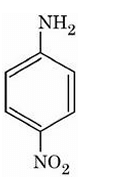
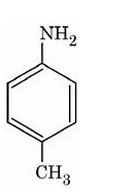
The strongest conjugate acid will result from:
1
2
3
4
Official Solution
Correct Option: (3)
Step 1: Understanding the Concept:
The strength of a conjugate acid is inversely proportional to the strength of its parent base. A weak base will produce a strong conjugate acid.
Step 3: Detailed Explanation:
Basicity of substituted anilines depends on the electron density on the Nitrogen atom.
- (B) is an EDG ( ), making the amine more basic.
- (D) is an EDG ( and hyperconjugation), making it more basic.
- (C) is a very strong EWG ( and ), which heavily withdraws electron density from Nitrogen, making p-nitroaniline the weakest base.
Since p-nitroaniline is the weakest base among the choices, its conjugate acid ( ) will be the strongest conjugate acid.
Step 4: Final Answer:
The strongest conjugate acid results from p-nitroaniline.
33
PYQ 2026
medium
chemistryID: jee-main
Which statements are True?
A. In Hoffmann bromamide degradation, 4 moles of NaOH and 2 moles of Br₂ are consumed per mole of an amide. B. Hoffmann bromamide reaction is not given by alkyl amides. C. Primary amines can be synthesized by Hoffmann bromamide degradation. D. Secondary amide on reaction with and NaOH will give secondary amine. E. The by-products of Hoffmann degradation are , and .
1
A, C and E only
2
B, C and D only
3
C and E only
4
C, D and E only
Official Solution
Correct Option: (3)
Step 1: Understanding the Concept:
The Hoffmann Bromamide reaction converts a primary amide into a primary amine with one less carbon atom. Step 2: Key Formula or Approach:
The balanced equation is:
Step 3: Detailed Explanation: A: Only 1 mole of is consumed, not 2. (False) B: It is given by both alkyl and aryl primary amides. (False) C: It is a primary method for preparing primary amines ( ). (True) D: Secondary amides ( ) do not undergo this reaction. (False) E: The by-products are exactly , , and . (True) Step 4: Final Answer:
Statements C and E are true.
34
PYQ 2026
medium
chemistryID: jee-main
n-Butane on monochlorination under photochemical condition gives an optically active compound "P". "P" on further chlorination gives dichloro compounds. The number of dichloro compounds obtained (ignore stereoisomers) is:
1
3
2
4
3
5
4
6
Official Solution
Correct Option: (2)
Step 1: Understanding the Concept:
n-Butane is . Monochlorination at C2 gives 2-chlorobutane ( ), which is chiral (Compound "P"). Step 2: Key Formula or Approach:
Identify all possible positions for a second chlorine atom on 2-chlorobutane. Step 3: Detailed Explanation:
Structure of P:
1. 1,2-dichlorobutane: Substitution at C1.
2. 2,2-dichlorobutane: Substitution at C2.
3. 2,3-dichlorobutane: Substitution at C3.
4. 1,3-dichlorobutane: (Note: 2-chlorobutane is symmetric in a way that C1/C4 and C2/C3 are relative, but once one Cl is fixed at C2, the positions become distinct).
5. 2,4-dichlorobutane (same as 1,3-dichlorobutane).
The unique structural isomers are: 1,2-dichloro, 2,2-dichloro, 2,3-dichloro, and 1,3-dichloro. Step 4: Final Answer:
There are 4 dichloro compounds obtained.
35
PYQ 2026
medium
chemistryID: jee-main
Which of the following will produce ?
1
2
3
4
Official Solution
Correct Option: (3)
Concept: Formation of isocyanides ( ) occurs via:
Carbylamine reaction (only with primary amines)
Reaction with (gives isocyanide)
Step 1: Check options
is nitrobenzene, not a primary amine → no carbylamine reaction