Assertion A : Hydrogen is the most abundant element in the Universe, but it is not the most abundant gas in the troposphere. Reason R : Hydrogen is the lightest element.
1
Both A and R are true and R is the correct explanation of A
2
Both A and R are true but R is NOT the correct explanation of A
3
A is true but R is false
4
A is false but R is true
Official Solution
Correct Option: (1)
Step 1: Hydrogen makes up about 75% of the baryonic mass of the universe. However, Earth's troposphere is dominated by (78%) and (21%). Statement A is true.
Step 2: Hydrogen is indeed the lightest element (atomic mass ). Statement R is true.
Step 3: Because it is so light, Hydrogen molecules have high thermal velocities that exceed Earth's escape velocity. Consequently, most primordial hydrogen escaped into space, which is why it's rare in our atmosphere. Thus, R explains A.
02
PYQ 2021
medium
chemistryID: jee-main
A home owner uses of methane ( ) gas, (assume is an ideal gas) in a year to heat his home. Under the pressure of 1.0 atm and 300 K, mass of gas used is g. The value of is ________. (Nearest integer) (Given R = 0.083 L atm )
Official Solution
Correct Option: (1)
Step 1: Understanding the Concept: Methane behaves as an ideal gas, so we can use the ideal gas equation to find the number of moles present in the given volume at a specific pressure and temperature. The total mass of the gas is the product of the number of moles and the molar mass of methane. Step 2: Key Formula or Approach: 1. Ideal Gas Law: . 2. Mass: . Step 3: Detailed Explanation: 1. Convert Units: Volume . Since , . Molar mass of ( ) = .
2. Calculate Moles ( ):
3. Calculate Mass ( ):
Rounding to the nearest integer, . Step 4: Final Answer: The value of is 26.
03
PYQ 2025
medium
chemistryID: jee-main
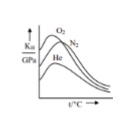
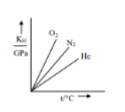
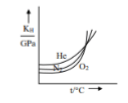
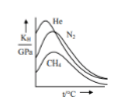
Which of the following graph correctly represents the plots of at 1 bar gases in water versus temperature?
1
2
3
4
Official Solution
Correct Option: (4)
As temperature increases, solubility first decreases then increases, hence first increases, then decreases. At moderate temperature, the value of follows the order:
04
PYQ 2026
medium
chemistryID: jee-main
The correct order of molar heat capacities measured at 298 K and 1 bar is :
1
Copper(s) >Bromine(l) >Helium(g)
2
Bromine(l) >Copper(s) >Helium(g)
3
Helium(g) >Bromine(l) >Copper(s)
4
Helium(g) >Bromine(l) Copper(s)
Official Solution
Correct Option: (2)
Step 1: Understanding the Concept:
Molar heat capacity ( ) depends on the degrees of freedom available to the substance in its current phase (solid, liquid, or gas) and its molecular complexity. Step 2: Detailed Explanation: 1. Helium (g): Helium is a monatomic gas. Its molar heat capacity at constant pressure ( ) is approximately . 2. Copper (s): According to the Dulong-Petit Law, the molar heat capacity of most solid elements is approximately . 3. Bromine (l): Bromine is a liquid at room temperature and is diatomic ( ). Liquids generally have much higher molar heat capacities than solids or gases because they possess many vibrational, translational, and rotational modes, along with strong intermolecular interactions. For Bromine (l), .
Comparing the values: .
Therefore, the order is Bromine(l) >Copper(s) >Helium(g). Step 3: Final Answer:
The correct order of molar heat capacities is Bromine(l) >Copper(s) >Helium(g).
05
PYQ 2026
hard
chemistryID: jee-main
Statement I: For an ideal gas, heat capacity at constant volume is always greater than the heat capacity at constant pressure. Statement II: In a constant volume process, no work is produced and all the heat withdrawn goes into the chaotic motion and is reflected by a temperature increase of the ideal gas. In the light of the above statements, choose the correct answer:
1
Both Statement I and Statement II are true
2
Both Statement I and Statement II are false
3
Statement I is true but Statement II is false
4
Statement I is false but Statement II is true
Official Solution
Correct Option: (4)
Step 1: Understanding the Concept:
Heat capacity at constant pressure ( ) and constant volume ( ) are related by Mayer's formula for an ideal gas: . Additionally, the First Law of Thermodynamics ( ) governs the energy distribution during these processes.
Step 2: Key Formula or Approach:
1. Mayer's Relation: . Since is a positive constant, .
2. Constant Volume Process: .
Step 3: Detailed Explanation:
1. Statement I analysis: According to Mayer's relation, is always greater than because at constant pressure, heat is used for both increasing internal energy and doing expansion work. Thus, Statement I is false.
2. Statement II analysis: In an isochoric (constant volume) process, work done is zero. Therefore, . All heat added increases the internal kinetic energy (chaotic motion) of the molecules, leading to a temperature rise. Thus, Statement II is true.
Step 4: Final Answer:
Statement I is false, but Statement II is true.
06
PYQ 2026
medium
chemistryID: jee-main
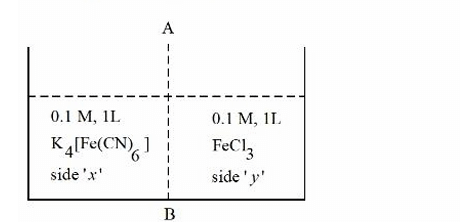
At , 0.1 M, 1 L aqueous solution and 0.1 M, 1 L aqueous solution are placed in a container separated by a semi permeable membrane AB. Assume complete dissociation of both the solutes. Which of the following statement is correct?
1
Blue color is formed on both sides.
2
Ionic solutes in aqueous solution can pass through semi-permeable membrane.
3
Solution on side 'y' is hypotonic.
4
To cause the reverse flow of solvent during osmosis, external pressure (any value) should be applied to side 'x'.
Official Solution
Correct Option: (3)
Step 1: Understanding the Concept:
Osmotic pressure depends on the total concentration of dissolved particles (osmolarity). A semi-permeable membrane allows solvent (water) to pass but blocks solute particles (ions). Hypotonic solutions have lower particle concentration compared to another.
Step 2: Key Formula or Approach:
1. Van't Hoff factor = total ions produced upon dissociation.
2. Osmotic concentration = .
Step 3: Detailed Explanation:
Side 'x' ( ): Dissociates into . Thus, .
Conc .
Side 'y' ( ): Dissociates into . Thus, .
Conc .
- (A) False: Ions don't pass membrane; Prussian blue reaction cannot happen.
- (B) False: Definition of semi-permeable membrane is that solutes cannot pass.
- (C) True: Side 'y' has lower osmolarity ( ), so it is hypotonic.
- (D) False: To stop or reverse osmosis, a specific minimum pressure (osmotic pressure difference) must be applied, not "any value".
Step 4: Final Answer:
Statement (C) is correct.
07
PYQ 2026
hard
chemistryID: jee-main
Consider the transition metal ions and and all form low spin octahedral complexes. The correct decreasing order of unpaired electrons in their respective -orbitals of the complexes is
1
2
3
4
Official Solution
Correct Option: (1)
Step 1: Determine electronic configuration of each ion. All complexes are low spin octahedral. Step 2: Count unpaired electrons in low spin case. Step 3: Arrange in decreasing order.