Given below are two statements. Statement I: are weakly attracted by magnetic field and are magnetized in the same direction as magnetic field. Statement II: and are weakly magnetized in opposite directions to the magnetic field. In the light of the above statements, choose the most appropriate answer from the options given below.
1
Both Statement I and Statement II are correct.
2
Both Statement I and Statement II are incorrect.
3
Statement I is correct but Statement II is incorrect.
4
Statement I is incorrect but Statement II is correct.
Official Solution
Correct Option:
(1)
To determine the correctness of the given statements about the magnetic properties of substances, let's explore the relevant concepts:
Statement I: are weakly attracted by magnetic field and are magnetized in the same direction as magnetic field. This statement describes the characteristics of paramagnetic substances. Paramagnetic materials are attracted by magnetic fields and their internal magnetic field aligns with the direction of the external magnetic field. Both (oxygen molecule) and transition metal ions like and have unpaired electrons, which give them their paramagnetic properties. Therefore, Statement I is correct.
Statement II: and are weakly magnetized in opposite directions to the magnetic field. This describes diamagnetic materials, which are characterized by a very weak magnetic moment that opposes the direction of the applied magnetic field. Both sodium chloride (an ionic compound) and water (a simple molecular compound) are diamagnetic because all their electrons are paired and thus they create a small magnetic field in the opposite direction. Hence, Statement II is correct.
Based on the explanations above, the correct answer is:
Both Statement I and Statement II are correct.
02
PYQ 2023
medium
chemistryID: jee-main
The bond order and magnetic property of acetylide ion are same as that of
1
2
3
4
Official Solution
Correct Option:
(3)
Step 1: Determine the Electron Configuration of the Acetylide Ion (C22-) The acetylide ion (C22-) consists of two carbon atoms, each contributing 6 electrons, and it has a -2 charge. Therefore, the total number of electrons is: - Total electrons = 2 (from C) + 2 (from charge) = 14 electrons. Step 2: Write the Molecular Orbital Diagram for C22- The molecular orbital configuration for C22- can be derived from the molecular orbital theory. The order of filling for the molecular orbitals for diatomic carbon species is: - σ(1s), σ*(1s), σ(2s), σ*(2s), σ(2p_z), π(2p_x), π(2p_y), π*(2p_x), π*(2p_y) For C22-, the electron configuration will be: - σ(1s)² σ*(1s)² σ(2s)² σ*(2s)² σ(2p_z)² π(2p_x)² π(2p_y)² Step 3: Calculate the Bond Order The bond order can be calculated using the formula: Bond Order = (Number of bonding electrons - Number of antibonding electrons) / 2 From the configuration: - Bonding electrons = 10 (σ(1s)² + σ(2s)² + σ(2p_z)² + π(2p_x)² + π(2p_y)²) - Antibonding electrons = 4 (σ*(1s)² + σ*(2s)²) Now, substituting into the formula: Bond Order = (10 - 4) / 2 = 3 Step 4: Determine the Magnetic Property To determine the magnetic property, we look at the number of unpaired electrons. In the case of C22-, all electrons are paired in the molecular orbital configuration. Therefore, C22- is diamagnetic. Step 5: Compare with Other Species We need to find another species with the same bond order (3) and magnetic property (diamagnetic). - The species that fits this description is the nitrosyl cation (NO+). - The electron configuration for NO+ (which has 14 electrons) is similar, leading to a bond order of 3 and being diamagnetic. Conclusion The bond order and magnetic property of the acetylide ion (C22-) are the same as that of the nitrosyl cation (NO+). Final Answer The correct answer is: NO+ (Nitrosyl cation).
03
PYQ 2024
hard
chemistryID: jee-main
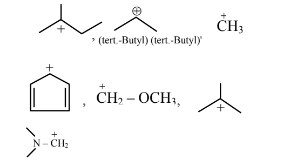
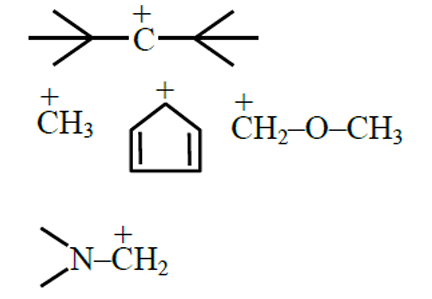
Number of carbocation from the following that are not stabilized by hyperconjugation is _________ .
Official Solution
Correct Option:
(1)
In the given structures, only certain carbocations can be stabilized by hyperconjugation. The carbocations which are not stabilized by hyperconjugation are: Therefore, the number of carbocations that are not stabilized by hyperconjugation is 5.
04
PYQ 2024
medium
chemistryID: jee-main
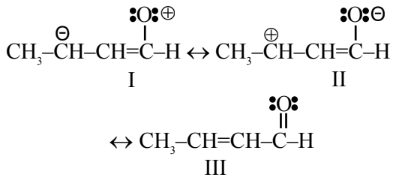
The correct stability order of the following resonance structures of is:
1
II > III > I
2
III > II > I
3
I > II > III
4
II > I > III
Official Solution
Correct Option:
(2)
To determine the stability order of the resonance structures of , we can evaluate each structure based on several key factors affecting resonance stability:
**Octet Rule Compliance**: The most stable resonance structure usually has atoms with completed octets.
**Charge Distribution**: Resonance structures with minimal formal charges are typically more stable.
**Electronegativity**: Negative charges are more stable on more electronegative atoms (e.g., oxygen).
Let's analyze each structure:
Structure I: The carbon atom in the chain has a negative charge. The electronegative oxygen has a positive charge, which is not favorable.
Structure II: The positive charge is on a carbon atom, while the negative charge is on oxygen. This is more favorable compared to Structure I.
Structure III: There are no charges, and all atoms comply with the octet rule. The double bond between carbon and oxygen is highly stable due to resonance.
Based on these observations, the stability order is:
Most Stable: Structure III – All atoms have full octets with no charges.
Intermediate Stability: Structure II – Favorable charge distribution with negative charge on oxygen.
Least Stable: Structure I – Unfavorable charge distribution. Negative charge on carbon and positive on oxygen.
Thus, the correct stability order is: III > II > I.
About Bond Energies - JEE-MAIN
Bond Energies is a vital chapter for JEE-MAIN aspirants. Mastering the concepts covered in this chapter is essential for securing a top rank.
By rigorously practicing the previous year questions associated with this chapter, you can identify high-yield topics, understand the examiner's perspective, and boost your confidence during the actual exam.
Frequently Asked Questions
Why focus on Bond Energies PYQs?
Analyzing PYQs for this specific chapter reveals the most frequently tested concepts and the typical complexity of questions, allowing you to tailor your study plan efficiently.
How to best use this analysis?
Review the topic breakdown to see which sub-topics within Bond Energies carry the most weight. Then, tackle the questions iteratively to solidify your understanding.