Gas Laws
13 previous year questions.
High-Yield Trend
Chapter Questions 13 MCQs
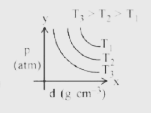
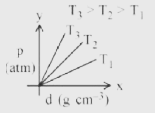
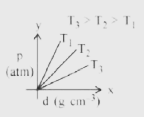
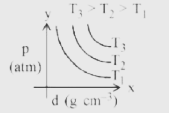
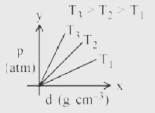
| List I (Anion) | List II (gas evolved on reaction with dil ) | ||
|---|---|---|---|
| A. | I. | Colourless gas which turns lead acetate paper black. | |
| B. | II. | Colourless gas which turns acidified potassium dichromate solution green | |
| C. | III. | Brown fumes which turns acidified KI solution containing starch blue. | |
| D. | IV. | Colourless gas evolved with brisk effervescence, which turns lime water milky. |
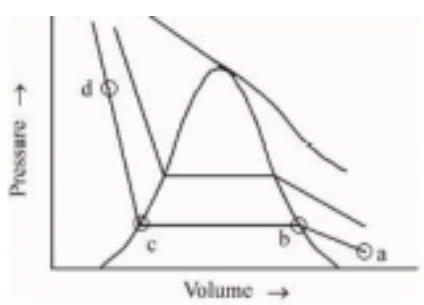
A. Carbon dioxide remains as a gas upto point (b)
B. Liquid carbon dioxide appears at point (c)
C. Liquid and gaseous carbon dioxide coexist between points (b) and (c)
D. As the volume decreases from (b) to (c), the amount of liquid decreases
List I | List II | ||
| A | 16 g of CH4 (g) | I | Weight 28g |
| B | 1 g of H2 (g) | II | 60.2 × 10²³ electrons |
| C | 1 mole of N2 (g) | III | Weighs 32 g |
| D | 0.5 mol of SO2 (g) | IV | Occupies 11.4 L volume at STP |
0.05 cm thick coating of silver is deposited on a plate of 0.05 m2 area. The number of silver atoms deposited on plate are _____ × 1023. (At mass Ag = 108,d = 7.9 g/cm³)
A. Basic vanadium oxide is used in the manufacture of .
B. The spin-only magnetic moment value of the transition metal halide employed in Ziegler-Natta polymerization is 2.84 BM.
C. The p-block metal compound employed in Ziegler-Natta polymerization has the metal in +3 oxidation state.
D. The number of electrons present in the outer most 'd' orbital of metal halide employed in Wacker process is 8.
Choose the correct answer from the options given below:
About Gas Laws - JEE-MAIN
Gas Laws is a vital chapter for JEE-MAIN aspirants. Mastering the concepts covered in this chapter is essential for securing a top rank.
By rigorously practicing the previous year questions associated with this chapter, you can identify high-yield topics, understand the examiner's perspective, and boost your confidence during the actual exam.
Frequently Asked Questions
Why focus on Gas Laws PYQs?
Analyzing PYQs for this specific chapter reveals the most frequently tested concepts and the typical complexity of questions, allowing you to tailor your study plan efficiently.
How to best use this analysis?
Review the topic breakdown to see which sub-topics within Gas Laws carry the most weight. Then, tackle the questions iteratively to solidify your understanding.