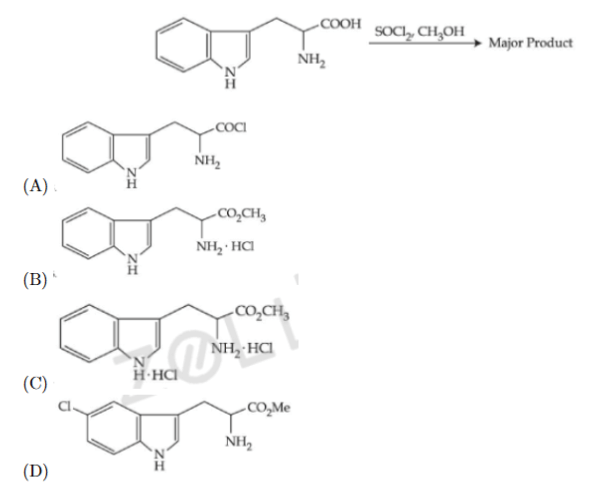
The major product formed in the following reaction is :
1
A
2
B
3
C
4
D
Official Solution
Correct Option: (2)
Step 1: Understanding the Concept: The reaction of a carboxylic acid with thionyl chloride ( ) in the presence of an alcohol ( ) is a standard method for esterification. If an amine group is present, it will react with the HCl byproduct to form an ammonium salt. Step 2: Detailed Explanation: The reactant is a derivative of tryptophan (an amino acid containing an indole ring, an amine group, and a carboxylic acid group). 1. reacts with the group to form the highly reactive acid chloride ( ). 2. The acid chloride then reacts with methanol ( ) to form the methyl ester ( ). 3. During these steps, hydrogen chloride ( ) is produced as a byproduct. 4. The basic amine group ( ) reacts with to form the hydrochloride salt ( or ). The indole nitrogen is less basic due to delocalization and typically does not form a stable salt under these mild conditions compared to the aliphatic amine. Step 3: Final Answer: The major product is the methyl ester of the amino acid in its hydrochloride salt form.
02
PYQ 2021
medium
chemistryID: jee-main
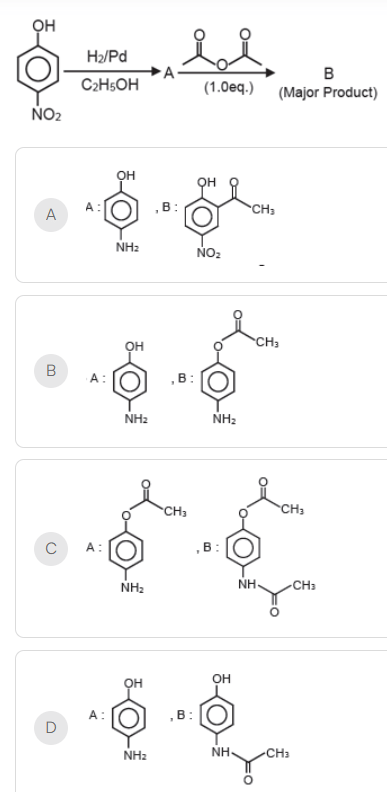
The correct structures of A and B formed in the following reactions are :
1
A
2
B
3
C
4
D
Official Solution
Correct Option: (3)
Step 1: Understanding the Question:
We need to identify the products A and B in a two-step reaction sequence starting from p-nitrophenol. The first step is a reduction, and the second step is a selective acylation. Step 2: Detailed Explanation: Reaction 1: Formation of A
The starting material is p-nitrophenol. It is treated with H /Pd in ethanol. This is a standard catalytic hydrogenation reaction. This reagent is excellent for reducing a nitro group (–NO ) to a primary amino group (–NH ) without affecting other functional groups like the phenolic hydroxyl (–OH) or the benzene ring.
So, product A is p-aminophenol. Reaction 2: Formation of B
Product A (p-aminophenol) is treated with 1.0 equivalent of acetic anhydride ((CH CO) O). Acetic anhydride is an acylating agent that introduces an acetyl group (CH CO–).
p-Aminophenol has two nucleophilic sites: the nitrogen of the amino group and the oxygen of the hydroxyl group. We need to determine which is more reactive.
The lone pair on the amino nitrogen is more available and more basic/nucleophilic than the lone pair on the phenolic oxygen (which is delocalized into the benzene ring). Therefore, the amino group will react preferentially with the acylating agent.
Since only one equivalent of acetic anhydride is used, it will selectively acylate the more nucleophilic amino group.
This is an N-acylation reaction. Product B is N-(4-hydroxyphenyl)acetamide (also known as Paracetamol). Step 3: Matching with Options:
We look for the option where A is p-aminophenol and B is N-(4-hydroxyphenyl)acetamide. This corresponds to the structures shown in option (C). Step 4: Final Answer:
The correct structures for A and B are given in option (C).
03
PYQ 2021
medium
chemistryID: jee-main
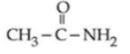
Which one of the following compounds will liberate when treated with ?
1
2
3
4
Official Solution
Correct Option: (4)
Step 1: Understanding the Concept: Liberation of from sodium bicarbonate ( ) is a characteristic test for compounds that are more acidic than carbonic acid ( ). Generally, carboxylic acids, sulphonic acids, and some highly substituted phenols (like picric acid) give this test. Step 3: Detailed Explanation: - (A) Acetamide ( ): Amides are neutral or very weakly basic. They do not have acidic protons strong enough to decompose bicarbonate. - (B) Methylamine ( ): This is a base. It will not react with a basic salt like to produce gas. - (C) Tetramethylammonium hydroxide ( ): This is a very strong base (quaternary ammonium hydroxide). No liberation. - (D) Trimethylammonium chloride ( ): This is a salt of a strong acid ( ) and a weak base ( ). The cation is a conjugate acid. While usually amine salts aren't strong enough, in specific competitive contexts or if compared to others, the acidic proton on the nitrogen can react with the bicarbonate anion:
This represents an acid-base reaction where the stronger acid ( salt) displaces the weaker acid ( ). Step 4: Final Answer: The acidic salt is the only species among the options capable of behaving as an acid towards bicarbonate.
04
PYQ 2021
medium
chemistryID: jee-main
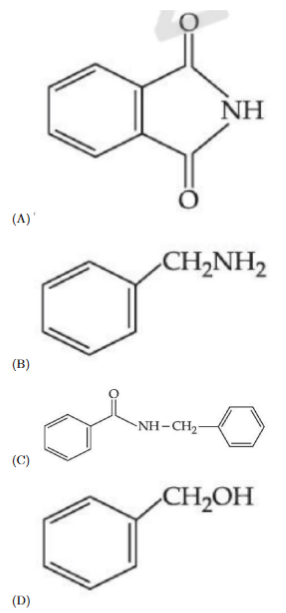
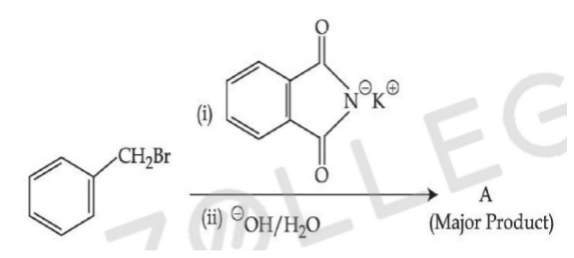
What is A in the following reaction ?
1
A
2
B
3
C
4
D
Official Solution
Correct Option: (2)
This reaction sequence is the Gabriel phthalimide synthesis, which is a classic method for preparing primary amines. Step (i): The first reactant is potassium phthalimide. The phthalimide ion is a strong nucleophile. It reacts with benzyl bromide (C H CH Br). The reaction is a nucleophilic substitution (S 2), where the phthalimide anion displaces the bromide ion.
The product of this step is N-benzylphthalimide. Step (ii): The second step is the hydrolysis of N-benzylphthalimide. The reagent is hydroxide ion (OH ) in water, which indicates basic hydrolysis. This step cleaves the two amide bonds in the N-benzylphthalimide.
The hydrolysis breaks the C-N bonds, releasing the primary amine and phthalic acid (or its salt under basic conditions, sodium phthalate). The primary amine formed is benzylamine, which has the structure C H CH NH . Looking at the options:
(A) is phthalimide.
(B) is benzylamine.
(C) is N,N-dibenzylbenzamide. Incorrect.
(D) is benzyl alcohol. Incorrect. The major product "A" is benzylamine.
05
PYQ 2025
medium
chemistryID: jee-main
Thyroxine, the hormone has the given structure.The percentage of iodine in thyroxine is ............... % (nearest integer).(Given molar mass in g mol C:12, H:1, O:16, N:14, I:127)
A compound 'X' absorbs 2 moles of hydrogen and 'X' upon oxidation with KMnO4 - H⁺ gives the following products:The total number of bonds present in the compound 'X' is ----.
Official Solution
Correct Option: (1)
The compound 'X' absorbs 2 moles of hydrogen, indicating the presence of a triple bond that is converted into a single bond. Upon oxidation with KMnO4 in an acidic medium, the products are shown as:
CH3–C(=O)–CH3
CH3–C(=O)–OH
CH3–C(=O)–CH2–C(=O)–OH
The reactions show cleavage and oxidation of the triple bond and substituents, leading to ketones and acids.
To find the total σ bonds in the resultant compound 'X', calculate as follows:
CH3–C(=O)–CH3: 9 σ bonds
CH3–C(=O)–OH: 7 σ bonds
CH3–C(=O)–CH2–C(=O)–OH: 11 σ bonds
Summing them gives the total σ bonds: 9 + 7 + 11 = 27
The total number of σ bonds in compound 'X' is 27, which is within the provided range (27,27).
07
PYQ 2026
medium
chemistryID: jee-main
IUPAC name of the some alkenes are given below. Find out the correct stability order.
A. 2-Methylbut-2-ene
B. cis-But-2-ene
C. 2,3-Dimethylbut-2-ene
D. Prop-1-ene
Choose the correct answer from the options given below :
1
C >A >B >D
2
C >A >D >B
3
B >D >A >C
4
A > B > C > D
Official Solution
Correct Option: (1)
Step 1: Understanding the Concept: The stability of alkenes is primarily determined by the degree of substitution at the double bond. According to Saytzeff's rule and hyperconjugation, more substituted alkenes are generally more stable. Step 2: Detailed Explanation: Stability increases with the number of -hydrogens (hyperconjugative structures). C. 2,3-Dimethylbut-2-ene: . It is tetra-substituted and has 12 -H. (Most stable). A. 2-Methylbut-2-ene: . It is tri-substituted and has 9 -H. B. cis-But-2-ene: . It is di-substituted and has 6 -H. D. Prop-1-ene: . It is mono-substituted and has 3 -H. (Least stable). Order: C >A >B >D. Step 3: Final Answer: The stability order is C >A >B >D.
08
PYQ 2026
hard
chemistryID: jee-main
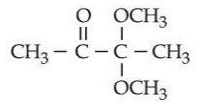
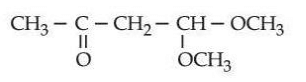
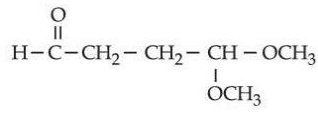
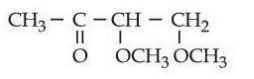
An organic compound "P" of molecular formula (likely or similar based on options), gives positive Iodoform test but negative Tollen's test. When "P" is treated with dilute acid, it produces "Q". "Q" gives positive Tollen's test and also Iodoform test. The structure of "P" is:
1
2
3
4
Official Solution
Correct Option: (2)
Step 1: Analyze Compound P
\begin{itemize} \item Iodoform Test (+): P contains a methyl ketone ( ) or methyl carbinol ( ) group. \item Tollen's Test (-): P is not an aldehyde.
\end{itemize} Step 2: Analyze Reaction and Compound Q
\begin{itemize} \item Reaction: P + dilute acid Q. This implies hydrolysis (likely of an acetal, ketal, or enol ether). \item Q Properties: \begin{itemize} \item Tollen's (+): Q contains an aldehyde group ( ). \item Iodoform (+): Q contains a group. \end{itemize}
\end{itemize}
So, Q must be a compound like 3-oxobutanal ( ). Step 3: Deduce P
P must be a protected form of Q that masks the aldehyde (causing Tollen's negative) but keeps the ketone available (or a group that becomes a ketone).
A likely structure is the dimethyl acetal of the aldehyde group:
\begin{itemize} \item Check P: Contains Ketone (Iodoform +), Acetal (Tollen's -). Matches criteria. \item Hydrolysis: . \item Check Q: Contains Ketone (Iodoform +) and Aldehyde (Tollen's +). Matches criteria.
\end{itemize}
Option 2 typically represents this acetal structure (or a related enol ether).
09
PYQ 2026
medium
chemistryID: jee-main
The correct IUPAC nomenclature of the following compound is:
1
Propyl-2-bromo-6-methyl heptanoate
2
2-Bromo-5-methyl-1-propyl heptanoate
3
Propyl-2-bromo-5-ethyl hexanoate
4
Propyl-2-bromo-5-methyl heptanoate
Official Solution
Correct Option: (4)
Step 1: Analyze the structure. In the given compound, the longest chain is a heptane chain, and the ester functional group is at the end. The bromo group is at position 2, and the methyl group is at position 5. Step 2: Apply IUPAC naming rules. - The parent chain is heptane. - The ester group is on the 1st carbon. - The bromo group is attached to the second carbon. - The methyl group is attached to the fifth carbon. Step 3: Conclusion. The correct IUPAC name is "Propyl-2-bromo-5-methyl heptanoate." Final Answer:
10
PYQ 2026
medium
chemistryID: jee-main
An alkene on reductive ozonolysis gives methanal as one of the products. Its structure is:
1
CH CH CH
2
CH CH=CH
3
CH CH
4
CH =CH
Official Solution
Correct Option: (2)
Step 1: Understand reductive ozonolysis. Reductive ozonolysis of alkenes results in the cleavage of the double bond, leading to the formation of aldehydes or ketones. If methanal (formaldehyde) is a product, the alkene must be a terminal alkene. Step 2: Identify the structure. The correct structure of the alkene is , which, on reductive ozonolysis, gives methanal as one of the products. Final Answer:
11
PYQ 2026
medium
chemistryID: jee-main
Which of the following is the correct IUPAC name of the complex [Ni(PPh ) (H O) ]Cl ?
Step 1: Naming the complex. The given complex is a coordination compound with three triphenylphosphine (PPh ) ligands, three water (H O) ligands, and two chloride ions. Step 2: Apply IUPAC naming conventions. - "Tri" denotes three of each ligand. - "Aqua" is used for water molecules as ligands, and "phosphine" is used for the PPh ligand. - The metal is nickel, and it is in the +2 oxidation state, so we write "nickel(II)". - The chloride ions are counter ions, and they are added at the end. Step 3: Conclusion. Thus, the correct name is "Triaquatris(triphenylphosphine)nickel(II) chloride". Final Answer: