Consider the following sequence for aspartic acid : The pI (isoelectric point) of aspartic acid is :
1
1.88
2
3.65
3
5.74
4
2.77
Official Solution
Correct Option: (4)
At Isoelectric point of Aspartic Acid both carboxylic as well as amino from co-exist.
02
PYQ 2019
medium
chemistryID: jee-main
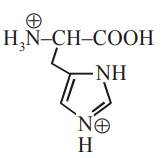
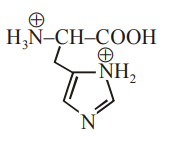
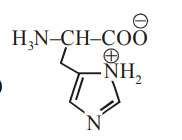
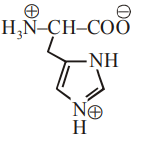
The correct structure of histidine in a strongly acidic solution (pH=2) is
1
2
3
4
Official Solution
Correct Option: (1)
Histidine is Zwitter ionic form
03
PYQ 2021
medium
chemistryID: jee-main
Out of the following, which type of interaction is responsible for the stabilisation of -helix structure of proteins?
1
Ionic bonding
2
Hydrogen bonding
3
Covalent bonding
4
vander Waals forces
Official Solution
Correct Option: (2)
Proteins are complex biological molecules that perform a wide variety of functions within living organisms. One common secondary structure found in proteins is the -helix. The stabilization of this structure is crucial for the protein’s functionality and is primarily due to a specific type of interaction.
The -helix is a right-handed coil structure. The key factor stabilizing this structure is the hydrogen bonds that form between the backbone atoms of the polypeptide chain.
In an -helix, the N-H group of one amino acid forms a hydrogen bond with the C=O group of an amino acid four residues earlier (i.e., the nth amino acid forms a hydrogen bond with the (n+4)th amino acid).
This regular pattern of hydrogen bonding along the backbone results in the helix structure.
Hydrogen bonds are relatively strong dipole-dipole interactions where a hydrogen atom is attracted to a highly electronegative atom like oxygen or nitrogen.
To understand why other options are not correct:
Ionic bonding: Although ionic bonds are crucial in proteins, especially those on the protein surface, they are not responsible for the -helix stabilization.
Covalent bonding: While covalent bonds (such as disulfide bridges) can stabilize the overall tertiary structure of proteins, they do not play a role in stabilizing the -helix specifically.
Van der Waals forces: Although these forces contribute to the stability of the protein structure, they are not the primary forces stabilizing the -helix.
Therefore, the correct answer is that hydrogen bonding is responsible for the stabilization of the -helix structure in proteins.
Bond Type
Relation to -Helix Stabilization
Ionic Bonding
Not involved in -helix stabilization
Hydrogen Bonding
Primary force stabilizing the -helix
Covalent Bonding
Does not stabilize -helix directly
Van der Waals Forces
Contributes to overall stability, but not primarily
04
PYQ 2022
easy
chemistryID: jee-main
A protein ‘A’ contains 0.30% of glycine (molecular weight 75). The minimum molar mass of the protein ‘A’ is _______ × 103 g mol–1 [nearest integer]
Official Solution
Correct Option: (1)
0.3% glycine means
100 g protein ‘A’ contains 0.3 g glycine.
Since, molar mass of glycine is 75.
75 g glycine will be present in
protein
Minimum molar mass of protein A is 25 × 103 g/mol
05
PYQ 2022
medium
chemistryID: jee-main
Stability of \alpha -Helix structure of proteins depends upon
1
dipolar interaction
2
H-bonding interaction
3
van der Walls forces
4
\pi -stacking interaction
Official Solution
Correct Option: (2)
The correct answer is (B) : H-bonding interaction Most of the time, H-bonding interaction is responsible for the stability of α-helix form.
06
PYQ 2022
medium
chemistryID: jee-main
In alanylglycylleucylalanyvaline, the number of peptide linkages is__,
Official Solution
Correct Option: (1)
The correct answer is 4 The given pentapeptide is : ALA – GLY – LEU – ALA – VAL It has 4 peptide linkages.
07
PYQ 2022
medium
chemistryID: jee-main
The structure of protein that is unaffected by heating is
1
Secondary Structure
2
Tertiary Structure
3
Primary Structure
4
Quaternary Structure
Official Solution
Correct Option: (3)
The correct answer is (C) : Primary structure Primary structure of protein is unaffected by physical or chemical changes.
08
PYQ 2023
easy
chemistryID: jee-main
Which of the following artificial sweeteners has the highest sweetness value in comparison to cane sugar?
1
Alitane
2
Saccharin
3
Aspartame
4
Sucralose
Official Solution
Correct Option: (1)
Sweetness value order wrt cane sugar Alitame > Sucralose > Saccharin > Aspartame
So, the correct option is (A): Alitane
09
PYQ 2023
easy
chemistryID: jee-main
A short peptide on complete hydrolysis produces 3 moles of glycine (G), two moles of leucine and two moles of valine per mole of peptide The number of peptide linkages in it are ______
Official Solution
Correct Option: (1)
The correct answer is 6.
Number of peptide linkage = (amino acid - 1) =7−1=6
10
PYQ 2023
easy
chemistryID: jee-main
Total number of tripeptides possible by mixing of valine and proline is ________
Official Solution
Correct Option: (1)
A tripeptide is formed by combining three amino acids, where the sequence of the amino acids matters. Since we are mixing two amino acids, valine (Val) and proline (Pro), each position in the tripeptide can be occupied by either valine or proline. Number of combinations: Total possible tripeptides = 23 = 8. Possible tripeptides: 1. Val-Val-Val 2. Val-Val-Pro 3. Val-Pro-Val 4. Val-Pro-Pro 5. Pro-Val-Val 6. Pro-Val-Pro 7. Pro-Pro-Val 8. Pro-Pro-Pro
11
PYQ 2023
easy
chemistryID: jee-main
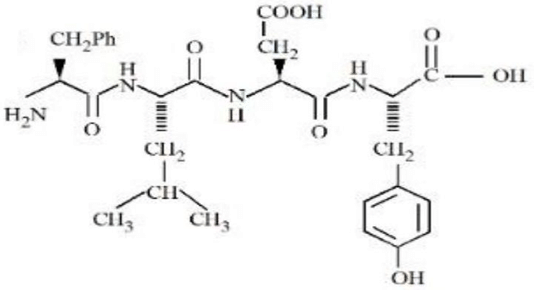
Following tetrapeptide can be represented as
(F, L, D, Y, I, Q, P are one letter codes for amino acids)
1
PLDY
2
FIQY
3
YQLF
4
FLDY
Official Solution
Correct Option: (4)
The given tetrapeptide contains the following amino acid residues:
- Phenylalanine ( )
- Leucine ( )
- Aspartic acid ( )
- Tyrosine ( )
Thus, the sequence of amino acids is FLDY.
12
PYQ 2024
medium
chemistryID: jee-main
Which structure of protein is intact after coagulation of egg white on boiling?
1
Primary
2
Secondary
3
Tertiary
4
Quaternary
Official Solution
Correct Option: (1)
The correct option is (A) : Primary
13
PYQ 2024
medium
chemistryID: jee-main
Which structure of protein remains intact after coagulation of egg white on boiling?
1
Primary
2
Secondary
3
Tertiary
4
Quaternary
Official Solution
Correct Option: (1)
Proteins are complex molecules that have different levels of structural organization: primary, secondary, tertiary, and quaternary structures. When it comes to the question of which structure remains intact after the coagulation of egg white upon boiling, we need to consider what happens physically and chemically during this process.
1. **Primary Structure**: This refers to the sequence of amino acids in a polypeptide chain. During coagulation, the primary structure remains intact as boiling does not break the peptide bonds between amino acids.
2. **Secondary Structure**: Refers to the folding of the polypeptide chain into alpha-helices and beta-sheets, stabilized by hydrogen bonds. Boiling can disrupt these hydrogen bonds, causing the secondary structure to alter.
3. **Tertiary Structure**: This is the overall three-dimensional shape of a protein. The intramolecular interactions like hydrogen bonds, ionic bonds, and disulfide bonds can be disrupted during the heat-induced coagulation.
4. **Quaternary Structure**: This applies to proteins with two or more polypeptide chains. Similar to tertiary structures, these interactions can be disrupted by heat.
Upon boiling, the egg white proteins denature, meaning that the secondary, tertiary, and quaternary structures are disrupted. However, the primary structure, which consists of the linear sequence of amino acids held together by covalent peptide bonds, remains unchanged.
The correct answer is Primary.
In conclusion, during the coagulation of egg white, only the primary structure of proteins remains intact, as chemical treatments like boiling affect non-covalent bonds and disulfide bonds, which are involved in the higher levels of protein structure.
14
PYQ 2024
medium
chemistryID: jee-main
Type of amino acids obtained by hydrolysis of proteins is:
1
- Amino acids
2
- Amino acids
3
- Amino acids
4
- Amino acids
Official Solution
Correct Option: (1)
To determine the type of amino acids obtained through the hydrolysis of proteins, we need to understand the structure of amino acids and the process of protein hydrolysis.
Proteins are composed of long chains of amino acids linked by peptide bonds. When these proteins undergo hydrolysis, the peptide bonds are broken, releasing individual amino acids.
The question presents four options:
-Amino acids
-Amino acids
-Amino acids
-Amino acids
The correct answer is -Amino acids. This is because the amino acids that constitute proteins are -amino acids, characterized by having the amino group ( ) attached to the alpha ( ) carbon, which is the first carbon adjacent to the carboxyl group ( ).
Each type of amino acid is named based on the position of the amino group relative to the carboxyl group:
-Amino acids: Amino group is on the first carbon (alpha carbon).
-Amino acids: Amino group is on the second carbon (beta carbon).
-Amino acids: Amino group is on the third carbon (gamma carbon).
-Amino acids: Amino group is on the fourth carbon (delta carbon).
Given that proteins are made up of -amino acids, the hydrolysis of proteins primarily yields -amino acids.
Therefore, the correct answer is:
-Amino acids
15
PYQ 2026
medium
chemistryID: jee-main
Identify the incorrect statement about tertiary structure of proteins.
1
They can be fibrous or globular in structure
2
The main forces that stabilize the structure are hydrogen bonding, disulphide links, van der Waals and electrostatic forces of attraction
3
The structure remains intact when exposed to pH changes
4
A linear polypeptide chain will convert to a secondary structure and then further folding of the secondary structure will convert to tertiary structure
Official Solution
Correct Option: (3)
Step 1: Understanding the Concept:
Tertiary structure refers to the overall folding of the polypeptide chain. It is highly sensitive to the surrounding environment. Step 2: Detailed Explanation: Option A: True. Tertiary structure describes the 3D shape, which is often globular or fibrous. Option B: True. These are the various intermolecular and intramolecular forces that hold the 3D shape together. Option C:Incorrect. Proteins undergo denaturation when exposed to significant changes in pH or temperature. This process disrupts the tertiary and secondary structures. Option D: True. Protein folding follows a hierarchical path from primary to secondary to tertiary. Step 3: Final Answer:
Statement (C) is incorrect.