Choose the most appropriate answer from the options given below:
1
(A)-(I), (B)-(II), (C)-(III), (D)-(IV)
2
(A)-(III), (B)-(II), (C)-(I), (D)-(IV)
3
(A)-(III), (B)-(I), (C)-(II), (D)-(IV)
4
(A)-(IV), (B)-(II), (C)-(I), (D)-(III)
Official Solution
Correct Option: (1)
The correct option is(A): (A)-(I), (B)-(II), (C)-(III), (D)-(IV)
Metal
Li
Na
K
RB
Cs
Colour
Crimson-red
Yellow
Violet
Red violet
Blue
λ/nm
670.8
589.2
766.5
780.0
455.5
03
PYQ 2022
medium
chemistryID: jee-main
Match List-I with List-II.
List-I (Metal)
List-II (Application)
(A) Cs
(I) High temperature thermometer
(B) Ga
(II) Water repellent sprays
(C) B
(III) Photoelectric cells
(D) Si
(IV) Bullet proof vest
Choose the most appropriate answer from the options given below:
1
(A)-(III), (B)-(I), (C)-(IV), (D)-(II)
2
(A)-(IV), (B)-(III), (C)-(II), (D)-(I)
3
(A)-(II), (B)-(III), (C)-(IV), (D)-(I)
4
(A)-(I), (B)-(IV), (C)-(II), (D)-(III)
Official Solution
Correct Option: (1)
The correct option is(A): (A)-(III), (B)-(I), (C)-(IV), (D)-(II)
Metal → Application
Cs → Photoelectric cells
Ga → High temperature thermometer
B → Bullet proof vest
Si → Water repellent sprays
04
PYQ 2022
medium
chemistryID: jee-main
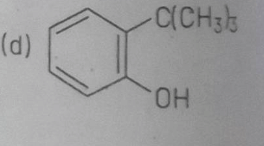
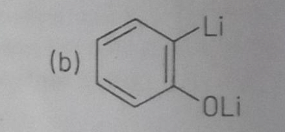
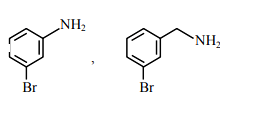
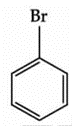
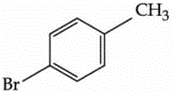
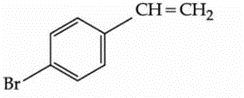
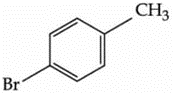
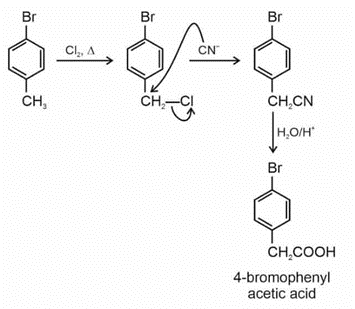
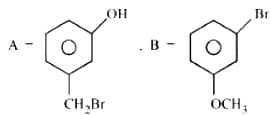
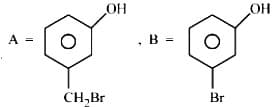
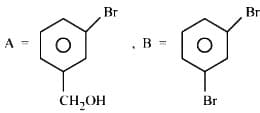
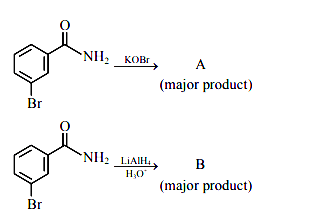
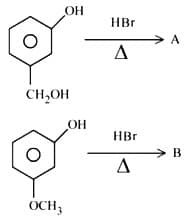
Consider the above reactions, the product A and product B, respectively are
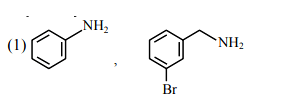
1
2
3
4
Official Solution
Correct Option: (4)
The correct option is: (D)
05
PYQ 2022
medium
chemistryID: jee-main
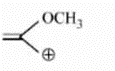
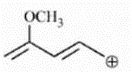
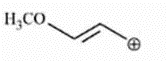
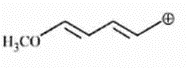
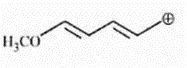
Which of the following carbocations is most stable?
1
2
3
4
Official Solution
Correct Option: (4)
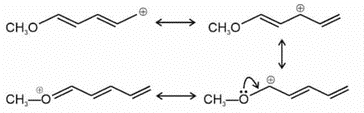
The correct answer is (D) :
Fig.
06
PYQ 2022
medium
chemistryID: jee-main
Fig.
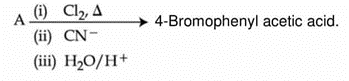
In the above reaction ‘A’ is
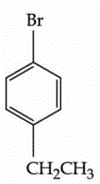
1
2
3
4
Official Solution
Correct Option: (3)
The correct answer is (C) :
Fig.
07
PYQ 2022
medium
chemistryID: jee-main
In Carius method of estimation of halogen, 0.45 g of an organic compound gave 0.36 g of AgBr. Find out the percentage of bromine in the compound. (Molar masses: AgBr = 188 g mol–1; Br = 80 g mol–1)

1
34.04%
2
40.04%
3
36.03%
4
38.04%
Official Solution
Correct Option: (1)
The correct answer is (A): 188g of AgBr = 80g of Br 0.36g of AgBr = ×0.36 Percentage of Br in given organic compound = 80× ×0.45×100 = 34.04%
08
PYQ 2023
easy
chemistryID: jee-main
Which will undergo deprotonation most readily in basic medium?
1
Both a and c
2
a only
3
b only
4
c only
Official Solution
Correct Option: (2)
Deprotonation is most favored when the conjugate base formed is resonance-stabilized. In structure (a), deprotonation leads to the formation of a conjugate base stabilized by resonance between the keto group and the enolate ion. Structures (b) and (c) do not have such strong resonance stabilization.
09
PYQ 2023
hard
chemistryID: jee-main
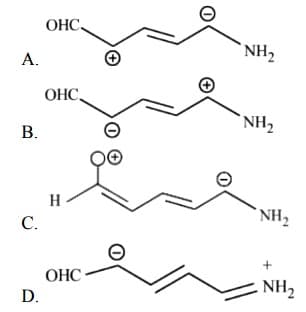
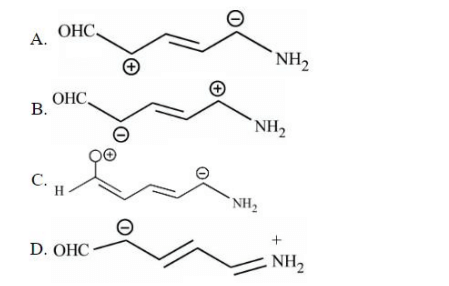
Increasing order of stability of the resonance structures is: Choose the correct answer from the options given below:
1
2
C, D, A, B
3
D, C, B, A
4
Official Solution
Correct Option: (2)
1. Factors affecting resonance stability: Structures with complete octets are more stable. Negative charges on more electronegative atoms are favored. Separation of charges decreases stability. 2. Analysis of the given structures: Structure C has significant charge separation and is the least stable. Structure D has localized charges but disrupts the aromatic system, so it is less stable than A and B. Structure A is more stable than C and D because it retains partial resonance. Structure B is the most stable because it has complete resonance and no significant charge separation. Thus, the correct order of stability is:
10
PYQ 2023
medium
chemistryID: jee-main
Increasing order of stability of the resonance structures is: Choose the correct answer from the options given below:
1
2
C, D, A, B
3
D, C, B, A
4
Official Solution
Correct Option: (2)
No option is matching the correct answer.
Order should be : C < A < B < D
11
PYQ 2023
hard
chemistryID: jee-main
Increasing order of stability of the resonance structures is: Choose the correct answer from the options given below:
1
2
C, D, A, B
3
D, C, B, A
4
Official Solution
Correct Option: (2)
No option is matching the correct answer.
Order should be : C < A < B < D
12
PYQ 2023
medium
chemistryID: jee-main
Reaction of with ammonia and hydrogen fluoride gives A which on thermal decomposition gives and What is ' ?
1
2
3
4
Official Solution
Correct Option: (4)
Step 1: Reaction Description - Beryllium oxide ( ) reacts with ammonia ( ) and hydrogen fluoride ( ) to form ammonium tetrafluoroberyllate ( ). - The reaction is as follows:
Step 2: Thermal Decomposition - On heating, decomposes to give beryllium fluoride ( ) and ammonium fluoride ( ).
- The reaction is as follows:
Conclusion: The compound 'A' is .
13
PYQ 2023
medium
chemistryID: jee-main
' ' and ' ' formed in the following set of reactions are:
1
2
3
4
Official Solution
Correct Option: (1)
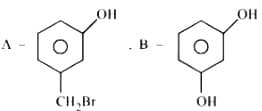
Reaction 1: Formation of Compound - The benzyl alcohol derivative reacts with under heat. - In the reaction, the group undergoes substitution to form . The group remains unaffected under these conditions. - Structure of : . Reaction 2: Formation of Compound - The anisole derivative reacts with under heat. - The group undergoes cleavage to form , while bromination occurs at the ortho position (relative to the group). - Structure of : . 5 Conclusion: - Compound : . - Compound : . The correct answer is Option (1).
14
PYQ 2023
medium
chemistryID: jee-main
Reaction of propanamide with produces :
1
Propylamine
2
Ethylnitrile
3
Propanenitrile
4
Ethylamine
Official Solution
Correct Option: (4)
This reaction is the Hofmann bromamide reaction, where amides are converted to primary amines with one fewer carbon atom. For propanamide ( ):
15
PYQ 2023
hard
chemistryID: jee-main
The number of colloidal systems from the following, which will have 'liquid' as the dispersion medium, is____. Gem stones, paints, smoke, cheese, milk, hair cream, insecticide sprays, froth, soap lather.
Official Solution
Correct Option: (1)
Colloidal Systems with Liquid Dispersion Medium Analysis
A colloid is a mixture where one substance is dispersed evenly throughout another. The substance being dispersed is the dispersed phase, and the substance it is dispersed in is the dispersion medium. We are looking for colloidal systems where the dispersion medium is a liquid.
Paints: Pigment particles are dispersed in a liquid medium (oil or water-based).
Milk: Fat globules and protein particles are dispersed in water.
Hair cream: Various ingredients are dispersed in a liquid base.
Froth: A gas is dispersed in liquid.
Soap lather: A gas is dispersed in a liquid (soap solution).
The following are not liquid-based colloids:
Gem stones: These are solid solutions, not colloids.
Smoke: Solid particles dispersed in a gas (air).
Cheese: A complex mixture with a solid matrix.
Insecticide sprays: Liquid dispersed in gas.
Conclusion:
Therefore, the colloidal systems with a liquid dispersion medium are paints, milk, hair cream, froth, and soap lather. There are 5 such systems.