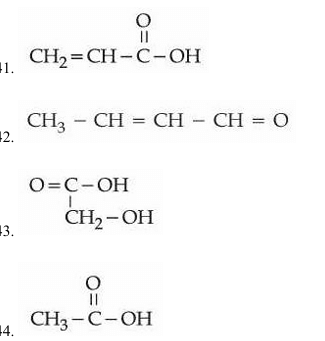
An organic compound "x" where molar ratio of C, O and H are equal, on treatment with 50% KOH under reflux followed by acidification produced "y". The most likely structure of "y" is: Options
1
1
2
2
3
3
4
4
Official Solution
Correct Option: (2)
Step 1: Reactivity with KOH.
KOH will break down a carbonyl compound into simpler products. The molar ratio of C, O, and H indicates the intermediate structure is likely an alkene with a hydroxyl group. Step 2: Acidification leads to product formation.
After treatment with acid, the likely structure will be an aldehyde or ketone.
Final Answer:
02
PYQ 2026
medium
chemistryID: jee-main
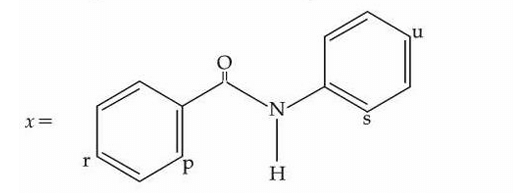
For the given molecule , the preferred site for the attack of the electrophile is:
1
Predominantly at
2
and
3
and
4
Predominantly at
Official Solution
Correct Option: (3)
Concept: Electrophilic aromatic substitution occurs preferentially at positions activated by electron donating groups. The substituent present is an amide linkage: The group donates electron density to the aromatic ring by resonance, activating ortho and para positions. Step 1:Analyze substituent effects} The carbonyl group withdraws electron density from the first ring, making it less reactive. However the group donates electron density into the second ring. Step 2:Determine activated positions} Thus electrophilic substitution occurs mainly at the ortho and para positions of the activated ring. These correspond to:
03
PYQ 2026
medium
chemistryID: jee-main
Which of the following statement is correct regarding the nature and directive influence of group in nitrobenzene?
1
It is an activating group and ortho/para director
2
It is a deactivating group and ortho/para director
3
It is a deactivating group and meta director
4
It is an activating group and meta director
Official Solution
Correct Option: (3)
Step 1: Nature of group. The group is an electron-withdrawing group, which deactivates the benzene ring and makes it less reactive towards electrophilic substitution reactions. Step 2: Directive influence of . The group directs incoming electrophiles to the meta position, as it deactivates the ortho and para positions due to its electron-withdrawing nature. Step 3: Conclusion. Thus, the correct answer is that is a deactivating group and a meta director. Final Answer:
04
PYQ 2026
medium
chemistryID: jee-main
A cycloalkene (X) is treated with Br and compound (Y) is formed with C : Br ratio 3 : 1. One mole of X required 1 mol of Br . Find the composition of 'Br' in Y compound (percentage).
Official Solution
Correct Option: (1)
Step 1: Analyze the reaction. The reaction involves the addition of Br to a cycloalkene. The C : Br ratio is 3 : 1, indicating that three carbon atoms are involved for every one bromine atom in the product. Step 2: Calculate the percentage of Br in the product. For each mole of X, one mole of Br is consumed, and each molecule of the product contains 1 bromine atom for 3 carbon atoms. Therefore, the percentage of bromine in the product is: Final Answer:
05
PYQ 2026
medium
chemistryID: jee-main
Match the two columns: based on the reaction Glucose + 'X' รขโ โ 'P' List-I (Reagent-X) A. Br /water B. Acetic anhydride (excess) C. Conc. HNO D. NH OH List-II (Product-P) (i) Glucose oxime (ii) Saccharic acid (iii) Glucose pentaacetate (iv) Gluconic acid
1
A รขโฌโ iv, B รขโฌโ ii, C รขโฌโ iii, D รขโฌโ i
2
A รขโฌโ ii, B รขโฌโ iv, C รขโฌโ iii, D รขโฌโ i
3
A รขโฌโ ii, B รขโฌโ iii, C รขโฌโ iv, D รขโฌโ i
4
A รขโฌโ iv, B รขโฌโ iii, C รขโฌโ ii, D รขโฌโ i
Official Solution
Correct Option: (4)
Step 1: Understand the reactions. - A. Br /water reacts with glucose to form gluconic acid (iv). - B. Acetic anhydride (excess) reacts with glucose to form glucose pentaacetate (iii). - C. Conc. HNO reacts with glucose to form saccharic acid (ii). - D. NH OH reacts with glucose to form glucose oxime (i). Step 2: Conclusion. The correct matching is A รขโฌโ iv, B รขโฌโ iii, C รขโฌโ ii, D รขโฌโ i. Final Answer: