Consider the following cell: Given: At equilibrium: Objective:
Official Solution
Correct Option:
(1)
Given the cell:
with and equilibrium condition:
Steps: 1. Half-reactions: \begin{itemize} \item Anode: \quad ( ) \item Cathode: \end{itemize} 2. Nernst equations: \begin{itemize} \item Anode: \item Cathode: \end{itemize} 3. Cell potential ( ): \subsection{Answer:}
The required pH is .
02
PYQ 2025
medium
chemistryID: jee-main
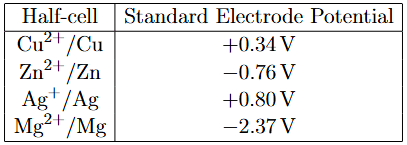
Standard electrode potentials for a few half-cells are mentioned below:
1
2
3
4
Official Solution
Correct Option:
(1)
To solve this problem, we need to calculate the standard cell potentials of the given galvanic cells. The standard cell potential is determined using the formula:
We will use the provided standard electrode potentials:
Half-cell
Standard Electrode Potential (V)
+0.34
-0.76
+0.80
-2.37
Cell:
Here, is the cathode and is the anode.
Cell:
Here, is the cathode and is the anode.
Cell:
Here, is the cathode and is the anode.
Cell:
Here, is the cathode and is the anode.
The cell with the highest positive standard cell potential is with .
Therefore, the correct answer is:
03
PYQ 2026
medium
chemistryID: jee-main
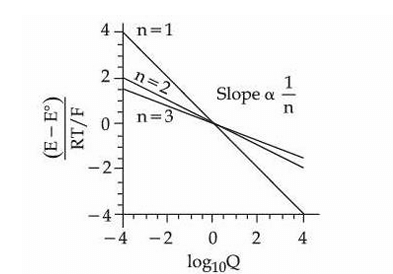
For a general redox reaction} Which of the following statement is incorrect?
1
The overall reaction can be written as
2
The electrons do not appear in the overall reaction because electrons produced at the anode are consumed at the cathode.
3
In the Nernst equation plot, slope , where is number of electrons transferred in the redox reaction.
4
If the reaction is carried out reversibly, the electrical work done is equal to the ratio of charge and potential difference through which charge is moved.
Official Solution
Correct Option:
(4)
Concept:
Electrochemical cell reactions follow electron transfer balance and thermodynamic relations. Step 1: {Check option (A)} To balance electrons: Adding both reactions: Thus statement (A) is correct. Step 2: {Check option (B)} Electrons cancel when half reactions are added, hence they do not appear in overall reaction. Thus (B) is correct. Step 3: {Check option (C)} Nernst equation: Thus slope of the graph between and is proportional to . Thus (C) is correct. Step 4: {Check option (D)} Electrical work done: Work equals product of charge and potential difference, not their ratio. Thus statement (D) is incorrect.
04
PYQ 2026
medium
chemistryID: jee-main
One half cell in a voltaic cell is constructed by dipping silver rod in solution of unknown concentration, other half cell is Zn rod dipped in 1 molar solution of .
A voltage of 1.60 V is measured at 298 K for this cell. What is the concentration of ions used in terms of ( )?
, ,
1
2
3
4
Official Solution
Correct Option:
(2)
Step 1: Understanding the Concept:
We use the Nernst equation to find the cell potential. First, we identify the cathode and anode based on standard reduction potentials, then determine the overall cell reaction and standard EMF. : Key Formula or Approach:
Standard Cell EMF: .
Nernst Equation: . Step 2: Detailed Explanation: 1. Identifying Electrodes:
Since , Silver acts as the cathode and Zinc acts as the anode.
Anode (Oxidation):
Cathode (Reduction):
Overall reaction: .
Here, .
2. Calculating Standard EMF:
.
3. Applying Nernst Equation:
. Step 3: Final Answer:
The value of is .
05
PYQ 2026
medium
chemistryID: jee-main
Consider the reaction , for which the rate constant at 30°C is . Which of the following statements are true?}
(A) When concentration of is increased to four times, the rate of reaction becomes 16 times.
(B) The reaction is a second order reaction.
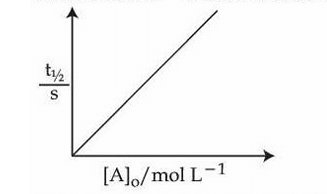
(C) The half-life period is independent of the concentration of .
(D) Decomposition of is an example of the above reaction.
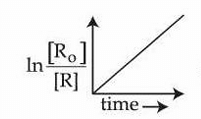
(E) is valid for the reaction
Choose the correct answer from the options given below:
1
A and B Only
2
A, B and C Only
3
A, B, D and E Only
4
C and D Only
Official Solution
Correct Option:
(1)
The given reaction is of the form , and we are provided with the rate constant at 30°C. The relationship between the rate of the reaction and the concentration of will depend on the order of the reaction. For a second-order reaction:
where is the rate constant. - (A) True: For a second-order reaction, if the concentration of is increased by a factor of 4, the rate will increase by , as per the rate law.
- (B) True: The reaction is second order, as indicated by the rate law being proportional to .
- (C) False: The half-life period for a second-order reaction is inversely proportional to the concentration of , so it is dependent on the concentration.
- (D) Not necessarily true: The decomposition of could be an example of a second-order reaction, but more information is needed.
- (E) True: The equation is valid for a first-order reaction, not second-order. Final Answer: A and B Only
06
PYQ 2026
medium
chemistryID: jee-main
Given below are two statements:
Statement I: When kcal/mol, the room temperature rate constant is doubled by a 10 °C increase in temperature (298 K to 308 K). Statement II: For a first order reactions , [the graph of rate vs [A] is a straight line through origin].
1
Both Statement I and Statement II are true
2
Both Statement I and Statement II are false
3
Statement I is true but Statement II is false
4
Statement I is false but Statement II is true
Official Solution
Correct Option:
(1)
Step 1: Understanding the Concept:
Statement I involves the Arrhenius equation relating rate constants at two temperatures. Statement II involves the rate law for first-order kinetics. Step 2: Detailed Explanation: Statement I: Using .
Given , , , .
Since , the rate constant doubles. (True) Statement II: For a first-order reaction, Rate . This is an equation of the form , which represents a straight line passing through the origin. (True) Step 3: Final Answer:
Both statements are true.
07
PYQ 2026
medium
chemistryID: jee-main
An electrochemical cell is constructed using half cells in the direction of spontaneous change} Which of the following option is correct?
1
Overall reaction
2
3
Fe is reduced in the electrochemical cell
4
is an extensive property
Official Solution
Correct Option:
(1)
Concept: In an electrochemical cell:
Reduction occurs at the cathode (higher reduction potential).
Oxidation occurs at the anode.
.
Step 1:Identify cathode and anode} Reduction potentials: Thus Step 2:Balance electrons} Multiply silver reaction by : Step 3:Add the reactions} Thus option (A) is correct. Step 4:Cell potential} Hence option (B) is incorrect. Step 5:Other statements}
Fe undergoes oxidation, not reduction.
is an intensive property.
Thus
About Electrochemical Cells And Gibbs Free Energy - JEE-MAIN
Electrochemical Cells And Gibbs Free Energy is a vital chapter for JEE-MAIN aspirants. Mastering the concepts covered in this chapter is essential for securing a top rank.
By rigorously practicing the previous year questions associated with this chapter, you can identify high-yield topics, understand the examiner's perspective, and boost your confidence during the actual exam.
Frequently Asked Questions
Why focus on Electrochemical Cells And Gibbs Free Energy PYQs?
Analyzing PYQs for this specific chapter reveals the most frequently tested concepts and the typical complexity of questions, allowing you to tailor your study plan efficiently.
How to best use this analysis?
Review the topic breakdown to see which sub-topics within Electrochemical Cells And Gibbs Free Energy carry the most weight. Then, tackle the questions iteratively to solidify your understanding.