Given below are two statements: Statement (I): It is impossible to specify simultaneously with arbitrary precision, the linear momentum and the position of a particle. Statement (II): If the uncertainty in the measurement of position and uncertainty in measurement of momentum are equal for an electron, then the uncertainty in the measurement of velocity is . In the light of the above statements, choose the correct answer from the options given below:
1
Statement I is true but Statement II is false.
2
Both Statement I and Statement II are true.
3
Statement I is false but Statement II is true.
4
Both Statement I and Statement II are false.
Official Solution
Correct Option:
(2)
- Statement I: This is a restatement of the Heisenberg Uncertainty Principle, which asserts that it is impossible to precisely determine both the position and the momentum of a particle simultaneously. This statement is true. - Statement II: The Heisenberg Uncertainty Principle provides the relationship between the uncertainty in position ( ) and momentum ( ), given by: For an electron, if the uncertainties in position and momentum are equal, the uncertainty in velocity can be expressed as: This statement is also correct. Therefore, the correct answer is Both Statement I and Statement II are true.
02
PYQ 2026
medium
chemistryID: jee-main
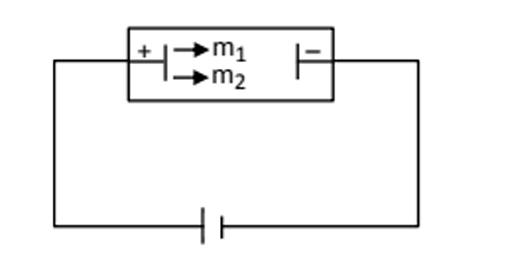
Two positively charged particles are accelerated by . The masses of particles are and .If the de-Broglie wavelength is times of the second particle , determine the value of .
Official Solution
Correct Option:
(1)
Concept:
The de-Broglie wavelength of a particle accelerated through a potential difference is given by:
For particles accelerated through the same potential difference , wavelength depends only on the square root of mass :
Step 1: Write Ratio of Wavelengths
Step 2: Substitute Given Values
Step 3: Determine
About Quantum Mechanics - JEE-MAIN
Quantum Mechanics is a vital chapter for JEE-MAIN aspirants. Mastering the concepts covered in this chapter is essential for securing a top rank.
By rigorously practicing the previous year questions associated with this chapter, you can identify high-yield topics, understand the examiner's perspective, and boost your confidence during the actual exam.
Frequently Asked Questions
Why focus on Quantum Mechanics PYQs?
Analyzing PYQs for this specific chapter reveals the most frequently tested concepts and the typical complexity of questions, allowing you to tailor your study plan efficiently.
How to best use this analysis?
Review the topic breakdown to see which sub-topics within Quantum Mechanics carry the most weight. Then, tackle the questions iteratively to solidify your understanding.