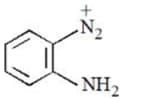
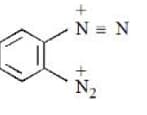
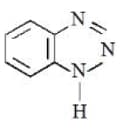
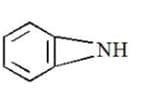
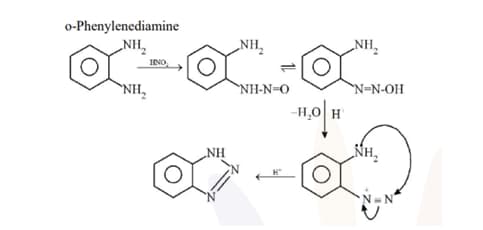
When o-phenylenediamine is treated with nitric acid, nitration occurs at the position ortho to the amino group. The nitro group ( ) replaces the hydrogen attached to the benzene ring, forming a nitrated product. In this case, the major product formed is an imine ( ) structure, which is the result of the reaction between the amino group and the nitro group.
Thus, the correct product is a structure with a carbon-nitrogen double bond (C = N).
02
PYQ 2023
hard
chemistryID: jee-main
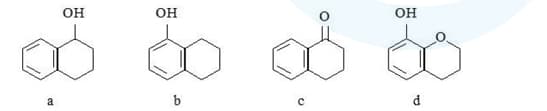
Arrange the following compounds in increasing order of rate of aromatic electrophilic substitution reaction:
1
(a)<(b)<(c)
2
(b)<(c)<(a)
3
(c)<(a)<(b)
4
(c)<(b)<(a)
Official Solution
Correct Option: (1)
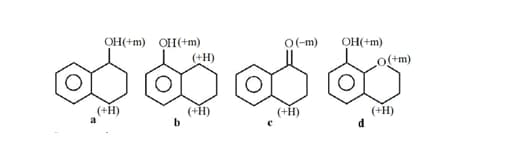
- Benzene becomes more reactive towards electrophilic aromatic substitution (EAS) when an electron-donating group (-OH, -NH ) is attached to the benzene ring.
- Benzene with electron-withdrawing groups (-NO , -COOH) decreases the reactivity, as it deactivates the ring towards electrophilic attack. Thus, the order is:
03
PYQ 2024
medium
chemistryID: jee-main
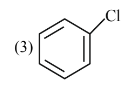
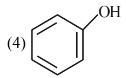
Which of the following compound will most easily be attacked by an electrophile?
1
2
3
4
Official Solution
Correct Option: (4)
The question asks to identify which of the given aromatic compounds is the most reactive towards an electrophilic attack. This reactivity is determined by the nature of the substituent attached to the benzene ring.
Concept Used:
The reaction in question is an Electrophilic Aromatic Substitution (EAS). In this reaction, an electrophile (an electron-deficient species) attacks the electron-rich benzene ring. The rate of this reaction depends on the electron density of the aromatic ring. Substituents on the ring can modify this electron density:
Activating Groups (Electron-Donating Groups, EDG): These groups increase the electron density in the benzene ring, making it more nucleophilic and thus more reactive towards electrophiles than benzene itself. They donate electrons primarily through the resonance effect (+R or +M) or hyperconjugation and the inductive effect (+I).
Deactivating Groups (Electron-Withdrawing Groups, EWG): These groups decrease the electron density in the ring, making it less reactive than benzene. They withdraw electrons through the resonance effect (-R or -M) or the inductive effect (-I).
The compound that is "most easily attacked" will be the one with the most powerful activating group.
Step-by-Step Solution:
Step 1: Analyze the substituent group in each compound.
(a) Phenol: The substituent is a hydroxyl group (–OH).
(b) Chlorobenzene: The substituent is a chlorine atom (–Cl).
(c) Benzene: There is no substituent other than hydrogen (–H), which serves as the reference compound.
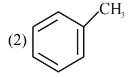
(d) Toluene: The substituent is a methyl group (–CH₃).
Step 2: Classify each substituent as activating or deactivating.
(a) Phenol (–OH group): The oxygen atom in the –OH group has lone pairs of electrons. It donates these electrons to the benzene ring through a strong positive resonance effect (+R effect). Although oxygen is electronegative and exerts a negative inductive effect (–I), the +R effect is far more dominant. Therefore, the –OH group is a strong activating group.
(b) Chlorobenzene (–Cl group): Chlorine is a halogen. It is highly electronegative, so it withdraws electron density from the ring via a strong negative inductive effect (–I). It also has lone pairs that it can donate through a positive resonance effect (+R). However, for halogens, the –I effect outweighs the +R effect. Thus, the –Cl group is a deactivating group.
(c) Benzene (–H group): This is our baseline for comparing reactivity.
(d) Toluene (–CH₃ group): The methyl group is an alkyl group. It is an electron-donating group through hyperconjugation and a weak positive inductive effect (+I). Therefore, the –CH₃ group is a weak activating group.
Step 3: Compare the activating strength of the groups.
We need to find the compound that is most reactive. We compare the activating power of the activating groups (–OH and –CH₃) and the deactivating power of the deactivating group (–Cl).
The –OH group is a strong activator due to its powerful +R effect.
The –CH₃ group is a weak activator due to hyperconjugation and the +I effect.
The –Cl group is a weak deactivator.
The resonance effect (+R) of the –OH group is significantly stronger than the hyperconjugation effect of the –CH₃ group. Therefore, the –OH group increases the electron density of the benzene ring much more than the –CH₃ group does.
Step 4: Determine the overall reactivity order.
Based on the effects of the substituents, the order of reactivity of the compounds towards electrophilic attack is:
Final Result:
The compound that will be most easily attacked by an electrophile is the one that is most activated. Phenol has the most strongly activating group (–OH) among the given options. Therefore, phenol is the most reactive.
The correct option is (b).
04
PYQ 2024
medium
chemistryID: jee-main
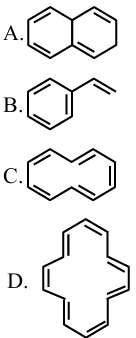
Which of the following are aromatic?
1
B and D only
2
A and C only
3
A and B only
4
C and D only
Official Solution
Correct Option: (1)
To determine which of the compounds are aromatic, we need to apply the rules of aromaticity. A compound is aromatic if it satisfies the following conditions:
It must be cyclic.
It must be planar.
It must have a continuous ring of p-orbitals (fully conjugated system).
It must follow Huckel's rule, which states that the number of π-electrons in the ring must be , where is a non-negative integer.
Let's analyze each compound provided in the image:
Compound A: This is naphthalene. It is cyclic, planar, and fully conjugated with 10 π-electrons. It satisfies Huckel's rule ( where ). Therefore, it is aromatic.
Compound B: This is benzene. It is cyclic, planar, and fully conjugated with 6 π-electrons. It satisfies Huckel's rule ( where ). Therefore, it is aromatic.
Compound C: This is not completely planar due to steric hindrance between hydrogens in the formation of a tubular structure that disrupts the planarity. Hence, it is not aromatic.
Compound D: This is anthracene. It is cyclic, planar, and fully conjugated with 14 π-electrons. It satisfies Huckel's rule ( where ). Therefore, it is aromatic.
Based on the analysis, compounds B and D are aromatic because they meet all the criteria for aromaticity.
The correct answer is: B and D only
05
PYQ 2024
medium
chemistryID: jee-main
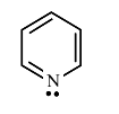
Total number of aromatic compounds among the following compounds is _______.
Official Solution
Correct Option: (1)
The chemical structure shown is pyridine, a six-membered aromatic ring with one nitrogen atom. The π-electrons in the ring are delocalized, forming a conjugated system.
$ π-electrons, where is an integer. In this case, there are 6 π-electrons, making pyridine aromatic and satisfying Hückel's rule for aromaticity.
\) $
06
PYQ 2024
medium
chemistryID: jee-main
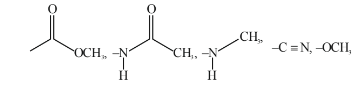
Total number of deactivating groups in aromatic electrophilic substitution reaction among the following is
Official Solution
Correct Option: (1)
The problem asks to identify and count the total number of deactivating groups for aromatic electrophilic substitution from a given list of functional groups.
Concept Used:
The reactivity of a substituted benzene ring towards an electrophile is determined by the nature of the substituent group. Groups are classified as either activating or deactivating based on their ability to donate or withdraw electron density from the ring.
Activating Groups: These groups donate electron density to the benzene ring, making it more nucleophilic and thus more reactive towards electrophiles than benzene itself. They are typically ortho, para-directing. This electron donation occurs primarily through the resonance effect (+R or +M) or the inductive effect (+I). Examples include , , , , and alkyl groups ( ).
Deactivating Groups: These groups withdraw electron density from the benzene ring, making it less nucleophilic and less reactive towards electrophiles. They are generally meta-directing (except for halogens). This electron withdrawal occurs through the resonance effect (-R or -M) or the inductive effect (-I). Examples include , , , and carbonyl groups ( , ).
Step-by-Step Solution:
Step 1: List the unique functional groups shown in the image.
The groups given are:
(Acetyl group)
(Methoxy group)
(Acetamido group)
(Methylamino group)
(Cyano group)
Step 2: Analyze each group to determine if it is activating or deactivating.
1. Acetyl group ( ):
The carbonyl group is strongly electron-withdrawing. It withdraws electron density from the ring through both the inductive effect (-I) due to the electronegative oxygen atom and the resonance effect (-R). Therefore, it is a deactivating group.
2. Methoxy group ( ):
The oxygen atom is electronegative and exerts an electron-withdrawing inductive effect (-I). However, it has lone pairs of electrons that can be delocalized into the benzene ring via the resonance effect (+R). The +R effect is stronger than the -I effect, leading to a net donation of electron density to the ring. Thus, it is an activating group.
3. Acetamido group ( ):
Similar to the methoxy group, the nitrogen atom has a lone pair that it can donate to the benzene ring (+R effect). Although this lone pair is also in resonance with the adjacent carbonyl group (which reduces its availability for the ring), the overall effect on the benzene ring is electron-donating. Therefore, it is an activating group (though less activating than ).
4. Methylamino group ( ):
The nitrogen atom has a lone pair that strongly donates electron density to the ring via the resonance effect (+R). This makes it a strong activating group.
5. Cyano group ( ):
This group is strongly electron-withdrawing due to the high electronegativity of nitrogen and the sp-hybridized carbon. It exhibits both a strong inductive effect (-I) and a resonance effect (-R), pulling electron density away from the ring. Therefore, it is a deactivating group.
Step 3: Count the number of deactivating groups.
Based on the analysis in Step 2:
Activating groups are: , , and .
Deactivating groups are: and .
There are two deactivating groups in the given list.
Final Result:
The total number of deactivating groups among the given options is 2.
07
PYQ 2024
easy
chemistryID: jee-main
Given below are two statements: Statement (I) : The NH2 group in Aniline is ortho and para directing and a powerful activating group. Statement (II) : Aniline does not undergo Friedel- Craft’s reaction (alkylation and acylation). In the light of the above statements Choose the most appropriate answer from the options given below :

1
Both Statement I and Statement II are correct
2
Both Statement I and Statement II are incorrect
3
Statement I is incorrect but Statement II is correct
4
Statement I is correct but Statement II is incorrect
Official Solution
Correct Option: (1)
This question asks us to evaluate two statements regarding the chemical properties of aniline and choose the correct option describing their validity.
Concept Used:
The analysis requires understanding the principles of Electrophilic Aromatic Substitution (EAS) and the role of substituents on the benzene ring.
Activating and Directing Effects: Substituents on a benzene ring can influence its reactivity towards electrophiles. Activating groups (electron-donating groups) increase the electron density of the ring, making it more reactive. They typically direct incoming electrophiles to the ortho and para positions. Deactivating groups (electron-withdrawing groups) decrease the ring's electron density, making it less reactive.
Resonance Effect (+R/-R) and Inductive Effect (+I/-I): These are the primary mechanisms through which substituents exert their electronic effects. The amino group (-NH₂) has a lone pair on the nitrogen atom, which it can donate to the ring via a strong positive resonance effect (+R).
Friedel-Crafts Reaction: This is a type of EAS used for alkylating or acylating an aromatic ring. It requires a strong Lewis acid catalyst, such as anhydrous aluminum chloride ( ).
Lewis Acids and Bases: A Lewis acid is an electron-pair acceptor (e.g., ), and a Lewis base is an electron-pair donor (e.g., aniline, due to the lone pair on nitrogen).
Step-by-Step Solution:
Step 1: Analyze Statement (I).
"The NH₂ group in Aniline is ortho and para directing and a powerful activating group."
The nitrogen atom in the amino group (–NH₂) has a lone pair of electrons. This lone pair can participate in resonance with the benzene ring, delocalizing the electrons into the ring. This is known as the +R (or +M) effect.
The resonance structures show that the electron density is specifically increased at the ortho and para positions. This makes these positions highly susceptible to attack by an electrophile, thus the –NH₂ group is an ortho and para director.
Furthermore, because the +R effect donates electron density to the ring as a whole, it makes the ring much more reactive towards electrophiles than benzene itself. The +R effect of the –NH₂ group is very strong, making it a powerful activating group.
Therefore, Statement (I) is a correct statement.
Step 2: Analyze Statement (II).
"Aniline does not undergo Friedel-Crafts reaction (alkylation and acylation)."
The Friedel-Crafts reaction requires a Lewis acid catalyst, typically anhydrous . Aniline, with its lone pair of electrons on the nitrogen atom, acts as a Lewis base.
When aniline is mixed with the catalyst, a strong acid-base reaction occurs before the alkylation or acylation can take place. The basic nitrogen atom of aniline donates its lone pair to the Lewis acid , forming a salt.
In this salt, the nitrogen atom now bears a formal positive charge. The resulting anilinium-type group ( ) becomes a very strong electron-withdrawing group (strong -I effect). This group strongly deactivates the benzene ring towards electrophilic attack. The ring becomes so electron-deficient that it fails to react with the electrophile (carbocation or acylium ion) required for the Friedel-Crafts reaction.
Therefore, Statement (II) is also a correct statement.
Final Result:
Both Statement (I) and Statement (II) are factually correct. Statement (I) describes the general activating and directing nature of the amino group, while Statement (II) describes a specific exception to this reactivity due to an interaction with the Lewis acid catalyst used in Friedel-Crafts reactions.
Thus, Both Statement (I) and Statement (II) are true.
08
PYQ 2024
easy
chemistryID: jee-main
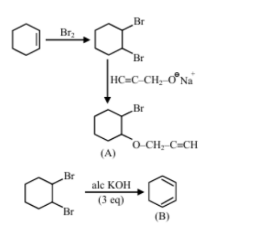
The major products from the following reaction sequence are product A and product B. The total sum of electrons in product A and product B are ______ (nearest integer)
Official Solution
Correct Option: (1)
The reaction proceeds as follows: Cyclohexane C H Br 1. Product A: Bromination followed by elimination with alcoholic KOH gives a conjugated diene:
- Benzene contains 6 electrons. 2. Product B: Bromination followed by reaction with sodium hydroxide gives an enolate ion:
- This product contains 2 electrons. Total electrons:
09
PYQ 2025
medium
chemistryID: jee-main
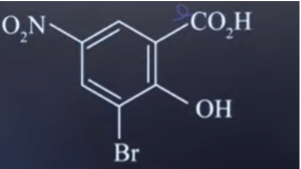
Find the IUPAC name of the compound.
1
3-Bromo-2-nitrobenzoic acid
2
2-Bromo-3-nitrobenzoic acid
3
4-Bromo-3-nitrobenzoic acid
4
3-Bromo-4-nitrobenzoic acid
Official Solution
Correct Option: (2)
The given compound is a substituted benzoic acid. We need to identify the positions of the substituents and name the compound according to the IUPAC rules. - The parent structure is benzoic acid, with a carboxyl group (-COOH) at position
1. - The other substituents are: - A bromine (Br) group attached at position
2. - A nitro (NO ) group attached at position 3. Thus, the correct IUPAC name for this compound is 2-Bromo-3-nitrobenzoic acid.
10
PYQ 2025
easy
chemistryID: jee-main
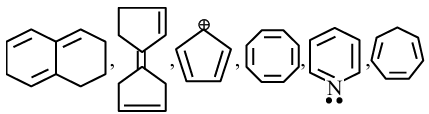
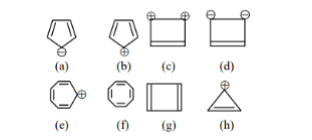
Designate whether each of the following compounds is aromatic or not aromatic.
1
e, g aromatic and a, b, c, d, f, h not aromatic
2
b, e, f, g aromatic and a, c, d, h not aromatic
3
a, b, c, d aromatic and e, f, g, h not aromatic
4
a, c, d, e, h aromatic and b, f, g not aromatic
Official Solution
Correct Option: (4)
Aromatic compounds (follow Huckel's rule): (a) Cyclic, planar, conjugated with 6 electrons (4n+2 where n=1) (c) Cyclic, planar, conjugated with 6 electrons (d) Cyclic, planar, conjugated with 6 electrons (e) Cyclic, planar, conjugated with 6 electrons (h) Cyclic, planar, conjugated with 6 electrons
Non-aromatic compounds: (b) Not fully conjugated (sp hybridized carbon breaks conjugation) (f) Not planar (twisted structure prevents conjugation) (g) Has 4 electrons (doesn't satisfy 4n+2 rule)
11
PYQ 2025
medium
chemistryID: jee-main
The compound with molecular formula C H , which gives only one monobromo derivative and takes up four moles of hydrogen per mole for complete hydrogenation has ___ electrons.
Official Solution
Correct Option: (1)
The compound with molecular formula C H is benzene. Benzene's structure involves a ring of six carbon atoms with alternating single and double bonds, indicating delocalized π-electrons across the ring. In benzene, all the carbon-carbon bonds are of equal length due to resonance, resulting in a stable compound exhibiting aromaticity.
To determine the number of π-electrons, consider the following:
Benzene's structure: C H is a cyclic compound with alternating double bonds, contributing π-electrons from the double bonds.
Each double bond consists of π-electrons shared between two carbon atoms. Benzene contains three double bonds.
Each double bond contributes two π-electrons, hence in benzene, there are 3 double bonds × 2 π-electrons/double bond = 6 π-electrons.
Since the problem states that benzene yields only one monobromo derivative, this indicates all hydrogen atoms in the ring are equivalent, further confirming its structure as benzene.
Upon complete hydrogenation, benzene takes up 4 moles of hydrogen, converting each double bond into a single bond, consistent with the presence of three double bonds.
The computed number of π-electrons is 6, which fits within the specified range of 6 to 6.
12
PYQ 2025
medium
chemistryID: jee-main
Area bounded by is equal to (in square units):
1
2
3
4
Official Solution
Correct Option: (2)
The problem asks for the area bounded by the inequality:
The inequality implies that for each , lies between and . To solve for the area, we need to determine the bounds for and the corresponding bounds for . From the inequality , we have two cases: 1. , which gives
2. , which gives Thus, for the bounded region, ranges from 0 to 4, and for each , the value of ranges from to . Now, the area can be computed as:
Let's calculate the integral:
Thus, the total area is:
Finally, multiplying by 4, we get the total area as:
13
PYQ 2025
hard
chemistryID: jee-main
The compound with molecular formula C H , which gives only one monobromo derivative and takes up four moles of hydrogen per mole for complete hydrogenation has electrons.
Official Solution
Correct Option: (1)
The compound with the molecular formula C H is benzene, which is a well-known aromatic compound. Benzene has a planar ring structure with alternating single and double bonds between the carbon atoms, forming a conjugated system. Each carbon-carbon double bond contributes 2 -electrons. Since benzene has 6 carbon atoms, and all of them participate in the conjugation, the total number of -electrons in benzene is 6. Thus, the answer is:
14
PYQ 2026
medium
chemistryID: jee-main
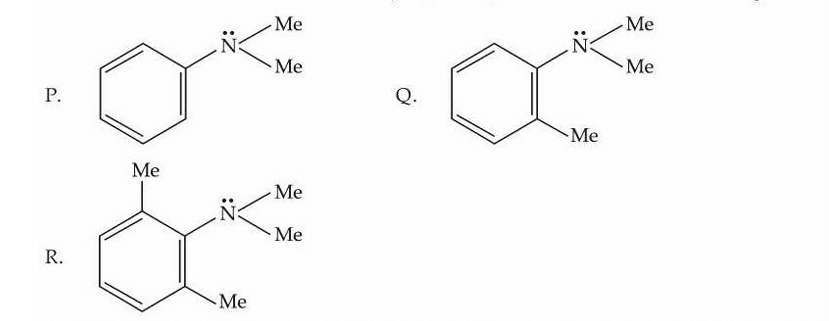
Consider the three aromatic molecules (P, Q and R). The correct order regarding the reactivity of these compounds with under optimum but slightly acidic medium is:
1
2
3
4
Official Solution
Correct Option: (2)
Concept: Reaction with is azo coupling, which is an electrophilic aromatic substitution. Electron donating groups increase reactivity of the aromatic ring. Step 1:Analyze substituents} All three molecules contain a strongly activating group. However methyl groups ( ) also donate electrons by hyperconjugation. Step 2:Compare activation}
: contains additional methyl groups → highest activation.
: contains only the dimethylamino group.
: steric hindrance reduces reactivity.
Thus the reactivity order is:
15
PYQ 2026
medium
chemistryID: jee-main
One mole of phenol is treated with dilute at to give a mixture of products. The mixture is separated by steam distillation. The steam volatile compound (X) is separated. The increase in percentage of oxygen in (X) with respect to phenol is ____ %. (Given molar mass in H:1, C:12, N:14, O:16)}
Official Solution
Correct Option: (1)
Step 1: Understanding the Question: Nitration of phenol with dilute gives ortho-nitrophenol and para-nitrophenol. Ortho-nitrophenol is steam volatile due to intramolecular hydrogen bonding. This is compound (X). We compare the oxygen percentage of (X) with that of phenol. Step 2: Key Formula or Approach:
Step 3: Detailed Explanation: 1. Phenol ( ): Molar mass = . % of O in phenol = . 2. Compound X (o-nitrophenol, ): Molar mass = . Mass of Oxygen = . % of O in X = . 3. Increase in percentage: Increase = . Expressed as : . Step 4: Final Answer: The value is 175.
16
PYQ 2026
medium
chemistryID: jee-main
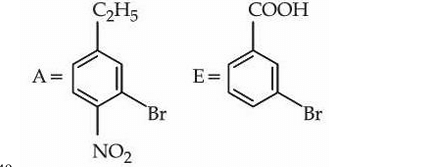
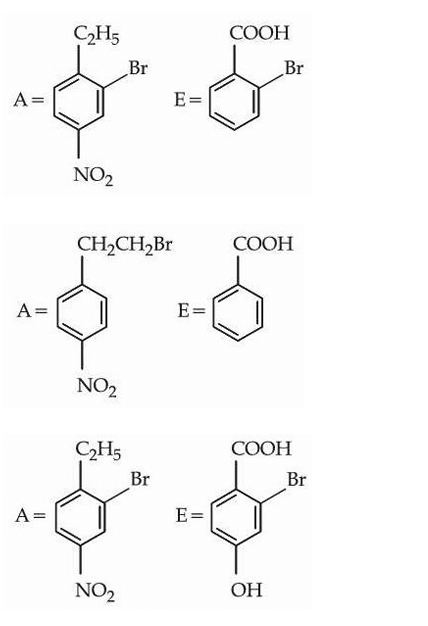
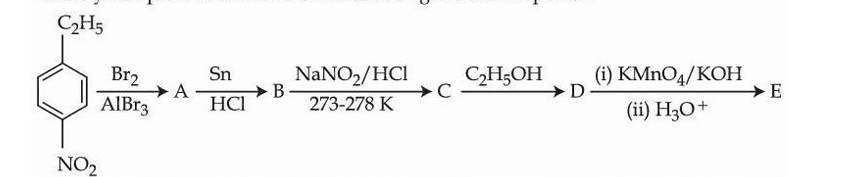
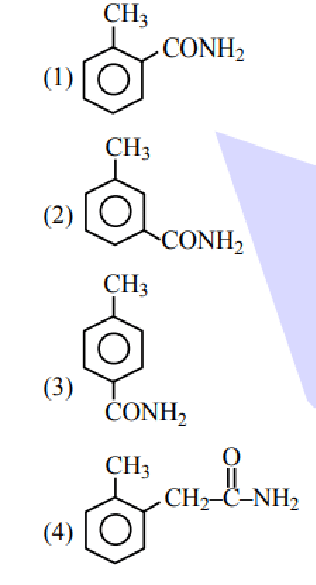
Identify compounds A and E in the following reaction sequence.
1
1
2
2
3
3
4
4
Official Solution
Correct Option: (1)
Step 1: Analyzing the reaction sequence.
In the given reaction sequence:
- The reaction with in the presence of is a bromination reaction, producing compound .
- The subsequent reaction with suggests that the compound undergoes electrophilic substitution.
- The reaction with and leads to a diazonium salt intermediate.
- The reaction with indicates oxidation, which converts to a carboxylic acid group.
Step 2: Identifying compounds.
- is ethyl benzene, and after oxidation, the compound converts into a carboxylic acid, which is . Step 3: Conclusion.
Therefore, and . Final Answer: (A) and (E)
17
PYQ 2026
medium
chemistryID: jee-main
Statement-I: Sucrose is dextrorotatory upon hydrolysis it becomes laevorotatory. Statement-II: Sucrose on hydrolysis gives glucose and fructose such that the levorotation of glucose is more than dexrotation of fructose.
1
Statement-I is true and Statement-II is false.
2
Statement-I is false and Statement-II is true.
3
Only Statement-I is correct.
4
Only Statement-II is correct.
Official Solution
Correct Option: (1)
Step 1: Analyzing Statement-I. Sucrose is a disaccharide composed of glucose and fructose. It is dextrorotatory (optically active in the clockwise direction). Upon hydrolysis with HCl, sucrose is broken down into glucose and fructose. The hydrolyzed products are laevorotatory. This is because the levorotation of the glucose is higher than the dexrotation of the fructose, leading to an overall negative optical rotation. Thus, Statement-I is true.
Step 2: Analyzing Statement-II. While it is true that glucose and fructose are produced upon hydrolysis of sucrose, Statement-II claims that the levorotation of glucose is more than the dexrotation of fructose. This is incorrect. The dexrotation of glucose is actually greater than the levorotation of fructose. Therefore, Statement-II is false.
Step 3: Conclusion. The correct conclusion is that Statement-I is true and Statement-II is false. Hence, the correct answer is (1).
18
PYQ 2026
medium
chemistryID: jee-main
An organic compound with molecular formula C H NO when reacts with KOH/BBr forms 'P' which on diazotisation forms 'Q' followed by its reaction with CuCN forms 'R' which on hydrolysis (acidic) formed 'S' (S can also be made by hydrolysis of original compound (X) C H NO). 'S' can react with KMnO /H forms 'T' which has two types of hydrogen. X will be:
1
1
2
2
3
3
4
4
Official Solution
Correct Option: (3)
Step 1: Understanding the reactions. - The organic compound C H NO, when reacted with KOH/BBr , forms 'P'. This suggests that the compound contains a reactive group such as amide or amine. KOH/BBr is known to react with amides to form an acylated derivative. - The diazotisation of 'P' forms 'Q', indicating that an amine group is present. Diazotisation is a reaction typically involving amines. - The reaction with CuCN forms 'R', suggesting the formation of an aryl nitrile group. - The hydrolysis of 'R' to form 'S' suggests that 'R' is an aryl nitrile, which when hydrolyzed (acidic conditions) forms a carboxylic acid. - 'S' reacts with KMnO /H to form 'T', which contains two types of hydrogen atoms. This reaction indicates oxidation, possibly of a methyl group to a carboxyl group.
Step 2: Identifying compound X. Based on the given reactions, X must contain a structure that allows these transformations: starting from an amide, undergoing diazotisation, forming a nitrile, and being hydrolyzed to a carboxylic acid. The structure of X fits with CH C NH, which is an imidic acid derivative.
Step 3: Conclusion. The correct structure of X is CH C NH, as it explains all the reactions described in the question. Hence, the correct answer is (3).
19
PYQ 2026
medium
chemistryID: jee-main
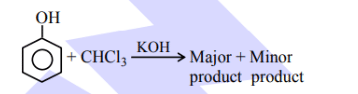
Statement-I: Major product is ortho substituted product and minor product is para substituted. Statement-II: Ortho \& Para substituted products can be separated by steam distillation.
1
Statement-I and Statement-II both are correct.
2
Statement-I and Statement-II both are incorrect.
3
Only Statement-I is correct.
4
Only Statement-II is correct.
Official Solution
Correct Option: (1)
Step 1: Analyzing Statement-I. The reaction of a phenol with chloroform in the presence of KOH leads to the formation of an ortho-substituted product as the major product and a para-substituted product as the minor product. This is the mechanism of the Reimer-Tiemann reaction.
Step 2: Analyzing Statement-II. Ortho and para substituted products have different boiling points. The higher boiling product (usually the ortho product) can be separated from the lower boiling para product by steam distillation.
Step 3: Conclusion. Both statements are correct, as they accurately describe the products and their separation by steam distillation. The correct answer is (1).